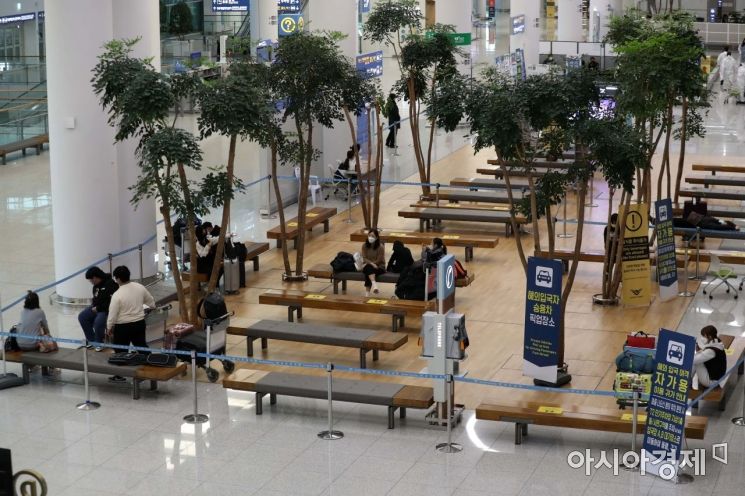
 On the 9th, as the spread of COVID-19 continues, arrivals are waiting at the arrival hall of Terminal 2 at Incheon International Airport. Photo by Mun Ho-nam munonam@
[Asia Economy Reporter Hyunseok Yoo] Last year, the performance gap between major airlines like Korean Air and low-cost carriers (LCCs) such as Jeju Air is expected to widen further. While major airlines generate profits based on air cargo, LCCs, which focus on passenger traffic, have continued to be affected by the aftermath of COVID-19.
According to FnGuide on the 5th, securities firms forecasted Asiana Airlines' consolidated revenue and operating profit for last year to be 4.0965 trillion KRW and 116.5 billion KRW, respectively. Compared to the previous year, revenue increased by 5.16%, and operating profit turned positive. The improvement in performance is expected to be influenced by rising freight rates due to increased air cargo volume.
Korean Air, which has already announced its results, recorded the highest operating profit in its history. Last year's standalone revenue was 8.7534 trillion KRW, up 18.2% from the previous year. Operating profit surged by 514.4% to 1.4644 trillion KRW. Net profit also turned positive, reaching 638.69 billion KRW.
The strong performance of major airlines is due to the increase in air cargo. Since the start of COVID-19, air cargo has experienced an unprecedented golden age. Last year, international air cargo at Incheon International Airport reached a record high of 3.329292 million tons, an 18% increase compared to 2.822370 million tons in 2020.
On the other hand, LCCs are expected to continue experiencing poor performance. Jeju Air, the largest LCC in the industry, posted consolidated revenue of 283.6 billion KRW last year, down 24.77% from the previous year, and recorded an operating loss of 312.5 billion KRW, indicating continued deficits. Other LCCs show similar trends. Jin Air's revenue forecast for last year is 235.2 billion KRW with an operating loss of 203.2 billion KRW. T'way Air is also expected to record revenue of 206 billion KRW and an operating loss of 155.7 billion KRW. Additionally, Air Busan and Fly Gangwon are also expected to report poor results.
The main reason is the decline in passengers due to COVID-19. For LCCs, most of their revenue comes from passengers rather than cargo. Last year, the number of passengers at Incheon International Airport was 3.198853 million, with arrivals and departures at 1.569129 million each. This represents a 73.4% decrease compared to 12.049851 million passengers the previous year. Arrivals and departures were 6.158819 million and 5.891032 million, respectively.
© The Asia Business Daily(www.asiae.co.kr). All rights reserved.
![Clutching a Stolen Dior Bag, Saying "I Hate Being Poor but Real"... The Grotesque Con of a "Human Knockoff" [Slate]](https://cwcontent.asiae.co.kr/asiaresize/183/2026021902243444107_1771435474.jpg)











