Joint Statement Targeting the U.S. Issued After China-Russia Summit
China and Russia Confirm Strong Ties... Also Oppose Politicization of Wuhan Coronavirus
[Asia Economy Beijing=Special Correspondent Jo Young-shin] China and Russia oppose the continued eastward expansion of the North Atlantic Treaty Organization (NATO).
Both countries also reaffirm the principle of 'One China.' Taiwan is Chinese territory, and they oppose Taiwan's independence.
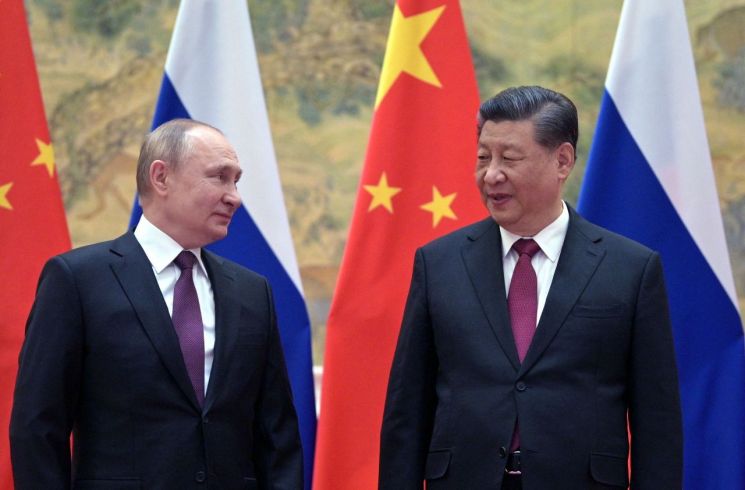
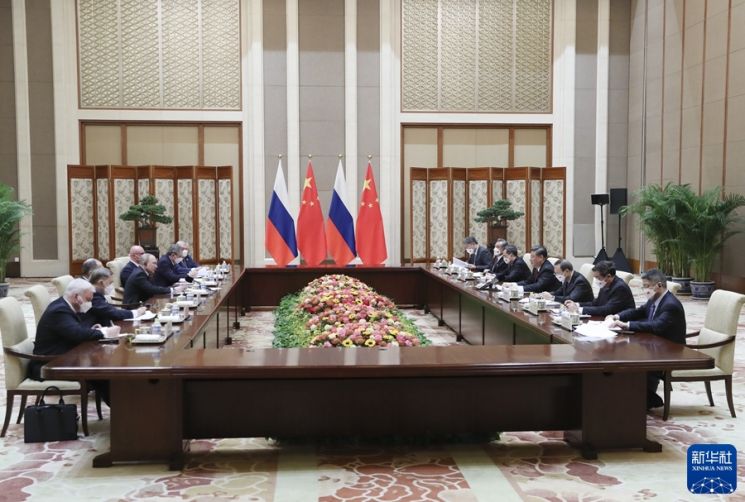
On the 4th, Chinese President Xi Jinping and Russian President Vladimir Putin held a summit at the Diaoyutai State Guesthouse in Beijing, China, and signed a joint statement titled "International Relations between the People's Republic of China and Russia and Sustainable Global Development in the New Era," which centered on these points.
The joint statement released that day is interpreted as a condemnation and warning against the United States and other Western powers. It also expresses the intention that China and Russia will effectively form an alliance to counter the United States and its allies.
In the statement, China and Russia diagnosed the current international situation by stating that a small group of forces (the United States and other Western powers) persistently insist on unilateralism and interfere in the internal affairs of other countries. They emphasized that democracy and human rights should not be used as tools to pressure other countries, and no country should abuse democracy. They added that the international community will never accept the unilateralism of a small group of forces.
Both countries also included in the joint statement that the sovereignty and development interests of all countries must be respected, and genuine multilateralism centered on the United Nations (UN) must be practiced.
The two countries then addressed the Ukraine issue. China and Russia stated in the joint statement that NATO must abandon Cold War-era ideology and opposed NATO's continued expansion. They also opposed the establishment of alliance systems and bloc confrontations in the Asia-Pacific region, expressing strong caution about the negative impact of the Indo-Pacific strategy promoted by the "United States" on peace and stability in the region. The word "United States" appears in the joint statement of over 6,700 characters, clearly indicating the target of China and Russia.
The Taiwan issue was also clarified. Russia stated in the joint statement that Taiwan is Chinese territory and opposes any form of independence, while opposing external forces' attempts to destroy the community.
The two countries also drew a line regarding the origin of COVID-19 in the joint statement. They argued that the COVID-19 issue is a matter for global scientists to cooperate on and that the pandemic should not be politicized. This appears to be a phrase aimed at the suspicions of the United States and other Western powers that Wuhan, China, is the origin of COVID-19.
The China-Russia joint statement also addressed the issue of the discharge of contaminated water from the Fukushima nuclear power plant in Japan. Both countries stated that Japan's discharge of radioactive contaminated water into the ocean has serious environmental impacts and emphasized that Japan must sufficiently consult with neighboring countries, stakeholders, and international organizations. They specified that the contaminated water must be properly disposed of with transparency, scientific verification, and a responsible attitude based on international law. This is seen as China and Russia's intention to jointly respond to Japan's discharge of contaminated water into the ocean, which is expected to place considerable pressure on the Japanese government.
The joint statement also included dissatisfaction with AUKUS (the security alliance between the United States, the United Kingdom, and Australia), which targets China. The two countries condemned AUKUS's construction of nuclear-powered submarines, stating that it contradicts the goals of safety and sustainable development in the Asia-Pacific region, increases the risk of regional arms races, and raises the risk of nuclear proliferation.
At the China-Russia summit, President Xi said, "The two countries actively participate in the reform of the global governance system and play a central role in jointly practicing genuine multilateralism," adding, "Although the international situation is developing seriously and complexly, China and Russia are striving to uphold international fairness and justice."
President Putin responded, "Russia and China are the most important strategic partners and like-minded friends," and said, "Russia-China relations are a model for international relations in the 21st century."
This joint statement is interpreted as President Xi supporting President Putin, who is in a standoff with U.S. President Joe Biden over the Ukraine crisis. President Putin also supported President Xi, who is engaged in a power struggle with President Biden over issues such as human rights in the Xinjiang Uygur Autonomous Region and Taiwan independence.
By once again aligning on the Ukraine crisis, the two leaders, who have maintained a strategic honeymoon relationship centered on anti-Americanism, have made the confrontation line between the United States and China-Russia even clearer.
© The Asia Business Daily(www.asiae.co.kr). All rights reserved.


















