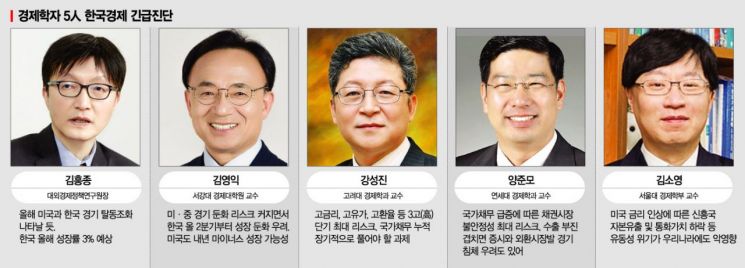
[Asia Economy Sejong=Reporters Kim Hyewon, Kwon Haeyoung, Moon Jewon] "South Korea's potential growth rate has fallen to the 1% range starting this year. The bubble-inflated U.S. economy may experience negative growth early next year. Inflation is high, but the economy is experiencing stagflation with low growth, which will have an adverse effect on the overall South Korean economy."
Professor Kim Young-ik of Sogang University Graduate School of Economics cited the slowdown in the U.S. economy as the biggest risk weighing on the Korean economy at the beginning of the year, and predicted that South Korea’s economic growth would start to slow from the second quarter. According to Professor Kim, South Korea’s potential growth rate has already entered the 1% range.
Major countries around the world, including the U.S., have adopted tightening fiscal policies by raising benchmark interest rates to curb inflation, but concerns about a double-dip recession have emerged along with weakening economic recovery, leading to a consensus that interest rate hikes will be limited. On the 3rd, Asia Economy conducted an urgent diagnosis of the current state of the Korean economy with five economic experts, and this opinion was predominant.
Short-term Risks: Interest Rates and Inflation; Long-term Risk: National Debt
Regarding last year’s U.S. economy, which recorded the highest growth rate in 37 years (5.7%) after overcoming COVID-19, Professor Kim raised the bubble theory, stating, "Due to U.S. interest rate hikes and economic slowdown, our exports are deteriorating, which will have negative effects on the financial market in the short term and on the overall economy in the medium to long term." In fact, from the beginning of the year, the Korean economy is estimated to have recorded a so-called ‘twin deficit,’ with both fiscal and current accounts in deficit. This raises concerns about foreign investors withdrawing funds amid the U.S.’s tightening monetary policy. Last month, South Korea’s trade balance recorded a historic deficit of $4.89 billion, making a current account deficit inevitable. The fiscal deficit for the same month also seems to have become a foregone conclusion.
Professor Yang Jun-mo of Yonsei University’s Department of Economics expressed concern, saying, "Instability in the bond market caused by the rapid increase in national debt is one of the major risks. If external credibility falls due to national debt and export sluggishness coincides, it could lead to a long-term economic recession."
In the short term, Professor Kang Sung-jin of Korea University’s Department of Economics diagnosed that the three high risks?high interest rates, high oil prices, and high exchange rates?will act as downward pressure on the Korean economy. As a result, the possibility of contraction in asset markets such as the stock market and real estate is high, but not at a panic level. Professor Kang predicted that regarding the G2 (U.S. and China), which South Korea is highly dependent on externally, "Most countries plan to raise interest rates and reduce liquidity, so China will not be able to lower rates indefinitely due to concerns about capital outflows."
Concerns Over Spread of Liquidity Crisis in Emerging Markets
Economic experts shared the view that aggressive interest rate hikes by countries such as the U.S. and Europe could trigger liquidity crises in emerging markets, including capital outflows and currency depreciation, which could quickly spread to the Korean economy. Professor Kim Soyoung of Seoul National University’s Department of Economics said, "Interest rates are the biggest variable, and the emerging market crisis caused by U.S. rate hikes will affect South Korea. If the Bank of Korea raises rates more than 2 to 3 times, unpredictable situations could arise in vulnerable sectors such as household debt." Most experts expected the U.S. to raise rates more than three times this year, and the Bank of Korea to raise rates two to three times.
There were also voices cautioning against excessive crisis theories. Kim Heung-jong, President of the Korea Institute for International Economic Policy, said, "The U.S. is expected to raise rates at least three times, but there is a decoupling occurring between the recovery trends of our economy and the U.S., so there is no need to feel great pressure from the interest rate gap. This year, the Korean economy is in a normalization phase from abnormality, and achieving a 3% economic growth rate should be feasible."
Meanwhile, the government, at the macroeconomic and financial monitoring meeting held that day, noted that volatility in domestic and international financial markets could increase due to monetary policies of major countries such as the U.S. and the Russia-Ukraine situation. Major risk factors cited included ▲uncertainty over normalization of monetary policies in major countries including the U.S., ▲instability in Ukraine’s situation, and ▲concerns over economic recovery slowdown due to the spread of the Omicron variant and global inflation. Lee Okwon, First Vice Minister of Strategy and Finance, urged, "Please thoroughly check the available measures for each market and situation according to the contingency plan so that immediate market stabilization measures can be activated if necessary."
© The Asia Business Daily(www.asiae.co.kr). All rights reserved.
![Clutching a Stolen Dior Bag, Saying "I Hate Being Poor but Real"... The Grotesque Con of a "Human Knockoff" [Slate]](https://cwcontent.asiae.co.kr/asiaresize/183/2026021902243444107_1771435474.jpg)
















