Securities Market Suggests KOSPI Index Band 2500~2900p
'Inflation' Biggest Variable... Pressure for Interest Rate Hikes Increases
Russia-Ukraine Risk and Oil Price Rise Also Variables
KOSPI May Rise Short-Term... Trend Rebound Uncertain
Semiconductor and Finance Sectors Favorable for Investment
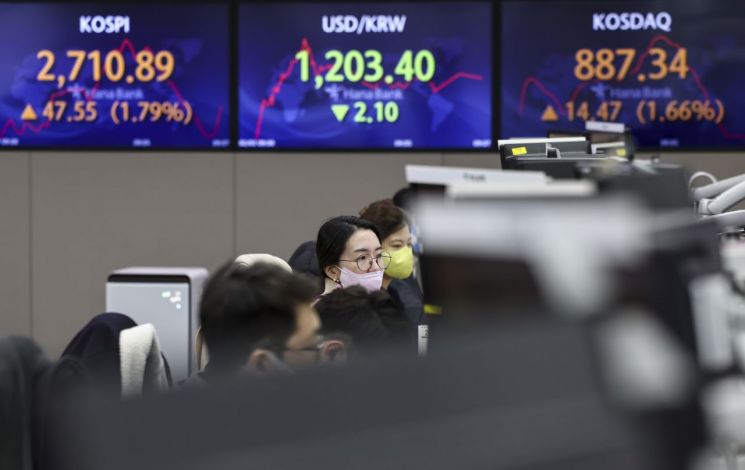
[Asia Economy Reporter Hwang Yoon-joo] The February stock market, which started after the holiday, kicked off briskly with both KOSPI and KOSDAQ rising by over 2%. However, experts unanimously agreed that a sustained rebound would be difficult. This is because major central banks, including the U.S., are showing a stance of actively responding to inflation (interest rate hikes). Still, they noted that KOSPI could stabilize at the bottom and rebound in the short term, recommending semiconductor and financial sectors as investment targets.
On the 3rd, KOSPI opened at 2706.34, up 1.61% (43.00 points) from the previous trading day, and extended its gains. After the positive start, large-cap stocks (+2.29%), mid-cap stocks (+2.53%), and small-cap stocks (+2.75%) all increased their gains. Foreign investors led the index by net buying 26.8 billion KRW, while institutions and individuals net sold 17.3 billion KRW and 5.8 billion KRW, respectively. The travel sector (+6.91%) showed a remarkable rise, along with cold chain (+5.45%), secondary batteries (+4.67%), and video content (+4.67%).
The securities industry set the domestic KOSPI market band for February at 2500?2900. From a valuation perspective, they recommended buying to seek a short-term rebound. However, the common view was that a sustained rebound needs to be observed further.
Market experts cited 'inflation' as the most important variable. The market’s focus is on the pace of interest rate hikes by the U.S. Federal Reserve (Fed). Earlier, Fed Chair Jerome Powell mentioned the possibility of a rate hike in March at the January Federal Open Market Committee (FOMC) meeting.
In February, the U.S. Consumer Price Index (CPI) release (on the 10th) and the January FOMC minutes disclosure (on the 16th) are scheduled. Both are indicators to gauge the Fed’s rate hike moves. Kiwoom Securities researcher Kim Yumi explained, "The market expects the U.S. CPI increase to expand further to the low 7% range year-over-year, which could heighten inflation concerns. Meanwhile, the Fed minutes released during this period could act as a catalyst reaffirming the Fed’s hawkish stance, as seen in January."
The conflict between Russia and Ukraine was also pointed out as a market risk factor. KB Securities researcher Ha In-hwan analyzed, "The credit default swap (CDS) premium indicates that the conflict between Russia and Ukraine is likely to soon reach a peak of concern."
As a result, the fact that crude oil prices remain high continues to add pressure to energy-driven inflation. Even assuming a WTI (West Texas Intermediate) crude oil price of $90, the inflation trajectory compared to the previous year declines but the timing of the decline is delayed, which is a burden. This is why it is difficult to expect an immediate easing of concerns about the Fed’s accelerated rate hikes.
The securities industry agreed that semiconductor and financial sectors are favorable investment sectors in February. Korea Investment & Securities recommended semiconductor, hardware, financial, and telecommunications-related stocks. Korea Investment & Securities researcher Kim Dae-jun said, "Market response favors watching quality stocks that can secure profitability and stability rather than high-valuation stocks with large declines. Quality stocks are those with annual profit growth, no deficits, and low profit volatility."
Shinhan Investment Corp. advised focusing on stocks with low price-to-earnings ratios (PER), low margin volatility, and upward earnings revisions, recommending priority attention to IT, industrial, and financial sector stocks with rising operating profit estimates. Shinhan Investment researcher Noh Dong-gil explained, "As the Q4 2021 earnings season fully begins, changes in earnings consensus can significantly impact performance. Based on the one-month change rate in KOSPI operating profit consensus, upward revisions are ongoing mainly in industrial, IT, and financial sectors, while reopening, chemical, and software sectors are relatively sluggish."
Kiwoom Securities researcher Han Ji-young also noted, "The decision by Hyundai Engineering to withdraw its planned IPO, which was expected to be around 4 to 7 trillion KRW in mid-February, is expected to improve the supply-demand environment during the month. In February, when a rebound is anticipated, it is appropriate to focus on large export stocks with excessive declines that have valid earnings growth expectations."
© The Asia Business Daily(www.asiae.co.kr). All rights reserved.

















