Kim Dong-yeon Appeals Mentioning Jibusangso
Lee Jae-myung Decides on Policy Debate with Minor Candidates
Policy Debate Without Negativity Expected
[Asia Economy Reporter Naju-seok] The first debate among presidential candidates will be held on the 2nd. The main participants are Lee Jae-myung, the Democratic Party presidential candidate, and Kim Dong-yeon, the New Wave presidential candidate. With the two-person debate between Lee and Yoon Seok-youl, the People Power Party presidential candidate, ultimately canceled amid disputes over the debate 'rules' ahead of the Lunar New Year holiday, interest in this first debate is very high.
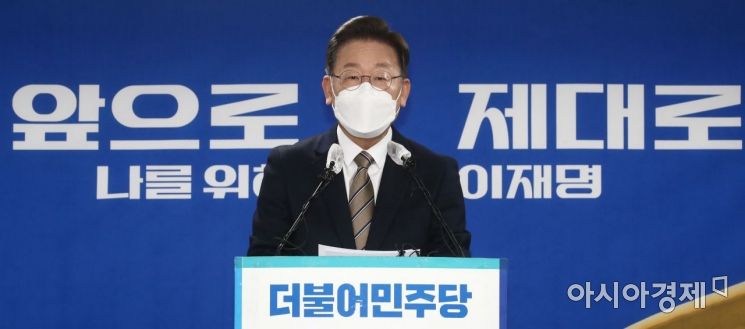 Lee Jae-myung, the Democratic Party presidential candidate, is holding a press conference at the party headquarters in Yeouido, Seoul on the 26th. Photo by Yoon Dong-joo doso7@
In fact, the first debate between candidate Kim and candidate Lee is unusual in many respects. First, unlike the typical debate format, it is notable that the debate is between a leading candidate with polling numbers ranking first or second and a minor candidate with relatively low support. Considering the usual rules for presidential candidate TV debates, a four-person debate involving Lee, Yoon, Ahn Cheol-soo of the People’s Party, and Sim Sang-jung of the Justice Party, or a two-person debate between Lee and Yoon, would have been the expected formats.
The reason this unusual debate was realized is due to the decisions made by candidates Kim and Lee.
It started with candidate Kim. On the 21st of last month, Kim proposed a presidential candidate debate through an emergency press conference introduced as a Jiboo Sangso (持斧上疏), meaning "if not accepted, strike my head with the axe I carry," symbolizing a serious appeal. At that time, he said, "With the current presidential election situation, there is no future or hope for the country," and appealed, "Before considering election strategies or advantages and disadvantages, we must selflessly devise measures to overcome the problems and crises before us." In particular, he urged, "Let’s meet to create proper agendas for the country’s future to overcome the economic crisis and save people’s livelihoods."
In response, on the 24th of last month, Gyeong Min-jeong, spokesperson for Lee’s campaign, stated, "We will seriously discuss the proposal for a presidential candidate meeting," expressing willingness to participate in the debate. On the same day that Lee’s side announced the meeting proposal, candidate Kim presented a specific direction for the debate in an interview with Asia Economy.
He said, "Issues related to personal and family corruption of candidates should be disclosed by each candidate to the public for judgment, and we should discuss urgent national issues," suggesting key debate topics including compensation for small business losses, youth, real estate, and constitutional reform including a major overhaul of the power structure. According to the agreement between Lee and Kim’s sides, the debate will be limited to three policy areas: economy, politics, and diplomacy/security.
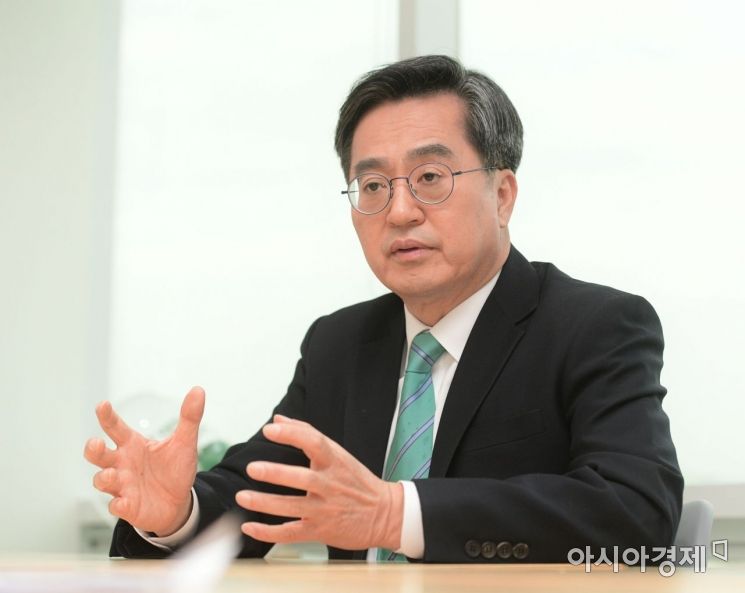
This format-breaking debate is expected to showcase policy expertise rather than the usual approach of probing opponents’ weaknesses under the guise of verification. Candidate Kim, a former Deputy Prime Minister for Economic Affairs with outstanding expertise among presidential candidates, is expected to have an in-depth debate with candidate Lee, who has experience as both a basic and metropolitan local government head.
In an interview with this paper, candidate Kim also hinted at exploring the possibility of common pledges through this debate. He said, "When I declared my presidential candidacy, I mentioned a citizens’ council to promote common pledges. If we can negotiate like that, it doesn’t matter who becomes president," adding, "The elected candidate should strongly push forward the pledges, and the losing candidates should support those efforts." He explained, "No matter who becomes president, the elected candidate should strongly promote the pledges, and the losing candidates should assist in those matters." Even if the presidential election is likened to a war, the minimum number of pledges to shape South Korea’s future should be set, and the election should be conducted based on that agreement.
Candidate Kim said, "First, we want to solve the problems that must be addressed during the presidential election phase through this, and also discuss the vision for five years ahead," adding, "I want to change the election agenda even if it’s through this process." He said, "Real estate is a highly sensitive issue, so we need to find the most reasonable solution, and the power structure issue is ultimately related to the vision of the new government. If candidates can narrow their opinions on these matters, it would be good."
Ko Yong-jin, senior spokesperson for the Democratic Party, expressed his aspirations regarding the two-person debate between candidate Lee and candidate Kim, saying, "We will strive to satisfy the public’s curiosity about the candidates and showcase the essence of alternative politics through intense policy debates," and "Through fierce policy debates, we will present a vision for South Korea’s future and earn voters’ trust."
© The Asia Business Daily(www.asiae.co.kr). All rights reserved.
![Clutching a Stolen Dior Bag, Saying "I Hate Being Poor but Real"... The Grotesque Con of a "Human Knockoff" [Slate]](https://cwcontent.asiae.co.kr/asiaresize/183/2026021902243444107_1771435474.jpg)












