Eco-friendly Vehicles Surpass 1 Million Units, 460,000 in 2018 → 1.16 Million in 2021
Diesel Vehicles Record -1.2% (120,000 Units) Year-on-Year Decline... First Decrease in Cumulative Registrations
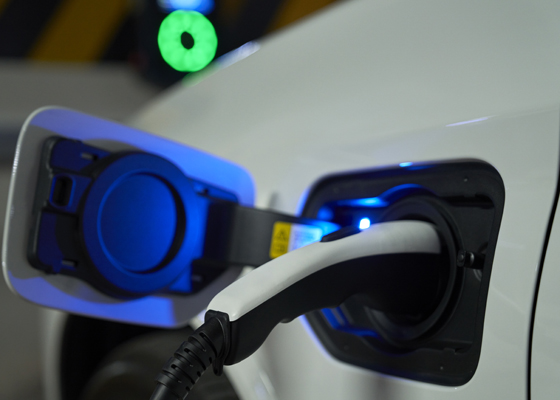
Last year, the number of registered vehicles nearly reached 25 million. The number of newly registered electric vehicles surpassed 100,000.
According to the Ministry of Land, Infrastructure and Transport on the 2nd, the cumulative number of registered vehicles as of December 2021 was 24.91 million, marking a 2.2% (550,000 vehicles) increase compared to the end of 2020 (24.366 million vehicles).
This means there is one car for every 2.07 people. The population per vehicle by country is 1.1 in the United States, 1.6 in Japan, 1.6 in Germany, 1.8 in Sweden, and 5.1 in China.
By origin, domestic cars held a cumulative market share of 88.2% (21.965 million vehicles). Meanwhile, the market share of imported cars has been rising annually from 8.4% (1.897 million vehicles) in 2017 to 9.3% (2.169 million vehicles) in 2018, 10.2% (2.414 million vehicles) in 2019, 11.0% (2.682 million vehicles) in 2020, and 11.8% (2.946 million vehicles) in 2021.
By fuel type, eco-friendly vehicles (electric, hydrogen, hybrid) increased by 41.3% (339,000 vehicles) compared to the previous year, reaching a cumulative registration of 1,159,087 vehicles.
In particular, hydrogen vehicles increased by 77.9% (8,498 vehicles) year-on-year, totaling 19,404 registered vehicles, while hybrids increased by 34.7% (234,000 vehicles) year-on-year, totaling 908,000 registered vehicles.
Electric vehicles increased by 71.5% (96,481 vehicles) compared to the previous year, reaching a cumulative total of 231,443 vehicles, which is about 4.2 times the number at the end of 2018.
Gasoline vehicles increased by 3.1% (349,000 vehicles) year-on-year, while diesel vehicles stopped increasing and showed a 1.2% (120,000 vehicles) decrease for the first time last year. The cumulative registration of diesel vehicles rose from 9.93 million in 2018 to 9.96 million in 2019 and 9.99 million in 2020 but decreased to 9.87 million last year.
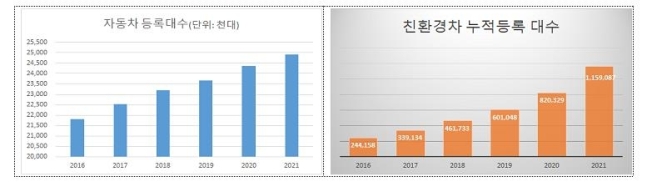 Total cumulative registrations of all vehicles and eco-friendly vehicles / Source=Ministry of Land, Infrastructure and Transport.
Last year, the number of newly registered vehicles was 1.743 million, a 9.0% (173,000 vehicles) decrease compared to the previous year (1.916 million vehicles) due to production disruptions caused by a shortage of automotive semiconductors.
By region, the largest decreases in new registrations were in Gwangju (-14.6%), Daejeon (-13.5%), Ulsan (-13.4%), and Seoul (-13.0%).
Compared to the previous year, new registrations of domestic cars decreased by 11.1% (179,000 vehicles) to 1.429 million, while new registrations of imported cars increased by 1.9% (6,000 vehicles) to 314,000, indicating a gradual rise in imported car registrations.
Although overall new vehicle registrations declined, new registrations of electric vehicles reached 100,000, a 115% (54,000 vehicles) increase compared to 2020 (46,000 vehicles). This made South Korea one of the countries with over 100,000 newly registered electric vehicles. In 2020, the United States, China, Germany, France, and the United Kingdom each had over 100,000 new electric vehicle registrations, and last year, Norway also reached this milestone.
According to domestic regional electric vehicle registration statistics, 93,000 electric vehicles were registered in Gyeonggi, Seoul, and Jeju, accounting for 40.3% of the total (231,000 vehicles).
By growth rate compared to 2020, Incheon, which offers substantial electric vehicle subsidies and allocations, had the highest increase at 139%, followed by Busan (131%) and Jeonbuk (122%).
By electric vehicle type, passenger cars accounted for 80% with 185,000 vehicles, followed by cargo vehicles with 43,000, vans with 3,100, and special-purpose vehicles with 130.
Market share by manufacturer was highest for Hyundai Motor Company at 44%, Kia at 23.7%, and Tesla at 14.2%. Tesla's electric vehicle market share has steadily increased from 1.6% in 2018.
As of the end of last year, the top registered electric vehicle models were Kona Electric with 32,789 units (14.2%), Porter II with 24,599 units (10.6%), Ioniq 5 with 22,583 units (9.8%), Tesla Model 3 with 21,456 units (9.3%), and Niro EV with 19,356 units (8.4%).
The number of used car transactions last year was 3.872 million, a 0.1% decrease from 3.874 million in 2020. Business-to-business transactions increased by 3.3% to 2.572 million, while private transactions decreased by 6.1% to 1.3 million.
Vehicle deregistrations due to used car exports increased by 21.6% to 338,000. While there was a sharp decline in 2020 due to the spread of COVID-19, last year saw a recovery to pre-pandemic levels.
Kim Eun-jung, head of the Vehicle Operation and Insurance Division at the Ministry of Land, Infrastructure and Transport, said, "Despite stagnation in overall vehicle sales last year, the supply of eco-friendly vehicles showed a strong increase. On the other hand, diesel vehicles stopped growing and decreased for the first time."
© The Asia Business Daily(www.asiae.co.kr). All rights reserved.
!["The Woman Who Threw Herself into the Water Clutching a Stolen Dior Bag"...A Grotesque Success Story That Shakes the Korean Psyche [Slate]](https://cwcontent.asiae.co.kr/asiaresize/183/2026021902243444107_1771435474.jpg)

















