26.3% of Total Municipal Waste is Food Waste: Reduction by Source and Expansion of Self-Treatment
Pilot Projects for Sink Dehydrators and Small-Scale Reducers... Apartment RFID Weighing Device Penetration Rate from 69% to 90%
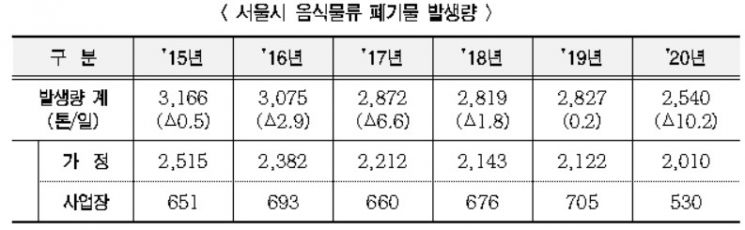
[Asia Economy Reporter Lim Cheol-young] The Seoul Metropolitan Government announced on the 2nd that it will intensively manage food waste with the goal of reducing it by 10% compared to the daily amount of 2,827 tons in 2019 by 2026, and by 20% by 2030. The amount of food waste generated in Seoul is 2,540 tons per day, accounting for 26.3% of the total household waste. In particular, potential factors for increase are rising due to the growth of single-person households and changes in dietary patterns.
Accordingly, Seoul has prepared a ‘Food Waste Focused Management Plan’ to implement reduction measures tailored to each source of generation such as households, large businesses, and restaurants, while expanding on-site treatment to build a foundation that can reduce the overall amount of waste generated. The main contents include ▲expanding reduction infrastructure in households ▲focused management of large businesses ▲conversion of food waste to biogas. If the food waste generation is reduced by 20% by 2030 as planned, it is expected to reduce 341,000 tons of greenhouse gases, an effect equivalent to planting 2 million pine trees.
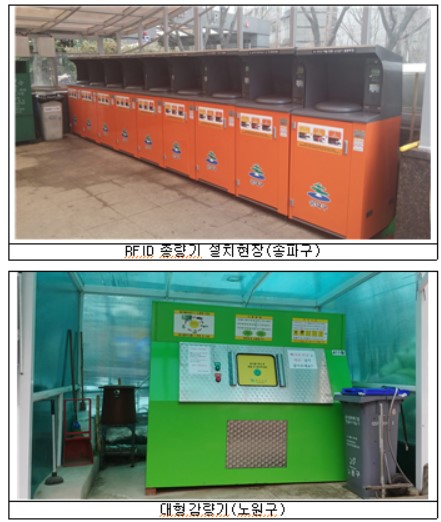
First, by 2030, 25,000 sink dehydrators and 6,850 small-scale reducers will be distributed to households. This year, 1,000 sink dehydrators and 50 small reducers will be distributed on a pilot basis to assess the reduction effect. Small reducers can reduce food waste by about 75% through drying and fermentation, and sink dehydrators are effective devices for removing moisture from food waste. Seoul plans to analyze the monitoring results of this year’s pilot project and expand distribution from next year to establish a foundation for reducing food waste in households.
Additionally, RFID volume-based waste meters installed in 69.2% of apartment complexes in Seoul will be increased to 70% this year. The city plans to expand distribution by about 2,000 units annually, raising the coverage rate to 80% by 2026 and 90% by 2030.
Next, large reducers, currently installed mainly in apartments and other multi-family housing, will be distributed to large businesses such as hotels, hospitals, restaurants, and cafeterias to enable on-site food waste treatment. This year, 105 units will be distributed mainly to public institution cafeterias, and a total of 1,000 units will be distributed by 2030 at a rate of 100 units per year. Food waste generated by about 8,000 large distribution stores, restaurants, and cafeterias in Seoul accounts for approximately 25% of the total food waste. This proportion has been gradually increasing from 20.6% in 2015 to 24.9% in 2019.
For public cafeterias, a pilot project using IT technology called the ‘AI Food Scanner’ will be promoted. The ‘AI Food Scanner’ is a technology that analyzes food information by scanning alone and can calculate weight without a scale. For example, scanning a food tray before and after a meal automatically calculates intake and leftover data. Through leftover monitoring and data analysis, it is possible to predict the amount of food to be cooked in advance, and in school meals, it is expected to reduce leftovers by up to 55%.
To encourage awareness improvement and active voluntary reduction in large businesses, customized consulting will be conducted by industry. Based on the consulting results, guidelines covering reduction and recycling will be developed and distributed. The professional consulting team will select 20 sites including large cafeterias in schools and hospitals, large restaurants, large distribution stores, and agricultural and fishery markets to investigate food waste generation and treatment status and provide guidance on reduction methods.
Seoul is also preparing measures to reduce food waste discarded during food manufacturing and distribution processes. In cooperation with related organizations such as food banks, the city plans to activate a system that supports surplus fresh food from agricultural and fishery markets and large marts to vulnerable groups.
Furthermore, food waste treatment facilities to be built by Seoul in the future will be installed as biogas facilities, which are gaining attention as new energy sources, and will be utilized for various energy sources such as heating, electricity, and hydrogen production. Biogas facilities reduce food waste by about 60%, significantly contributing to carbon neutrality.
Currently, the construction of the Gangdong Resource Circulation Center and the Seonam and Nanji Water Reclamation Centers includes plans to establish and improve food waste and wastewater treatment facilities and convert them to biogas facilities. Seoul is promoting the construction of an integrated biogas facility with a daily capacity of 350 tons (300 tons of food waste and 50 tons of sewage) on the site of the Nanji Water Reclamation Center. The biogas produced at the treatment facility will be used as various energy sources such as facility heating, hydrogen production (equivalent to 336,000 vehicles annually), and power generation (enough to supply 8,100 households of four members annually).
Yoo Yeon-sik, Head of the Climate and Environment Headquarters of Seoul, said, “Discarded food is a significant economic loss and also adversely affects greenhouse gas emissions. To fundamentally solve this, the amount of waste generated itself must be reduced,” adding, “We will strive to establish policies that reduce food waste by source such as households and businesses and ultimately reduce it at the source.”
© The Asia Business Daily(www.asiae.co.kr). All rights reserved.


















