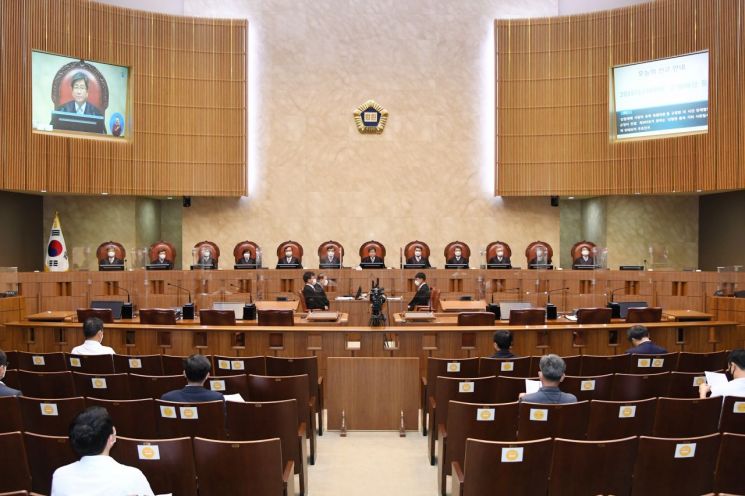
[Asia Economy Reporter Choi Seok-jin, Legal Affairs Specialist] The Supreme Court has ruled that if a defendant was detained during litigation and did not receive the official copy of the first-instance judgment, they cannot be held responsible for missing the two-week appeal period, and thus can file a supplementary appeal after release.
A supplementary appeal refers to filing an appeal within two weeks from the day the reason for missing the appeal deadline, which was beyond the party's control, has ceased to exist.
Article 173(1) of the Civil Procedure Act (Supplementation of Litigation Acts) states, "If a party fails to meet a fixed period due to reasons beyond their responsibility, they may supplement the neglected litigation act within two weeks from the day the reason ceases to exist."
The Supreme Court's Third Division (Presiding Justice Kim Jae-hyung) announced on the 30th that it overturned the lower court's ruling in favor of a merchants' association of a complex shopping center in an unjust enrichment refund claim lawsuit against merchant A, and remanded the case to the Seoul Northern District Court.
According to the court, the merchants' association filed a lawsuit on September 27, 2017, claiming about 6 million won for management fees from A. The first-instance court, considering it a small claim case, issued a payment recommendation order on October 11, 2017, without holding a hearing.
Merchant A received a copy of the payment recommendation order on October 18, 2017, filed an objection with the court on October 19, and submitted a response. The next day, October 20, 2017, A was detained at Anyang Prison.
The first-instance court sent hearing notices and preparatory documents submitted by the merchants' association to A's address, but delivery failed due to "closed door absence" (the mail carrier found the door locked and no one was present). The court then used a method of delivery by dispatch, but A, being incarcerated, did not receive these documents and could not respond.
Ultimately, the first-instance court held two hearings on November 16 and December 14, 2017, concluded the proceedings, and on January 11, 2018, ruled in favor of the merchants' association. The official judgment copy was sent to A's address, but again delivery failed due to closed door absence. Following the judge's order, the court used public notice delivery, which took effect at midnight on February 10, 2018. Public notice delivery means that after posting documents for a certain period, delivery is deemed complete.
A was released on August 19, 2018, obtained the first-instance judgment copy on August 21, and filed a supplementary appeal on September 3. However, the second-instance court dismissed A's appeal, stating that the appeal was filed after the appeal period had expired.
The court reasoned that supplementation of litigation acts is allowed only when the party fails to meet the fixed period due to reasons beyond their responsibility. In A's case, since the lawsuit had already begun before detention, and A had filed an objection and submitted a response, A had a duty to investigate the litigation progress, which detention did not exempt. Therefore, A was held responsible for missing the appeal deadline.
The Supreme Court first stated, "If a party is detained during ongoing litigation and the court does not deliver the official judgment copy to the prison warden as stipulated in Article 182 of the Civil Procedure Act but instead uses public notice delivery to the party's address, even if there is a defect in meeting the requirements for public notice delivery, the delivery is effective as long as it is done under the judge's order."
However, the Supreme Court overturned the second-instance ruling, stating, "A detained party is not obligated to report a change of delivery location under Article 185 of the Civil Procedure Act, and if the party fails to meet the appeal deadline due to defective public notice delivery, it is considered that the party did not know of the judgment delivery without fault. In such cases, it qualifies as a reason beyond responsibility for failing to meet the fixed period, allowing a supplementary appeal within two weeks after the reason ceases."
The court explained, "Since A obtained and confirmed the first-instance judgment copy on August 21, 2018, it should be recognized that A became aware of the judgment and the fact that it was delivered by public notice delivery at that time. Therefore, the supplementary appeal filed on September 3, within the two-week appeal period, is lawful."
Furthermore, the court pointed out, "Nevertheless, the lower court dismissed the supplementary appeal, holding that the defendant did not fall under the case of failing to meet the appeal period due to reasons beyond responsibility. This constitutes an error that affected the judgment by misunderstanding the law on supplementation of litigation acts and exceeding the limits of free evaluation of evidence contrary to logic and experience."
© The Asia Business Daily(www.asiae.co.kr). All rights reserved.
!["The Woman Who Threw Herself into the Water Clutching a Stolen Dior Bag"...A Grotesque Success Story That Shakes the Korean Psyche [Slate]](https://cwcontent.asiae.co.kr/asiaresize/183/2026021902243444107_1771435474.jpg)
















