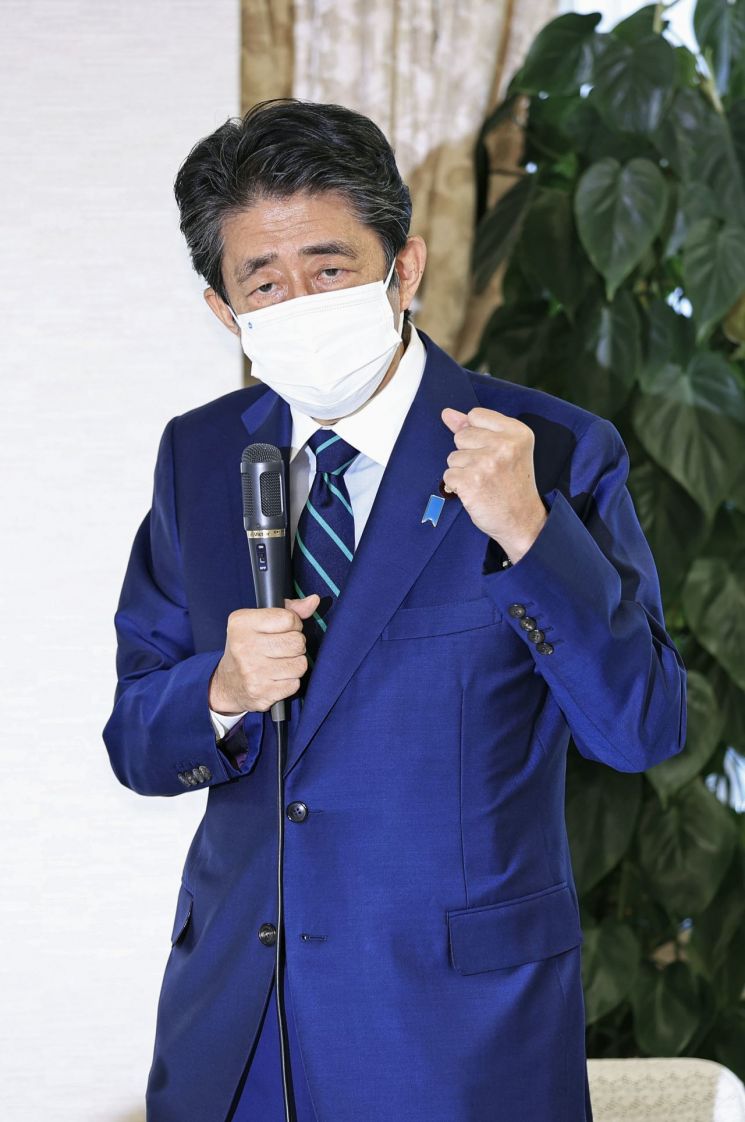
[Asia Economy Reporter Hwang Sumi] Japanese Prime Minister Fumio Kishida reportedly decided to recommend the Sado Mine for UNESCO World Heritage inscription after two phone calls with former Prime Minister Shinzo Abe.
According to the Asahi Shimbun on the 29th, after the Cultural Affairs Council of Japan's Agency for Cultural Affairs selected the Sado Mine as a candidate for UNESCO World Cultural Heritage recommendation on the 28th of last month, the prevailing opinion within the government was to temporarily withhold the recommendation.
This was due to South Korea's opposition, citing the Sado Mine as a "site of forced labor of Koreans," and concerns over the possibility of rejection by the UNESCO World Heritage Committee.
In fact, Sanae Takaichi, the LDP Policy Research Council Chair, expressed outrage at a press conference on the 19th, stating it was "an issue related to Japan's honor."
However, this sentiment led to backlash from hardline members within the ruling Liberal Democratic Party, and Prime Minister Kishida called former Prime Minister Abe to consult.
On the 20th, at a meeting of the largest faction within the LDP led by Abe (the Abe faction), Abe pressured Kishida, saying, "It is wrong not to apply for inscription in a way that avoids confrontation with South Korea."
The Asahi reported that this remark by former Prime Minister Abe changed the atmosphere at the Prime Minister's Office.
However, Kishida was also paying attention to the stance of the United States.
After a virtual summit with U.S. President Joe Biden on the 21st, a U.S. State Department official conveyed to the Japanese side that it would be best for South Korea and Japan not to cause discord between each other.
The U.S. State Department official stated, "With the huge presence of China facing the alliance, it is problematic for South Korea and Japan to be at odds with each other."
Meanwhile, the LDP hardliners pressed even more strongly for the Sado Mine to be recommended as a World Heritage site, and Kishida, troubled, called former Prime Minister Abe again.
During the second call, Kishida showed interest in how Abe had responded to South Korea's opposition regarding forced labor when the "Meiji Industrial Revolution Heritage," which included Hashima Island (known in Japan as Gunkanjima), a site of forced Korean labor, was inscribed in 2015.
Former Prime Minister Abe explained that he had prepared by collecting historical documents and other evidence at the Prime Minister's Office and had a chief aide negotiate with the South Korean side.
He also advised, "Even though it was the conservative Park Geun-hye government at the time of Hashima, South Korea was still very noisy," adding, "Delaying it will only lead to the same result."
Following Abe's strong recommendation and criticism from the LDP hardliners labeling it as "submissive diplomacy," Kishida ultimately decided to proceed with recommending the Sado Mine for World Heritage inscription, the Asahi Shimbun reported.
Regarding Kishida's decision to recommend the Sado Mine, former Prime Minister Abe commented, "I support the Prime Minister's judgment," adding, "He made a calm and correct decision."
The Nihon Keizai Shimbun evaluated, "In a situation where there is no prospect of improving Japan-South Korea relations, Kishida prioritized listening to domestic party claims to stabilize his administration's foundation."
Meanwhile, South Korea is strongly opposing Japan's decision to recommend the Sado Mine for World Heritage inscription, as it was a site of forced labor of Koreans during the Japanese colonial period.
The South Korean Ministry of Foreign Affairs issued a spokesperson's statement saying, "Despite repeated warnings from our side, the Japanese government’s decision to push for the inscription of the Sado Mine, a site of forced labor of Koreans during World War II, as a UNESCO World Heritage site is deeply regrettable," and "We strongly urge the cessation of such attempts."
Professor Seo Kyung-deok of Sungshin Women's University said, "This was fully expected, so it is not surprising," adding, "Now that it has come to this, we must turn it into a 'good opportunity' to properly inform the world about Japan's history of forced labor."
Professor Seo emphasized, "We need to present the 'entire history' of the Sado Mine, including the history of forced Korean labor, and widely expose Japan's historical distortion to the international community."
© The Asia Business Daily(www.asiae.co.kr). All rights reserved.

















