Financial Authorities Pressure "Build More Provisions"
February Rate Hike and March End of COVID Support Arrive Together
Banking Sector Calls for Policies on Zombie Borrowers Unable to Pay Interest
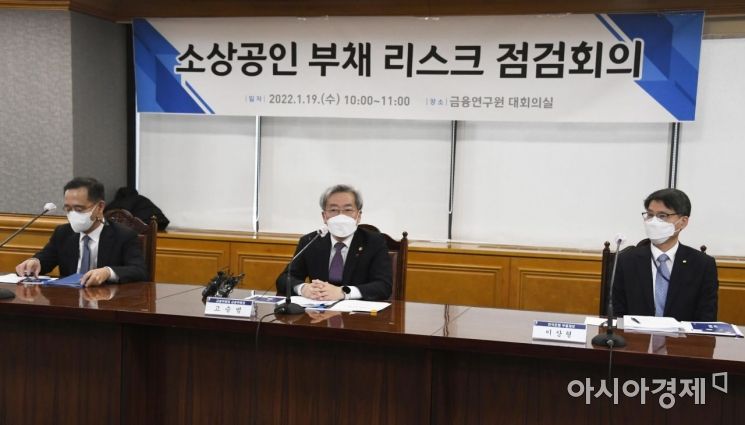 Financial Services Commission Chairman Ko Seung-beom is delivering opening remarks at the meeting to review debt risks of small business owners held on the 19th at the Korea Institute of Finance in Jung-gu, Seoul. Photo by Hyunmin Kim kimhyun81@
[Asia Economy Reporter Sim Nayoung] "Financial institutions must analyze the potential expansion of default risks due to interest rate hikes and sufficiently build buffer capacity such as loan loss provisions." (Financial Services Commission Chairman Ko Seung-beom on the 14th)
"The risks we have been concerned about are now appearing in the market. Recently, the amount of provisions held by financial institutions has decreased compared to last year. They must absorb the risks." (Financial Supervisory Service Governor Jung Eun-bo on the 27th)
As financial authorities pressured banks to increase loan loss provisions to prepare for default risks, banks found themselves in a dilemma. The key issue is how much to set aside for provisions in the fourth quarter ahead of last year's settlement.
Provisions refer to the amount deducted in advance from profits for expected losses on loan assets with a high risk of default. The more provisions accumulated, the better the institution can weather a default crisis without significant impact on financial statements. However, the more provisions set aside, the lower the dividends, which increases the likelihood of shareholder backlash.
According to the four major banks (Kookmin, Shinhan, Hana, Woori) on the 29th, the total balance of provisions increased from KRW 4.8078 trillion at the end of 2019 to KRW 5.2969 trillion in the third quarter of 2020, then slightly decreased to KRW 5.0713 trillion in the third quarter of 2021.
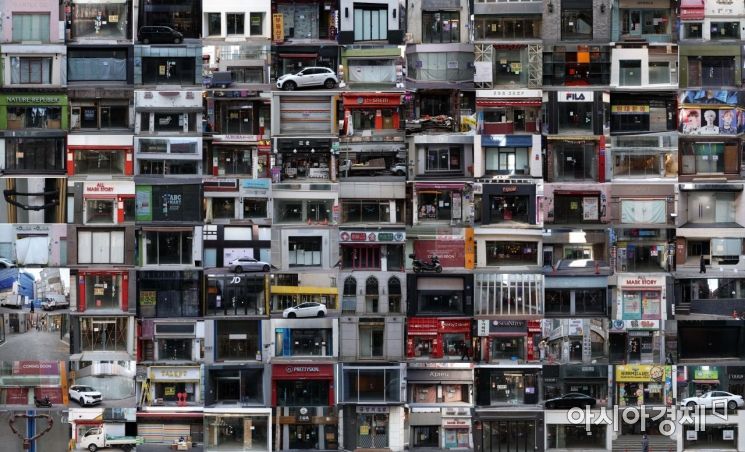 The streets of Myeongdong were colder. It was not just because of the subzero temperatures. Due to the resurgence of COVID-19, the decrease in tourists, and the strengthening of social distancing measures, numerous rental inquiries, temporary closure notices, and business termination announcements were posted throughout the shops in this area, which was most affected. On the 7th, over 100 closed stores in Myeongdong were captured on camera. Photo by Moon Honam munonam@
There are two reasons why authorities have repeatedly emphasized the accumulation of provisions. First, the Bank of Korea's forecasted base rate hike in February, and second, the end of COVID-19 loan maturity extensions (KRW 115 trillion) and interest payment deferrals (KRW 12.1 trillion) for small business owners and SMEs in March. If loan interest rates rise and small business owners fail to repay their debts, a significant shock could occur all at once.
On the surface, there are no signs of default yet. Comparing the end of 2019, just before the COVID-19 outbreak, with the third quarter of last year, non-performing loans classified as substandard or below (loans overdue for more than three months) decreased (KRW 4.1555 trillion → KRW 3.1561 trillion), and the delinquency rate also fell (0.26% → 0.17%).
The prevailing opinion is that this is merely an illusion caused by the loan maturity extensions during COVID-19. Starting in March, when banks remove the life support for small business owners and SMEs buried in debt, these will immediately emerge as default time bombs.
An official from a commercial bank said, "Individuals and companies who pay interest but cannot repay principal are better off, but borrowers who cannot even pay interest pose a real threat of default to the financial sector," adding, "Along with banks' provision accumulation, after the March presidential election, the political and regulatory authorities will have no choice but to prepare policies to liquidate zombie borrowers who cannot even pay interest."
© The Asia Business Daily(www.asiae.co.kr). All rights reserved.
![User Who Sold Erroneously Deposited Bitcoins to Repay Debt and Fund Entertainment... What Did the Supreme Court Decide in 2021? [Legal Issue Check]](https://cwcontent.asiae.co.kr/asiaresize/183/2026020910431234020_1770601391.png)

















