Home treatment for 7 days if vaccinated test positive
PCR tests for high-risk groups only from the 3rd of next month
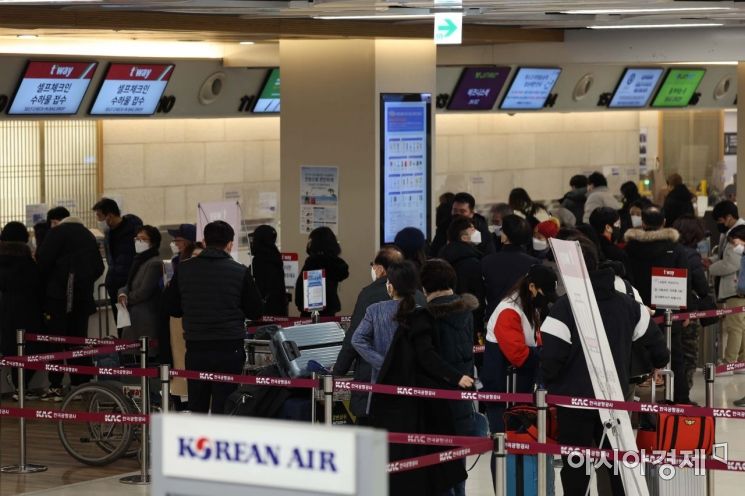 On the 28th, one day before the Lunar New Year holiday, despite fears of the COVID-19 Omicron variant and the government's request to refrain from traveling home, the domestic terminal at Gimpo Airport in Gangseo-gu, Seoul, was crowded with passengers. Photo by Mun Ho-nam munonam@
Starting today (29th), the government will fully operate the 'Omicron-tailored COVID-19 Prevention System.' Rapid antigen tests that can determine COVID-19 infection status within 15 minutes will be available for free at screening clinics nationwide. If the rapid antigen test result is 'negative,' it can also be used for the quarantine pass (vaccination certificate/negative confirmation system).
PCR and Rapid Antigen Tests Conducted Concurrently During the Holiday Period
According to the Central Disease Control Headquarters on the 29th, 256 COVID-19 screening clinics installed at public health centers and large hospitals nationwide will conduct both polymerase chain reaction (PCR) tests and rapid antigen tests concurrently starting today.
Visitors to the screening clinics can choose the PCR test, which has very high accuracy but takes at least half a day to get results, or the rapid antigen test, which is less accurate but provides results within minutes.
From today, rapid antigen test results conducted at screening clinics can also be used for the quarantine pass. In four areas where the Omicron variant spread rapidly?Anseong, Pyeongtaek, Gwangju, and Jeonnam?the Omicron response testing system has already been proactively implemented since the 26th.
If COVID-19 symptoms appear during the Lunar New Year holiday, individuals can visit screening clinics to receive free PCR or rapid antigen tests, or purchase self-test kits at pharmacies for testing. However, even if the rapid antigen test or self-test kit shows a positive result, a PCR test must be taken additionally for a final confirmed diagnosis. If a self-test kit at home shows two lines (positive), one must wear a mask and travel to the screening clinic by walking, private car, or quarantine taxi to receive a PCR test.
If confirmed positive by PCR test, the basic protocol is to stay at home and undergo home treatment. The public health center will send a home treatment kit containing an oxygen saturation monitor, antipyretics, and other supplies to the patient's home. Those who have completed their second vaccination 14 to 90 days prior or have received a third dose will be quarantined for 7 days, while unvaccinated individuals will be quarantined for 10 days (including 3 days of voluntary quarantine).
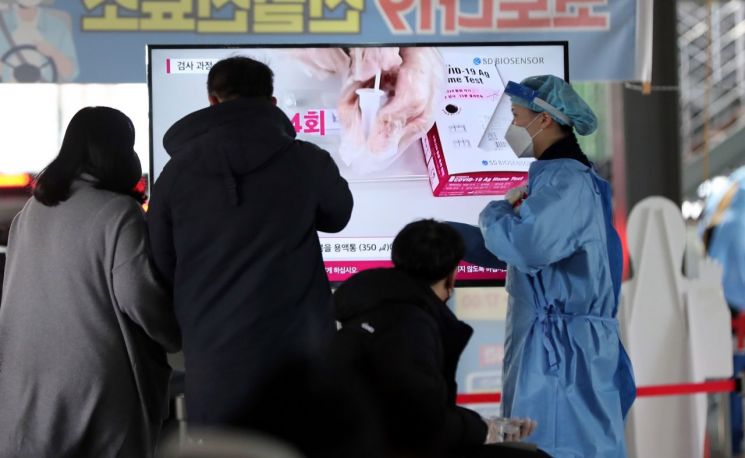 On the morning of the 26th, when the Omicron response system was implemented in some areas, a video explaining how to use the 'self-diagnosis kit' was being shown at the screening clinic in Buk-gu, Gwangju, while individuals who underwent rapid antigen testing were waiting for their results.
 [Image source=Yonhap News]
PCR Test Eligibility Restricted After the Holiday
From the 3rd of next month, after the holiday ends, not only screening clinics but also 204 temporary screening centers nationwide and some hospitals and clinics participating in COVID-19 treatment, including respiratory-specialized clinics, will join the new testing system.
Under the new system, PCR tests will be conducted first for 'priority test subjects,' including ▲elderly aged 60 and above ▲people with a doctor's note indicating the need for testing ▲epidemiologically related individuals (close contacts, overseas entrants, pre-release quarantine testers) ▲persons related to vulnerable facilities (nursing facility workers, residents of foreigner protection facilities, juvenile protection institutions, correctional facilities, soldiers returning from leave, patients before hospital admission) ▲and those confirmed positive by rapid antigen tests.
The general public must first take a rapid antigen test and can only receive a PCR test if the result is 'positive.' This measure aims to concentrate PCR testing capacity on high-risk groups with a higher probability of severe illness or death. Those eligible for PCR testing should bring identification, employment certificates, text messages designating them as test subjects, doctor's notes, leave certificates, or other proof confirming their priority status to the screening clinic to receive PCR testing immediately.
If someone not eligible develops COVID-19 symptoms such as cough, fever, or sore throat, they can visit a medical institution designated as a respiratory-specialized clinic to receive a doctor's consultation and a professional rapid antigen test. The test is free, but a 5,000 KRW consultation fee applies. If the rapid antigen test is positive or the doctor recommends a COVID-19 test, the individual can visit a screening clinic for a PCR test.
Other individuals wishing to be tested can receive rapid antigen tests at screening clinics or temporary screening centers. Test kits provided at clinics or centers are intended for on-site use, but if the waiting line is long, they may be taken home for use. However, only one test kit per person is provided, and extra kits cannot be given for family members or others.
© The Asia Business Daily(www.asiae.co.kr). All rights reserved.


















