Ministry of Land, Infrastructure and Transport, Approval and Confirmation of the '2nd Expressway Construction Plan' by the Road Policy Deliberation Committee
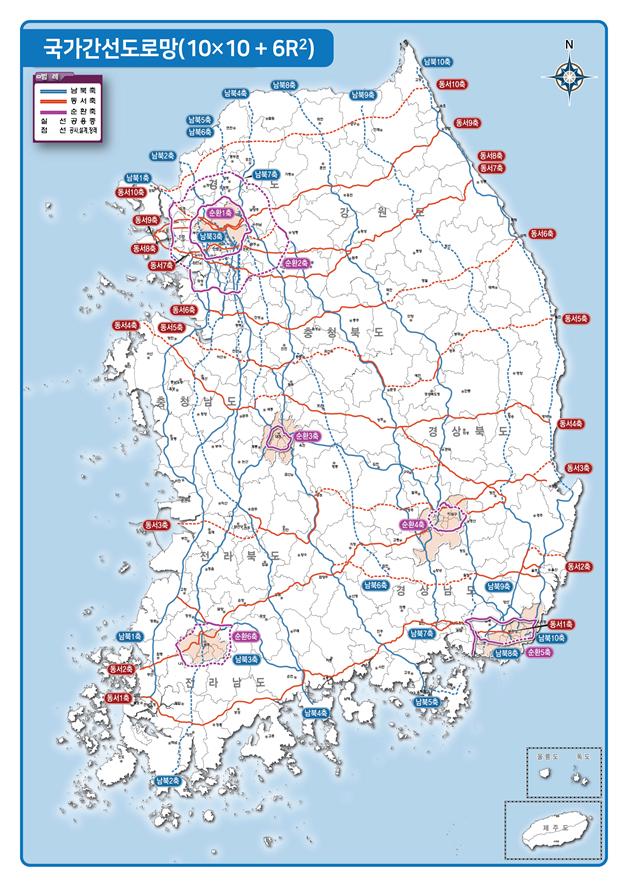
The Ministry of Land, Infrastructure and Transport announced on the 28th that it has finalized the "2nd Highway Construction Plan," a mid- to long-term investment plan for highway construction through 2025, after review by the Road Policy Deliberation Committee.
This plan selected projects centered on four major tasks: regional balanced development, traffic congestion relief, logistics industry support, and preparation for inter-Korean cooperation, to support economic growth and build comfortable and convenient highways. Accordingly, a total of 37 highway projects worth 55 trillion KRW, including 19 new highways and 18 expansions, were newly included.
The Ministry plans to implement the 10×10 grid network proposed last September and improve highway accessibility in regions with relatively weak transportation infrastructure to establish a foundation for regional balanced development. This includes highway plans for the Yeongwol-Samcheok, Muju-Seongju, and Seongju-Daegu sections to expand east-west arterial roads, which are relatively underdeveloped compared to north-south directions.
Specifically, the Yeongwol-Samcheok highway will complete the east-west 6-axis of the national arterial road network and significantly improve mobility between the Gangwon Yeongdong and Yeongseo regions by reducing travel time by more than 20 minutes from Yeongwol and Danyang counties to Samcheok and Donghae cities.
The Muju-Seongju and Seongju-Daegu highways will complete the east-west 3-axis of the national arterial road network, strengthen connections between Yeongnam and Honam regions, and directly link the Gyeongbu Line, Jungbu Line, and Jungbu Inland Line in the east-west direction, reducing detour distances by more than 60%.
Additionally, to strengthen arterial functions, a new highway will be constructed on the Yeongdong-Jincheon section between the Jungbu Line and Jungbu Inland Line in the Chungcheong region, where the average spacing between national arterial roads (about 30 km) is exceeded (average spacing 73 km).
The plan also includes the Wando-Gangjin highway to realize highway access within 30 minutes in the southern Jeonnam region, including Wando, Haenam, and Gangjin counties.
Furthermore, the plan aims to significantly expand road capacity in traffic congestion sections and strengthen investments to complete the radial ring network* in metropolitan areas, improving habitual traffic congestion sections and creating convenient traffic conditions.
In particular, for habitual congestion sections where horizontal road capacity expansion is impossible due to surrounding urban development, such as the Gyeongbu Line, Gyeongin Line, and the 1st Ring Road of the Seoul metropolitan area, additional underground roads (tunnels) will be expanded to increase road capacity.
For example, on the Gyeongbu Line, which currently experiences severe congestion with daily traffic exceeding 200,000 vehicles (optimal traffic volume 134,000 vehicles), an additional underground road (tunnel) will be constructed below the existing highway in the Hwaseong-Seoul section south of Yangjae IC, while keeping the existing highway intact.
Additional underground roads (tunnels) will also be constructed beneath the existing roads in the Toegyewon-Pangyo section of the 1st Ring Road of the Seoul metropolitan area and the Incheon-Seoul section of the Gyeongin Line to alleviate habitual traffic congestion. As a result, bus-only lanes will be expanded on the existing surface roads, which will have increased capacity, to strengthen the highway's public transportation service support function.
The plan also includes road capacity expansion projects for 18 traffic congestion sections, such as the Cheongseong-Dongi section of the Buseon Line and the Gimcheon-Nakdong section of the Jungbu Inland Line.
To complete the ring network in the Gwangju and Honam metropolitan areas, the plan promotes the Geumcheon-Hwasun highway to alleviate traffic congestion in these metropolitan areas.
To resolve traffic demand generated by major infrastructure and improve logistics movement efficiency, the plan aims to strengthen mobility and accessibility of major transportation and logistics hubs such as national industrial complexes, airports, and ports.
The plan includes the construction of the Gimhae-Miryang highway to connect with the Busan New Port-Gimhae highway, further enhancing accessibility to Busan New Port, and the Gigae-New Port highway to support transportation at Yeongilman Port.
Highways on the Ochang-Goesan section to improve access to Cheongju International Airport, the Gumi-Gunwi section in preparation for the relocation of Daegu-Gyeongbuk Integrated New Airport, and the Geoje-Tongyeong section to revitalize the Okpo National Industrial Complex are also planned.
To prepare for future environmental changes such as activating inter-Korean exchange and cooperation and linking international land transportation in the Asian region, the plan includes building arterial road networks in border areas.
To prepare for inter-Korean cooperation and respond to traffic demand in the northern metropolitan area including Yangju New Town development, the Seoul-Yeoncheon highway is planned.
To support industrial and tourism revitalization in underdeveloped border areas, highway plans for the Pocheon-Cheorwon, Chuncheon-Cheorwon, and Sokcho-Goseong sections are also included.
The Ministry explained that projects included in the "2nd Highway Construction Plan" will be promoted sequentially (with priority on key projects) after securing feasibility through preliminary feasibility studies and will proceed through related procedures such as feasibility studies and design.
The Ministry expects that if this plan is implemented smoothly, the average travel time between regions will be reduced by about 6%, and the proportion of national land area accessible to highways within 30 minutes will increase from 74.3% to 84.5%, significantly enhancing arterial functions. It also explained that approximately 53.8 trillion KRW in benefits from traffic improvements such as reduced travel time and operating costs, about 97 trillion KRW in economic ripple effects including production inducement and added value effects, and about 340,000 jobs will be generated.
Lee Yoon-sang, Director of the Road Bureau at the Ministry of Land, Infrastructure and Transport, said, "We will strive to ensure that the projects included in this plan are carried out without delay to expand the national arterial network that supports citizens' mobility convenience and economic growth," adding, "We will fully collect opinions from related agencies, residents, and stakeholders in advance on possible issues such as environment and safety to ensure smooth project implementation."
© The Asia Business Daily(www.asiae.co.kr). All rights reserved.
![User Who Sold Erroneously Deposited Bitcoins to Repay Debt and Fund Entertainment... What Did the Supreme Court Decide in 2021? [Legal Issue Check]](https://cwcontent.asiae.co.kr/asiaresize/183/2026020910431234020_1770601391.png)















