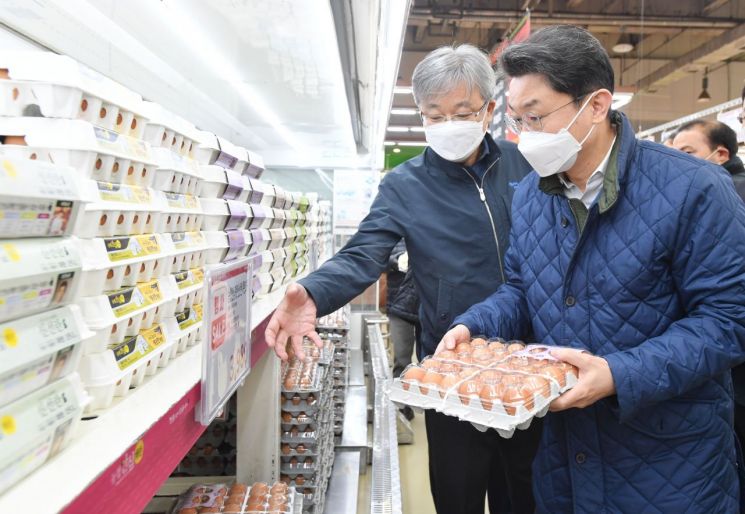
[Asia Economy Sejong=Reporter Kim Hyewon] The government is considering extending the fuel tax reduction measure, which is scheduled to end at the end of April. It also plans to significantly strengthen monitoring of unfair trade practices such as collusion. Priority monitoring targets include everyday items like duck, native chicken, and ice cream.
On the 28th, the government announced this at a price vice ministerial meeting held at Hanaro Mart in Yangjae-dong, Seoul, chaired by Lee Eokwon, the 1st Vice Minister of the Ministry of Economy and Finance.
The government intends to review the extension of the fuel tax reduction measure, scheduled to end at the end of April, depending on international oil price trends. This is because the recent rise in international oil prices due to the Ukraine situation is expected to be reflected in gasoline and diesel prices going forward.
Monitoring of unfair practices such as price collusion will also be strengthened. As upward pressure on prices spreads comprehensively, there is a high possibility of unfair practices like price collusion and opportunistic price hikes exploiting this situation.
In particular, the government plans to intensify monitoring of collusion and resale price maintenance activities. It will strengthen surveillance on everyday items with high public sensitivity such as duck, native chicken, and ice cream, and will consider strong corrective measures if violations are detected.
The government plans to conduct a fact-finding survey on sales commissions and sales incentives targeting 34 distribution brands including department stores, home shopping, large marts, and online shopping malls, as well as 28 corporations, and announce the results. Separately from the Consumer Organizations Council’s plan to independently collect and disclose delivery fees, the government is also considering a fact-finding survey at the government level. The Fair Trade Commission was asked to explain that participating in inter-ministerial industry meetings and sharing information could also constitute collusion. The government also requested active identification and improvement of regulatory issues that restrict market competition based on industry suggestions.
Since the Lunar New Year livelihood stabilization measures on the 5th, prices of 16 out of 17 major seasonal products have fallen. The items with price decreases include napa cabbage, radish, pear, beef, pork, chicken, eggs, chestnuts, jujubes, and rice. The only item with a price increase, apples, are still trading at prices 17.1% lower compared to the same period last year.
Vice Minister Lee encouraged Hanaro Mart officials who participated in expanding the supply of seasonal products and discount events, saying, "We will cooperate with related ministries to proactively manage and prevent rapid price increases after the Lunar New Year."
© The Asia Business Daily(www.asiae.co.kr). All rights reserved.
![User Who Sold Erroneously Deposited Bitcoins to Repay Debt and Fund Entertainment... What Did the Supreme Court Decide in 2021? [Legal Issue Check]](https://cwcontent.asiae.co.kr/asiaresize/183/2026020910431234020_1770601391.png)















