Investing 65 Billion Won by 2024 to Install Elevators for Transportation-Disadvantaged to Use Subway Independently
Currently Securing 'One Station One Route' at 254 Stations
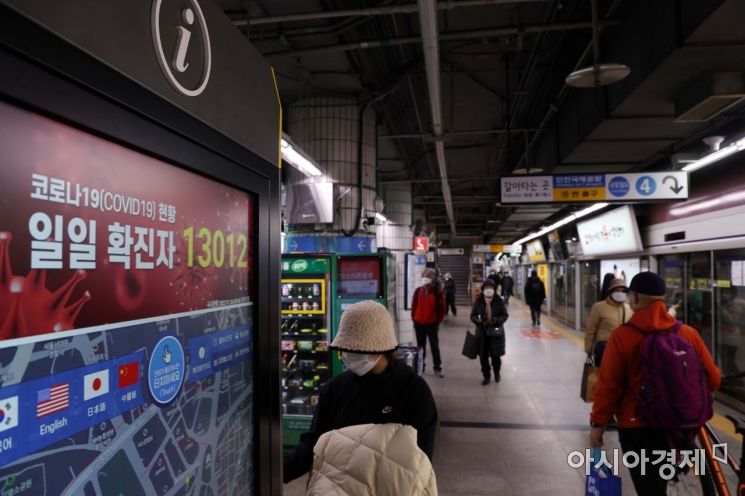 On the 26th, information about new COVID-19 confirmed cases is being displayed on the platform signboard at Seoul Station on Subway Line 1 in Seoul. Photo by Mun Ho-nam munonam@
[Asia Economy Reporter Han Jinju] Elevators will be installed in all 275 subway stations on Seoul Subway Lines 1 to 8 by 2024.
On the 28th, Seoul Metro announced that by 2024, Seoul City will invest approximately 65 billion KRW to install elevators in all 275 stations to secure a 'one station, one route' system.
'One station, one route' refers to a route that allows transportation-vulnerable people such as the disabled and elderly to independently use elevators from the subway station exits on the ground to the concourse and platforms.
Currently, 254 stations (as of 2021, securing rate 92.3%) have the 'one station, one route' system in place. Seoul Metro plans to start elevator installation work at 10 stations aiming for completion next year.
Namguro Station on Line 7, the only station operated by Seoul Metro without an elevator, will have a new elevator installed.
At nine stations where elevators exist but the 'one station, one route' system was not secured?such as Gangdong and Jongno 3(sam)-ga Stations on Line 5; Saejeol, Sangwolgok, Bonghwasan, and Gusan Stations on Line 6; Suraksan, Cheongdam, and Gwangmyeongsageori Stations on Line 7?additional elevators will be installed.
At six stations where elevator installation was difficult due to space constraints?Sangil-dong Station on Line 5, Express Bus Terminal Station on Line 3, Bokjeong Station on Line 8, Sinseol-dong and Kkachisan Stations on Line 2, and Daehung Station on Line 6?design work is underway or various design plans are being reviewed.
Elevators at five stations?Cheongnyangni Station on Line 1, Yongdap Station on Line 2, Gyodae Station on Line 3, Myeongdong Station on Line 4, and Macheon Station on Line 5?where elevator construction began between 2020 and 2021, will be operational starting this year.
Most subway stations lacking convenience facilities for transportation-vulnerable people were built between the 1970s and 1990s. Seoul Metro explained that financial difficulties intensified due to the burden of free rides and low fare structures compared to transportation costs, making it difficult to secure budgets for elevator installation.
Kim Sang-beom, CEO of Seoul Metro, said, "The most necessary thing for installing boarding convenience facilities is funding," and added, "We earnestly ask for government support considering the difficult construction circumstances."
© The Asia Business Daily(www.asiae.co.kr). All rights reserved.
![User Who Sold Erroneously Deposited Bitcoins to Repay Debt and Fund Entertainment... What Did the Supreme Court Decide in 2021? [Legal Issue Check]](https://cwcontent.asiae.co.kr/asiaresize/183/2026020910431234020_1770601391.png)
















