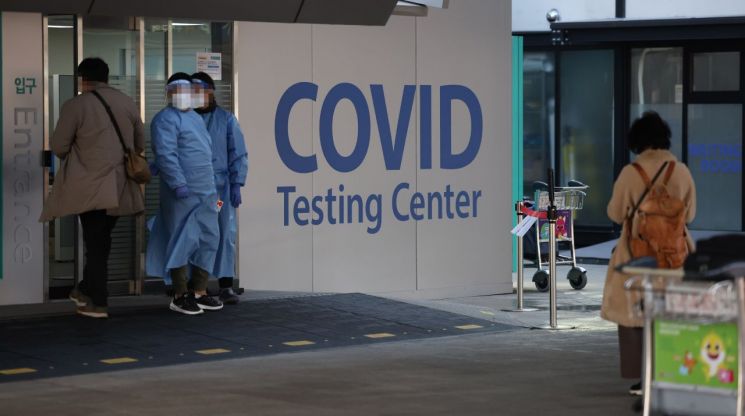
 On the 26th, as Omicron spreads and new confirmed cases continue to reach record highs daily, in front of the COVID-19 testing center at Incheon International Airport Terminal 1 [Image source=Yonhap News]
As the Omicron variant spreads, oil prices remain high, and the U.S. is approaching fiscal tightening, multiple domestic and international risks are occurring simultaneously, increasing anxiety about the domestic economic situation. With COVID-19 cases maintaining over 10,000 for four consecutive days, concerns are rising that the recovering employment trend may worsen. Additionally, the possibility of deteriorating trade conditions due to exchange rates and high oil prices suggests that economic uncertainty will persist for the time being.
According to the Bank of Korea on the 28th, the net commodity terms of trade index fell for the ninth consecutive month in December last year, hitting its lowest point in 9 years and 1 month. This means that import prices rose sharply while export prices did not keep pace, indicating a worsening of South Korea's trade conditions. The rise in international oil prices and other raw material costs is interpreted as an increased burden on domestic companies.
With international oil prices exceeding $80 per barrel, concerns are emerging that trade conditions could worsen further. A Bank of Korea official said, "A worsening index means that our country is selling goods cheaply and buying them expensively, so if other conditions remain the same, it is not a good sign," adding, "Oil prices have also been rising recently, so we need to watch closely."
The import value index also rose for the 13th consecutive month in December last year, reaching 170.64, a 37.6% increase compared to the same month the previous year. This index is calculated by multiplying import prices by import volumes. Since imported goods often undergo processing before being exported, it cannot be directly linked to economic downturns. However, as this is also a fluctuation caused by rising raw material prices, it shows that the burden on domestic companies has increased.
In this month's Business Survey Index (BSI), the BSI for business conditions across all industries fell by 1 point from the previous month to 86, indicating a deterioration in overall corporate sentiment. The market is concerned that the economic burden will increase further as the won-dollar exchange rate surpassed the 1,200 won mark amid the U.S.'s accelerated tightening measures.
The depreciation of the won increases the burden on domestic import companies, which can lead to expanded inflationary pressures and reduced consumption. Export manufacturing companies, which often import raw materials from overseas to export processed goods, may also face negative impacts due to decreased price competitiveness. Experts expect that, given the significant domestic and international uncertainties, the exchange rate will fluctuate around the 1,200 won level, which is considered a "psychological resistance line," for the time being.
The number of domestic business workers increased by more than 470,000 in December last year, marking the largest increase since the COVID-19 outbreak. However, about half of them?226,000?were temporary or daily workers, raising concerns about employment shocks due to the spread of the Omicron variant. Workers in the accommodation and food service sectors, which have been heavily affected by COVID-19 measures, also increased for two consecutive months, but the sustained daily case count of over 10,000 is expected to dampen this upward trend.
Professor Kang Sung-jin of Korea University’s Department of Economics said, "I thought COVID-19 would disappear in the first half of the year and consumption would increase, but the situation is not like that, so the pace of economic recovery is unlikely to be fast." Professor Kang added, "Although South Korea is moving toward raising interest rates, the government is simultaneously injecting money, which could cause the exchange rate to rise and inflation concerns to worsen," emphasizing, "The government needs to respond proactively."
© The Asia Business Daily(www.asiae.co.kr). All rights reserved.