US Signals Rate Hike in March... Upward Trend Likely to Continue for a While
[Asia Economy Reporter Seo So-jeong] The domestic foreign exchange market is fluctuating following the hawkish (monetary tightening preference) remarks by Jerome Powell, Chairman of the U.S. Federal Reserve (Fed).
With the acceleration of the U.S. tightening monetary policy, along with the spread of Omicron, China's economic slowdown, and the Russia-Ukraine conflict, volatility in the exchange rate appears to be increasing due to various domestic and international factors. Experts predict that due to internal and external uncertainties, the Korean won per U.S. dollar exchange rate will surge to the psychological resistance level of 1,250 won.
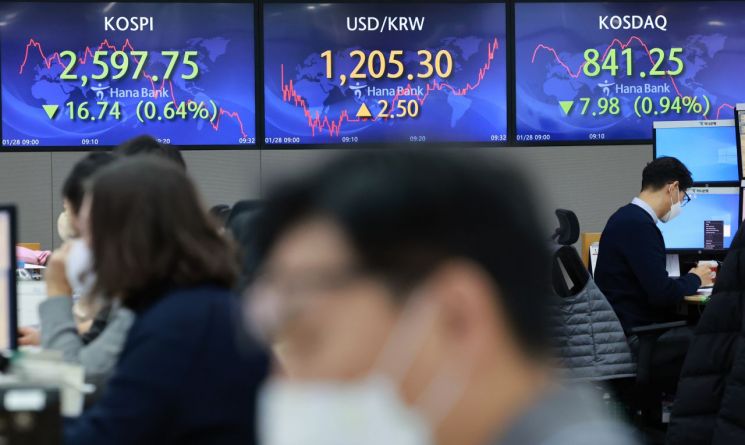
According to Seoul Foreign Exchange Brokerage on the 28th, the won-dollar exchange rate opened at 1,205.0 won, up 2.2 won from the previous trading day, and has been fluctuating in the low 1,200 won range in the Seoul foreign exchange market. The aftereffects of Powell's hawkish remarks the previous day, which caused the rate to break through the 1,200 won level and show instability, are continuing.
Experts expect the upward trend to continue for the time being due to increased volatility, reaching the short-term peak of 1,250 won in the first half of the year. Oh Chang-seop, a researcher at Hyundai Motor Securities, said, "Due to the influence of the U.S. Federal Open Market Committee (FOMC), the won-dollar exchange rate, which surpassed the 1,200 won level, is expected to reach the upper band of 1,250 won in the first half of the year," adding, "There is also a possibility that the annual high of 1,250 won will be breached earlier than expected."
Researcher Oh added, "The exchange rate is soaring due to concerns over a full-scale Russia-Ukraine war combined with foreign capital outflows," and said, "This month, the foreign exchange authorities verbally intervened, citing excessive exchange rate volatility, and there is a high possibility that the upper limit will be capped if foreign exchange intervention occurs after the Lunar New Year holiday."
However, experts expect that the Bank of Korea's ongoing interest rate hikes and the maintained interest rate differential between Korea and the U.S. will prevent the exchange rate from staying above the crisis level of 1,200 won for an extended period.
Jeon Gyu-yeon, a researcher at Hana Financial Investment, said, "In the first quarter, concerns about Fed tightening are high, and volatility is expanding due to confusion in market communication," adding, "However, since the dollar index itself is already priced in for monetary policy and domestic tightening is being maintained, it is expected to decline in the second to third quarters."
© The Asia Business Daily(www.asiae.co.kr). All rights reserved.