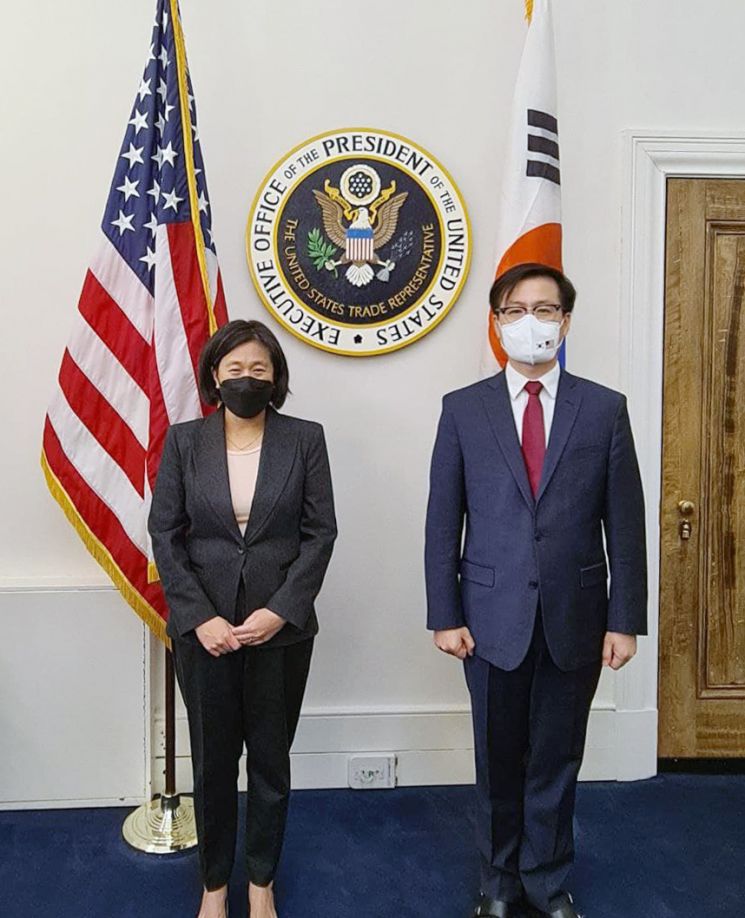
 From the left in the photo are Katherine Tai, U.S. Trade Representative (USTR), and Yeo Han-gu, Director-General for Trade Negotiations at the Ministry of Trade, Industry and Energy. [Photo provided by the Ministry of Trade, Industry and Energy]
[Asia Economy Sejong=Reporter Lee Junhyung] The government urged the United States to improve negotiations on Section 232 of the Trade Expansion Act, which limits imports of Korean steel.
The Ministry of Trade, Industry and Energy announced that Yeo Han-gu, the head of the Trade Negotiations Office, held a Korea-US trade ministerial meeting with Katherine Tai, the U.S. Trade Representative (USTR), in Washington DC on the 27th (local time). On this day, the trade ministers of both countries focused on discussing the Section 232 measures on steel, the U.S. Indo-Pacific Economic Framework, and ways to strengthen bilateral cooperation to commemorate the 10th anniversary of the Korea-US Free Trade Agreement (FTA). They also shared efforts to strengthen supply chain resilience and reform the World Trade Organization (WTO).
The Ministry emphasized the need to improve Section 232 of the Trade Expansion Act. Section 232 allows the U.S. to restrict imports or impose high tariffs on imports deemed to threaten national security. Former President Trump, advocating protectionism, imposed a 25% tariff on steel imports from the European Union (EU), Japan, China, and others in 2018 under Section 232. South Korea was exempted from steel tariffs at that time but accepted a quota system limiting steel exports to within 70% of the average export volume of the previous three years.
Head Yeo pointed out that despite several discussions on the need to improve Section 232, progress has been slow. He emphasized growing domestic concerns about the measure and urged prompt improvements. In fact, the domestic steel industry is intensifying outreach activities targeting the U.S. Congress, economic organizations, and think tanks due to concerns over import restrictions under Section 232.
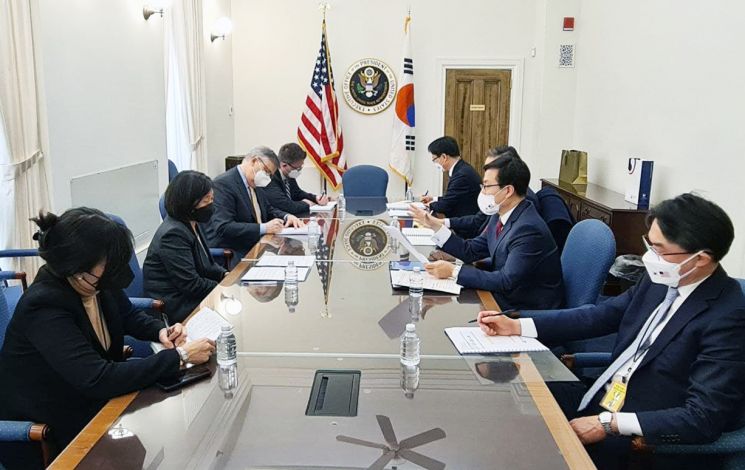 Officials from the Ministry of Trade, Industry and Energy are holding talks with the United States Trade Representative (USTR).
 [Photo by Ministry of Trade, Industry and Energy]
Regarding the Indo-Pacific Economic Framework (IPEF) proposed by the U.S., a consensus was formed. IPEF is an initiative announced by President Joe Biden in October last year for comprehensive economic cooperation in the Indo-Pacific region. Both the Korean government and the U.S. agreed on the importance of the Indo-Pacific region in the global economy. They also agreed that regional cooperation is essential for digital and green economic transitions, which have emerged as key topics for economic growth, and for supply chain resilience.
Head Yeo stated, "Let us continue consultations as the U.S. builds the framework," adding, "It is important that the Indo-Pacific Economic Framework encompasses standards and cooperation based on openness, transparency, and inclusiveness that many countries in the region can accept." The U.S. emphasized that the Indo-Pacific Economic Framework is a forward-looking and sustainable initiative that can enhance the competitiveness of regional countries and increase economic opportunities.
Discussions were also held on establishing a new senior-level trade consultation channel. The Korea-US Free Trade Agreement (FTA) Joint Committee agreed last November to establish this senior-level trade consultation channel. The channel is expected to become a platform for close cooperation on emerging issues such as supply chains and climate change.
Meanwhile, Head Yeo and Representative Tai agreed that Korea-US cooperation can contribute to the recovery of the global economy and sustainable growth after COVID-19.
© The Asia Business Daily(www.asiae.co.kr). All rights reserved.