Failed Fundraising but Significance of Public Discussion on Joint Ownership
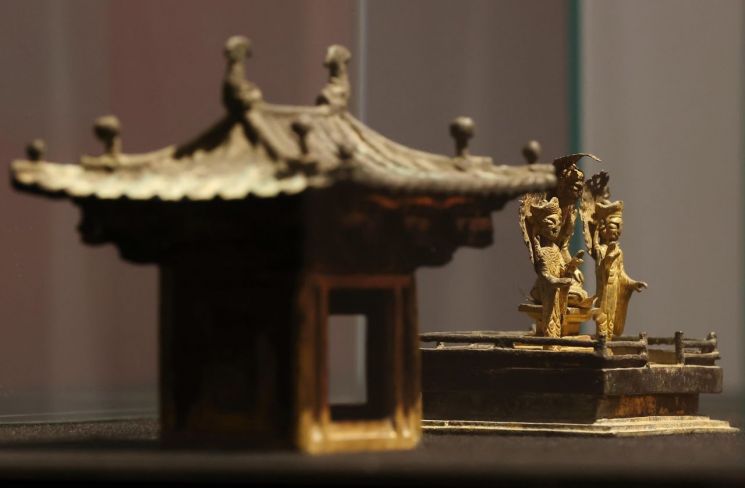 The National Treasure No. 72, "Gye-mi-myeong Gilt-Bronze Triad Buddha Statue," and National Treasure No. 73, "Gilt-Bronze Triad Buddha Shrine," housed at the Kansong Art Museum. Photo by Yonhap News
[Asia Economy Reporter Kim Heeyoon] On the 27th of last month, two nationally designated cultural assets, both National Treasures, appeared for the first time ever at a K-Auction auction, drawing significant attention. The protagonists were National Treasure No. 72, the ‘Gye-mi-myeong Gilt-Bronze Triad Buddha Statue,’ which Jeon Hyeongpil of Kansong protected even during his flight from the Korean War, and National Treasure No. 73, the ‘Gilt-Bronze Triad Buddha Shrine.’ The estimated prices were 3.2 billion to 4.5 billion KRW for the Triad Buddha Statue and 2.8 billion to 4 billion KRW for the Triad Buddha Shrine. Amid the uncertainty surrounding the fate of these National Treasures, a project emerged within the blockchain industry proposing the formation of a Decentralized Autonomous Organization (DAO) to participate in the auction, attracting attention. ‘GukboDAO,’ established mainly by Jung Woohyun, CEO of Atomix Lab, and Han Jaeseon, CEO of Ground X, was launched with the purpose of pooling citizens’ power to jointly own and manage the two National Treasures.
DAO stands for Decentralized Autonomous Organization, an organization based on blockchain technology that anyone can voluntarily join and that makes decisions democratically through member voting. Based on this, it is also possible to secure new forms of funding through blockchain technology-centered cryptocurrencies.
This is not the first time a DAO has been formed to protect cultural heritage. Previously, in the United States, when a first edition of the Constitution was put up for auction at Sotheby’s last year, Constitution DAO was formed and raised approximately 47 billion KRW worth of Ethereum in less than a week. Participants in Constitution DAO aimed to ‘rescue the cultural asset, the Constitution, from the hands of private collectors’ and actively shared horizontal opinions on where to store and exhibit it if they won the auction. Although they failed to win the auction, they exceeded their fundraising goal, leaving a precedent of a decentralized autonomous organization moving toward a common goal.
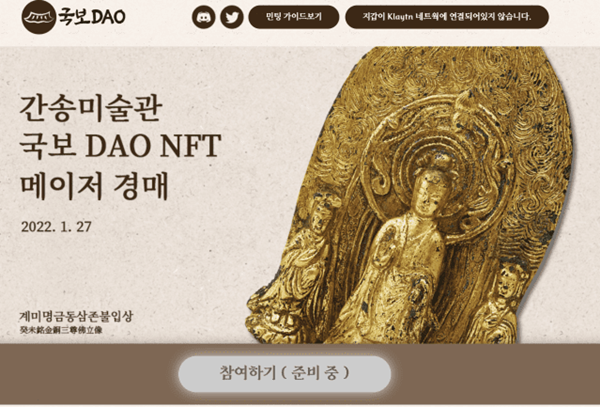
Unlike Constitution DAO, which adopted Ethereum, GukboDAO conducted fundraising on Klaytn, a blockchain network created by Kakao. This was intended to reduce high fees and attract domestic coin investors rather than overseas participants by utilizing a domestic network. Jung Woohyun, CEO of Atomix Lab and a leader in forming GukboDAO, explained, “It is not desirable for a National Treasure to become the property of a wealthy individual,” adding, “Even if the law prohibits the overseas export of National Treasures, the individual owner might emphasize only the legal aspects of private ownership, block external access, and fail to properly manage the treasure.”
He continued, “To continuously arouse citizens’ interest and share and expand the historical significance of cultural assets, it is desirable that an entity that properly understands the public nature of cultural heritage acquires them. This is why we formed GukboDAO,” and diagnosed, “In terms of cultural asset ownership, a model of joint ownership by a majority of members who primarily agree on the principle of publicness, rather than exclusive ownership by individuals or a few, will become necessary.”
GukboDAO opened its fundraising site just four days before the auction, a somewhat tight schedule, and raised about 2.4 billion KRW, failing to secure the minimum participation fund of 5 billion KRW for the auction. However, the concept of joint ownership through blockchain and decentralized autonomous organization systems sparked significant implications in discussions about National Treasures. The two National Treasures submitted by the Kansong Art Foundation were ultimately passed over at the auction. Amid calls from some in the cultural heritage sector for a systematic public-private framework to preserve the Kansong collection, there is growing discussion on whether DAO could be an alternative, as well as new issues regarding the legal status of DAOs under current law and how to view joint ownership of cultural assets.
© The Asia Business Daily(www.asiae.co.kr). All rights reserved.
![User Who Sold Erroneously Deposited Bitcoins to Repay Debt and Fund Entertainment... What Did the Supreme Court Decide in 2021? [Legal Issue Check]](https://cwcontent.asiae.co.kr/asiaresize/183/2026020910431234020_1770601391.png)
















