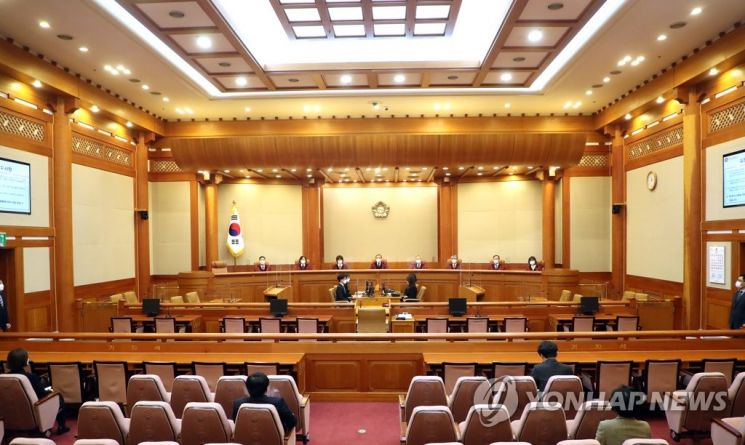
[Asia Economy Reporter Choi Seok-jin, Legal Affairs Specialist] The Constitutional Court has ruled that the provision in the National Assembly Act, which in principle prohibits the disclosure of meetings of the National Assembly Intelligence Committee overseeing the National Intelligence Service, violates the constitutional principle of open meetings.
While meetings of other standing committees in the National Assembly have generally been open to the public, meetings of the National Assembly Intelligence Committee have not been disclosed at all except in extremely exceptional cases such as personnel hearings or public hearings, due to Article 54-2 of the National Assembly Act, which was at issue in this constitutional complaint case. As a result, when the National Intelligence Service reported sensitive national secrets such as North Korea’s movements to the Intelligence Committee, it was customary for the party coordinators to coordinate and brief the media on some of the meeting contents.
However, following this Constitutional Court decision, it is expected that the exceptional cases in which the National Assembly Intelligence Committee meetings can be held in private will be more specifically defined through amendments to the National Assembly Act.
On the 27th, the Constitutional Court ruled unconstitutional by a 7 (unconstitutional) to 2 (constitutional) vote in a constitutional complaint case filed by the 'National Intelligence Service Monitoring Network,' a coalition including People’s Solidarity for Participatory Democracy and the Lawyers for a Democratic Society, along with the civic group Military Human Rights Center, arguing that Article 54-2, Paragraph 1 of the National Assembly Act, which prohibits disclosure of National Assembly Intelligence Committee meetings, infringes on the public’s right to know.
This constitutional complaint was filed after the 'National Intelligence Service Monitoring Network,' a coalition including People’s Solidarity for Participatory Democracy and the Lawyers for a Democratic Society, and the Military Human Rights Center requested to attend or have certain parts of the minutes of the Intelligence Committee meetings disclosed to the National Assembly but were refused. The Constitutional Court has been reviewing two cases filed in 2018 and 2020, which were consolidated for hearing.
Earlier, in 2018, the National Intelligence Service Monitoring Network applied to attend the Intelligence Committee’s Bill Examination Subcommittee meeting to monitor the review of the National Intelligence Service Act amendment bill but was denied attendance based on the relevant provision of the National Assembly Act, leading them to file a constitutional complaint against the act and the refusal.
On November 22, 2018, the National Intelligence Service Monitoring Network applied to the chairman of the National Assembly Intelligence Committee to attend the first Bill Examination Subcommittee meeting of the Intelligence Committee to monitor the review of the National Intelligence Service Act amendment bill. However, upon receiving a notice from the Secretariat staff stating, "According to the National Assembly Act regulations, whether to permit attendance at this meeting is not a matter for discussion, so a written response cannot be provided," members including A from the National Intelligence Service Monitoring Network filed a constitutional complaint with the Constitutional Court in 2018, arguing that the decision not to disclose the meeting and the basis for it, Article 54-2, Paragraph 1 of the National Assembly Act, violate Article 50, Paragraph 1 of the Constitution, which stipulates the principle of open meetings, and infringe on the right to know.
Additionally, B from the Military Human Rights Center requested the Secretary-General of the National Assembly to disclose certain parts of the minutes of the full meeting of the Intelligence Committee but was refused. B then filed a lawsuit seeking cancellation of the refusal to disclose information and, during the trial, requested a constitutional review of Article 54-2, Paragraph 1 of the National Assembly Act, which was the basis for the refusal. When the court dismissed this request on July 24, 2020, B filed a constitutional complaint with the Constitutional Court on August 24 of the same year.
The Constitutional Court first dismissed the constitutional complaint regarding the chairman of the National Assembly Intelligence Committee’s refusal to allow attendance, unanimously agreeing that the subjective right to protection had expired as the meeting had already concluded. The Court reasoned that even if the measure was deemed unconstitutional, the fundamental rights already infringed could not be restored, so there was no need to rule on it.
The Constitutional Court judged that the main text of Article 54-2, Paragraph 1 of the National Assembly Act (Special Provisions on the Intelligence Committee), which states, "The meetings of the Intelligence Committee shall not be open to the public. However, in cases of public hearings or personnel hearings pursuant to Article 65-2, the committee may decide to disclose the meetings," violates the constitutional principle of open meetings and is therefore unconstitutional.
Article 50, Paragraph 1 of the Constitution, which stipulates the principle of open meetings, states, "The meetings of the National Assembly shall be open to the public. However, if a majority of the members present agree or the Speaker recognizes it as necessary for national security, the meetings may be closed."
Paragraph 2 of the same article delegates to laws the authority to prescribe procedures for the disclosure of contents of non-public meetings.
Regarding the interpretation of this constitutional provision, the Constitutional Court stated, "Considering the structure of Article 50, Paragraph 1 of the Constitution, the constitutional principle of open meetings does not require that all National Assembly meetings be open at all times, but if a meeting is not disclosed, certain conditions prescribed by the Constitution must be met."
Furthermore, the Court added, "The procedures and reasons for closing meetings stipulated in the proviso of Article 50, Paragraph 1 of the Constitution are very specific in wording, and exceptions to this must be strictly recognized."
The Court clarified, "Therefore, it cannot be said that absolute non-disclosure prohibiting any disclosure is allowed under Article 50, Paragraph 1 of the Constitution. Setting a blanket rule that certain National Assembly meetings or specific committee meetings are always closed, thereby blocking any possibility of disclosure, does not conform to Article 50, Paragraph 1 of the Constitution."
While the Constitution allows laws to specify exceptions for non-disclosure of National Assembly meetings, these must be strictly set as exceptions while maintaining the principle of open meetings as the rule. The provision concerning the National Assembly Intelligence Committee meetings in the National Assembly Act reverses this principle and exception, the Court noted.
The Court pointed out, "The provision under review makes all meetings of the Intelligence Committee non-public, effectively making it impossible for the public to monitor and check the activities of the Intelligence Committee."
Additionally, the Court ruled that the constitutional requirement for non-disclosure of National Assembly meetings under the proviso of Article 50, Paragraph 1, which requires the consent of a majority of members present at each meeting, cannot be satisfied merely because the provision on non-disclosure of the National Intelligence Committee meetings was passed by a majority of the total members and a majority of members present during the legislative process.
For these reasons, seven Constitutional Court justices concluded, "The provision under review violates Article 50, Paragraph 1 of the Constitution and infringes on the petitioners’ right to know."
Meanwhile, Justices Eun Ae Lee and Young-jin Lee dissented, arguing, "All meetings of the Intelligence Committee are substantially related directly or indirectly to national secrets, so non-disclosure is necessary for national security."
These justices stated that Article 54-2, Paragraph 1 of the National Assembly Act at issue does not violate the constitutional principle of open meetings nor the principle of proportionality.
A Constitutional Court official explained the significance of this decision, saying, "This ruling explicitly confirms that fundamentally blocking the disclosure of National Assembly meetings is directly contrary to Article 50, Paragraph 1 of the Constitution, which declares the principle of open meetings, and is therefore not permissible."
The Military Human Rights Center welcomed the ruling and stated, "We will continue activities to rectify unconstitutional laws and systems that infringe on the right to know and make monitoring and checks impossible by excessively broad and indiscriminate information restrictions by state agencies solely on the grounds of national defense and security."
© The Asia Business Daily(www.asiae.co.kr). All rights reserved.