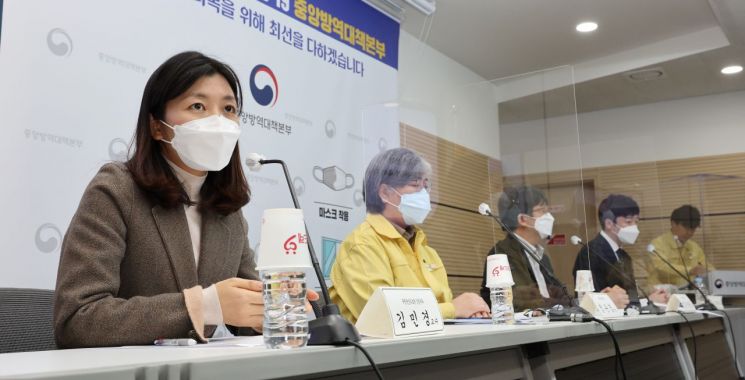
 On the afternoon of the 27th, at the Korea Disease Control and Prevention Agency in Cheongju, Chungbuk, Professor Kim Min-kyung of the National Medical Center is answering questions during a special briefing with invited experts on response measures to the characteristics of the COVID-19 Omicron variant. From left to right in the photo: Professor Kim Min-kyung of the National Medical Center, Director Jeong Eun-kyeong, Director Im Seung-kwan of Gyeonggi Provincial Medical Center Anseong Hospital, and Professor Jeong Jae-hoon of Gachon University College of Medicine. [Image source=Yonhap News]
[Asia Economy Reporter Lee Chun-hee] The quarantine authorities recently held a session to address controversies surrounding the effectiveness and safety of vaccines amid the spread of the Omicron COVID-19 variant. Experts emphasized that although the infection prevention effect of vaccination may somewhat decrease due to the spread of the Omicron variant, the prevention effect against severe illness and death clearly exists, and the safety is not at a concerning level, urging active vaccination.
Professor Jung Jae-hoon of the Department of Preventive Medicine at Gachon University College of Medicine explained at a special COVID-19 briefing held on the afternoon of the 27th at the Korea Disease Control and Prevention Agency in Osong, Chungbuk, "Three doses of vaccination provide some degree of infection prevention effect," adding, "Especially, the effect of preventing progression to severe illness or death is maintained at a very high level."
Professor Jung cited follow-up and observation data on third-dose recipients conducted in the United States and the United Kingdom. According to this data, the infection prevention effect against the Omicron variant based on three doses of messenger RNA (mRNA) vaccines is maintained at about 50% up to the 10th week after vaccination. Furthermore, regarding the prevention effect against hospitalization and severe illness, which is known to be substantially maintained even when variants emerge, he stated, "An effect of about 80-90% can last up to six months."
However, Professor Jung refrained from commenting on the vaccination effect if another variant emerges following Omicron, saying, "There is no data yet on the characteristics or immune evasion ability of the variant virus that will become dominant next."
There was also a rebuttal to claims that frequent vaccinations such as the third and fourth doses could disrupt the immune system. Professor Kim Min-kyung of the Infectious Diseases Department at the National Medical Center said, "I do not think the claims that multiple vaccinations cause new diseases or adversely affect the immune system are valid," adding, "There was no research result or scientific evidence supporting that." However, Professor Kim added that for the third dose and the fourth dose being discussed for high-risk groups and immunocompromised individuals, "There will be thorough future studies on any side effects or related issues."
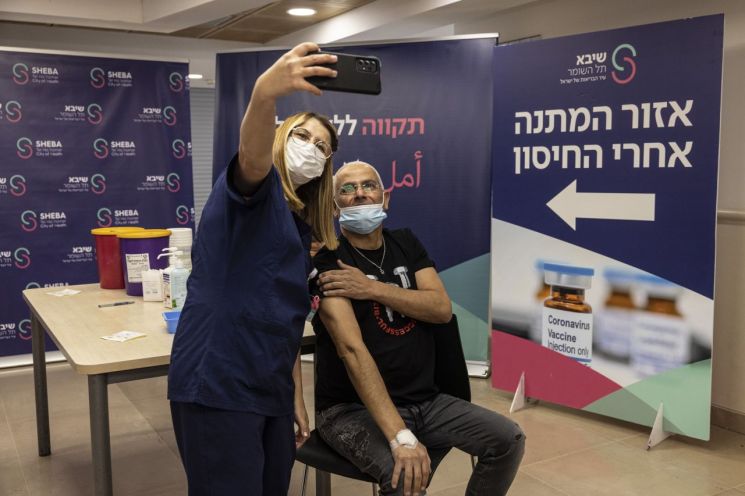 A man is taking a commemorative 'selfie' with a nurse after receiving the fourth dose of the Pfizer COVID-19 vaccine at Sheba Medical Center in Ramat Gan, western Israel.
 [Image source=AP Yonhap News]
The government is currently discussing the fourth dose for immunocompromised individuals following the third dose. Director Jung Eun-kyung of the Korea Disease Control and Prevention Agency explained, "Even after three doses, immunocompromised individuals do not form immunity well," adding, "We are reviewing the fourth dose for immune enhancement purposes with experts and the (Vaccination Expert) Committee." Director Jung also noted that monitoring is ongoing regarding the effectiveness and safety of vaccination in other age groups.
Experts also emphasized the importance of vaccination for children and adolescents. Professor Jung said, "Vaccination for children and adolescents still offers benefits that greatly outweigh the risks of side effects," adding, "The benefits are increasing." He explained, "The frequency of complications that can occur when infected with COVID-19 is observed to be very high in most diseases compared to adverse reactions that may arise from vaccination," and stated, "Given the clear ongoing large-scale spread of Omicron for several months, vaccination is the most beneficial choice from an individual health perspective." Furthermore, he reiterated the need for vaccination to quickly normalize in-person classes to overcome serious educational deficits caused by the COVID-19 pandemic.
Professor Jung also mentioned that the benefits of vaccination outweigh the risks for pregnant women who are delaying vaccination due to concerns about potential side effects on the fetus. He said, "The risk of miscarriage and stillbirth increases when infected with COVID-19," expressing concern that "Pregnant women are likely to have severely weakened immunity due to pregnancy." He also emphasized, "There is currently no evidence of differences in miscarriage and stillbirth rates between vaccinated and unvaccinated individuals."
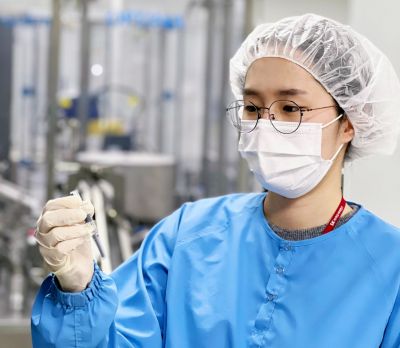 Novavax COVID-19 vaccine 'Nuvaxovid Prefilled Syringe' is being produced at the L House factory of Andong SK Bioscience. (Photo by SK Bioscience)
Meanwhile, the Novavax vaccine, which is gaining attention as a vaccine that may alleviate concerns about adverse reactions after vaccination, is expected to begin administration as early as next month. The Novavax vaccine is developed using a synthetic antigen platform, a traditional vaccine platform different from mRNA (Pfizer, Moderna) or viral vector (AstraZeneca, Janssen) vaccines, and is known to have fewer side effects.
Director Jung said, "The schedule for the initial supply of the vaccine has not been finalized, but it will be supplied in February," adding, "We are preparing the vaccination plan." Currently, SK Bioscience is contract-developing and manufacturing the domestic supply, while authorities are surveying vaccination site demand among contracted medical institutions and conducting training.
However, the Novavax vaccine is currently only permitted for the basic vaccination series where both the first and second doses are Novavax. There are ongoing requests to allow Novavax for 'heterologous vaccination' for incomplete vaccinees who experienced strong adverse reactions in previous doses or for 'additional doses' for second-dose recipients. Director Jung said, "Experts are currently reviewing this, and the (Vaccination Expert) Committee is deliberating," adding, "We will provide guidance as soon as possible."
© The Asia Business Daily(www.asiae.co.kr). All rights reserved.
![User Who Sold Erroneously Deposited Bitcoins to Repay Debt and Fund Entertainment... What Did the Supreme Court Decide in 2021? [Legal Issue Check]](https://cwcontent.asiae.co.kr/asiaresize/183/2026020910431234020_1770601391.png)

















