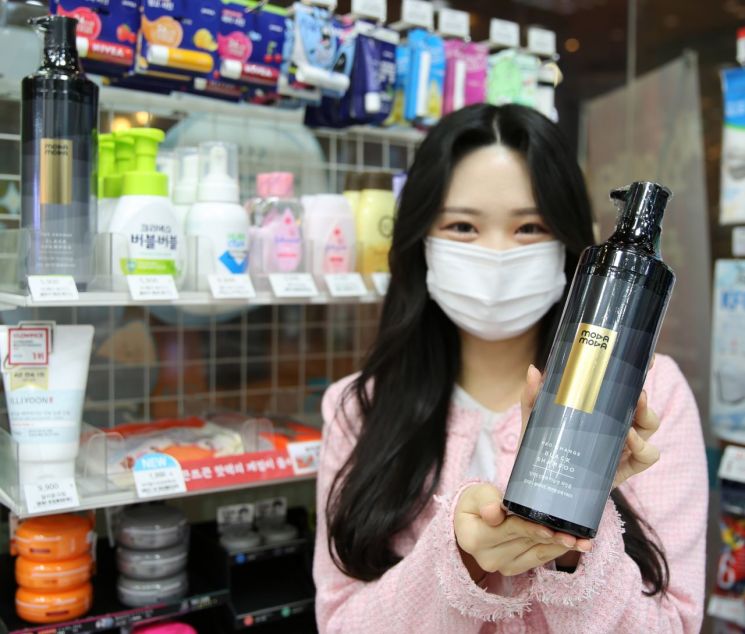
[Asia Economy Reporter Kim Bong-su] Professor Lee Hae-shin of the Department of Chemistry at KAIST, the developer of Modamoda Black Shampoo, which has sparked controversy over excessive regulation of innovative technology, has opposed the Ministry of Food and Drug Safety's ban on ingredient use, saying, "Why kill new technology by listening only to some opinions?"
On the afternoon of the 27th, Professor Lee held an online press conference together with Momamoda CEO Bae Hyung-jin, expressing regret over the Ministry of Food and Drug Safety's announcement the previous day that the ingredient ‘1,2,4-Trihydroxybenzene (THB)’ contained in Modamoda Black Shampoo was designated as a prohibited cosmetic ingredient, and revealed plans for additional genetic toxicity testing of the product.
Professor Lee developed a technology that dyes hair brown simply by shampooing without using hair dye, based on seven years of research on the natural browning effect of polyphenol components inspired by the browning phenomenon of apples. He also commercialized this technology with Modamoda, and since its market launch in August, it has gained tremendous popularity among people suffering from the toxicity of hair dyes, achieving sales of about 20 billion won.
However, controversy arose when the Ministry of Food and Drug Safety recently designated the THB ingredient in Modamoda shampoo as a prohibited cosmetic ingredient, citing a report from the European Union (EU) that the ingredient is harmful to the human body.
In response, Professor Lee stated on the day, "I agree that the Ministry of Food and Drug Safety's decision is intended to protect public safety, but I object to the fact that the basis is limited to the EU report, which was evaluated mainly on hair dyes," adding, "Above all, it is unreasonable to apply the same regulation to Modamoda shampoo, which is the subject of this regulation, without evidence of its harmfulness. It is reasonable to postpone the Ministry of Food and Drug Safety's judgment until the ongoing additional toxicity-related research is completed."
In other words, the THB ingredient, which the Ministry of Food and Drug Safety judged to have potential genetic toxicity concerns, is approved for use in most countries except the EU. It is also known that there was considerable controversy at the expert meeting hosted by the Ministry of Food and Drug Safety on the 18th before concluding to ban this ingredient as a cosmetic raw material.
Professor Park Sung-young of the Department of Chemical and Biological Engineering at Korea National University of Transportation also criticized at the press conference, saying, "From the perspective of regulatory science, chemical products with various functions such as dyeing can inherently have harmfulness, but the risk to the human body can vary depending on the environment in which they are used," and added, "It is reasonable for the Ministry of Food and Drug Safety to additionally verify the risk according to the environment in which the regulated product is used by people and set standards such as content to balance user convenience and safety."
Meanwhile, the Ministry of Science and ICT also stated at a meeting hosted by Minister Lim Hye-sook on the same day, "It is regrettable that innovative technology is being discarded due to regulation," and announced plans to establish measures such as involving regulatory agencies from the research and development stage to pre-check for any conflicts.
© The Asia Business Daily(www.asiae.co.kr). All rights reserved.
![User Who Sold Erroneously Deposited Bitcoins to Repay Debt and Fund Entertainment... What Did the Supreme Court Decide in 2021? [Legal Issue Check]](https://cwcontent.asiae.co.kr/asiaresize/183/2026020910431234020_1770601391.png)















