January 27 Morning New Year Press Conference
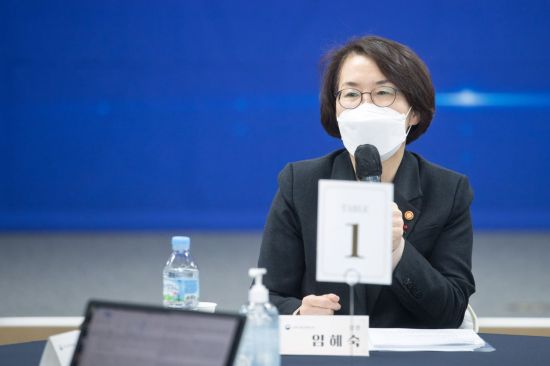
[Asia Economy Reporter Kim Bong-su] Minister Lim Hye-sook of the Ministry of Science and ICT responded to controversies surrounding K-quarantine, such as the argument that COVID-19 vaccines are ineffective, by saying, "I think we need to improve policy communication." Regarding the discussion on establishing a Deputy Prime Minister for Science and ICT, she expressed a positive stance, stating, "It would guarantee much stronger policy driving force." She also hinted at the possibility of postponing the second Nuri rocket launch scheduled for May and emphasized that the newly promoted aerospace specialized agency should be placed under the Ministry of Science and ICT.
Minister Lim made these remarks during a New Year's press briefing held on the morning of the 27th at the Ministry of Science and ICT building in Sejong City. When asked about her position as the head of national science and technology policy amid rising vaccine anxiety due to the emergence of the Omicron variant, she said, "The Korean people have a very high level of trust in government policies, which results in a high vaccination rate," and added, "I believe that concerns from some quarters can be resolved by strengthening policy communication."
Regarding the Nuri rocket launch plan in May, she explained, "The investigation results on the cause of the failure to enter satellite orbit during the first launch last October have been released, and we are currently carrying out technical improvements. Appropriateness evaluations and simulations are necessary," adding, "We will launch within this year, but I cannot say for sure that it will be exactly in May."
On the recent controversy over excessive regulation of innovative technology, specifically the 'Modamoda Shampoo' issue raised by Professor Lee Hae-shin of KAIST, she said, "The Ministry of Food and Drug Safety is making judgments based on scientific evidence," expressing regret that technology is being stifled due to regulations. She added, "We plan to pilot a system where regulatory agencies participate from the research and development stage to provide consulting and make preemptive improvements."
Regarding overlapping duties with the Korea Communications Commission, she said, "I was very confused at first as well," and stated, "Personally, I think working together is fine. However, having both promotion and regulation duties within one ministry can cause difficult issues," showing a reserved stance.
She emphasized that the space-dedicated agency should be established within the Ministry of Science and ICT. Minister Lim said, "The Ministry of Science and ICT has been effectively managing major space-related tasks and leading cooperation with related ministries," and argued, "To emphasize domestically and internationally that space is being used peacefully from the perspective of new technology development rather than national security, the newly established organization should be led by the Ministry of Science and ICT."
Regarding the recent claim by Yeom Han-woong, Vice Chairman of the National Science and Technology Advisory Council, who argued that the designation of 'national essential strategic technologies' should be entrusted to the private sector, she countered, "The top 10 strategic technologies include important elements related to supply chains, trade, and national security, so the government's role is crucial in this era of technological hegemony competition," adding, "National efforts to solve social problems are naturally underway, and I hope this is understood as an intention to take a closer look at essential strategic technologies."
On the development of Small Modular Reactors (SMR), she said, "Korea possesses highly competitive technology, and SMRs have advantages such as safety and flexibility that large nuclear power plants do not have," and, as a personal opinion, added, "I think they can be utilized domestically as well as for overseas exports."
Regarding delays in the heavy ion accelerator project, she explained, "Commissioning will begin in September this year, and researchers will be able to use beam extraction in 2024," and asked for understanding, saying, "It is a difficult and new technology worldwide, so trial and error is inevitable."
Minister Lim also expressed her desire to successfully conclude her remaining term of about three months by properly implementing policies to foster national essential strategic technologies and support young scientists and engineers. She said, "Once I actually joined the ministry, it was much more positive," adding, "It was very rewarding and positive to see ideas being realized after proposing them."
© The Asia Business Daily(www.asiae.co.kr). All rights reserved.