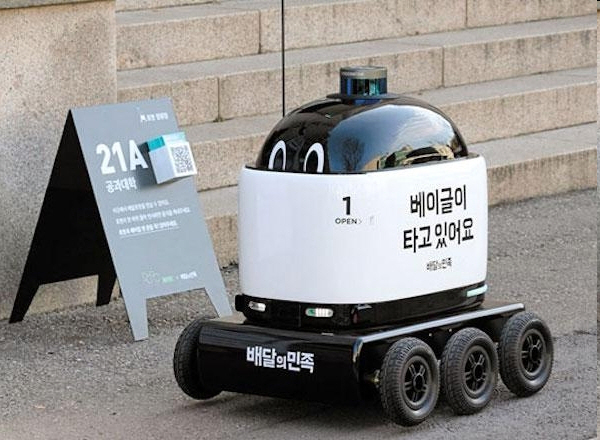
[Asia Economy (Daejeon) Reporter Jeong Il-woong] As logistics has established itself as one of the core competencies of companies, the logistics robot market is also expanding. Market research and analysis firm ABI Research has projected that by 2030, the global logistics warehouse robot market will exceed 60 trillion won.
In line with this market trend, patent applications related to logistics robots are rapidly increasing. This is interpreted as a reflection of companies' strategies to enhance competitiveness in the logistics market through patents.
According to the Korean Intellectual Property Office on the 27th, patent applications related to logistics robots have recorded an average annual growth rate of 29% between 2016 and 2020.
By robot type, logistics warehouse pick-up and loading robots accounted for 118 cases (50.4%), and unmanned delivery robots accounted for 116 cases (49.6%), making up the majority.
In particular, the unmanned delivery robot sector has shown an increasing trend with patent applications growing by 67% annually since 2018.
This is analyzed to be due to the expansion of contactless services and the growing demand for unmanned delivery in logistics sites, leading to active development of unmanned delivery technologies combining autonomous driving and artificial intelligence technologies within the industry.
Above all, recently, multifunctional robots that not only simply pick up and transport goods but also sort and package them have been emerging one after another, indicating fierce competition in logistics robot technology development within the industry.
Domestic patent applications related to logistics robots are divided into 78% by nationals and 22% by foreigners. Among domestic applicants, small and medium-sized enterprises (SMEs) accounted for 32% (76 cases), large corporations 22% (52 cases), universities and research institutes 15% (66 cases), and individuals 8% (19 cases), in that order.
Notably, while patent applications related to logistics robots by large corporations have recently slowed, applications by SMEs are increasing. Since 2018, patent applications related to logistics robots by SMEs have shown an average annual growth rate of 90%.
In particular, the increase in patent applications related to unmanned delivery robots by SMEs suggests that the industry is focusing on technology development in the unmanned delivery field.
Lee Seong-hyun, an examiner at the Intelligent Robot Examination Division of the Korean Intellectual Property Office, said, “In the logistics robot industry, the trend of expanding growth through technological convergence (multifunctionality) is clear. If large corporations focus on front-end logistics technologies such as packaging, sorting, and loading, and SMEs focus on final-stage logistics technologies such as delivery to secure related patents, it is expected that the competitiveness of our companies in the logistics robot market will be further enhanced.”
© The Asia Business Daily(www.asiae.co.kr). All rights reserved.

















