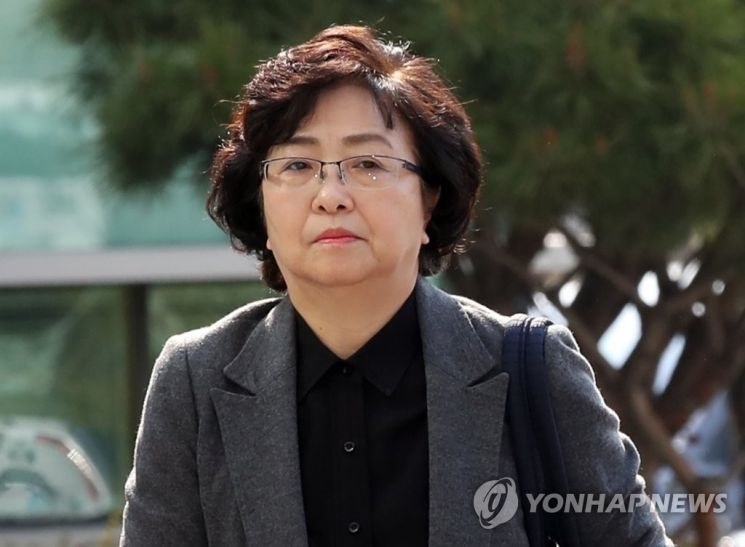
[Asia Economy Reporter Choi Seok-jin, Legal Affairs Specialist] The conviction of former Environment Minister Kim Eun-kyung, who was prosecuted on charges related to the so-called 'Ministry of Environment Blacklist,' has been finalized.
On the 27th, the Supreme Court's 3rd Division (Presiding Justice Ahn Cheol-sang) upheld the lower court's ruling sentencing former Minister Kim to two years in prison on charges including abuse of authority and obstruction of the exercise of rights.
Shin Mi-sook, former Blue House Secretary for Balanced Personnel Affairs, who was tried alongside Kim, also had her sentence of one year in prison with a three-year probation confirmed.
The court stated the reason for dismissing the appeals from both the prosecution and the defendants, explaining that "there were no errors such as violating the rules of logic and experience, exceeding the limits of free evaluation of evidence, misinterpretation of the law regarding the establishment of abuse of authority and obstruction of rights, omission of judgment, or contradictory reasoning in the lower court's decision."
Both individuals were prosecuted on charges of forcing resignations from executives of public institutions under the Ministry of Environment appointed during the Park Geun-hye administration in 2017-2018, and then placing individuals selected by the Blue House or the Ministry of Environment in the vacant positions.
The first trial court recognized a significant portion of the charges as guilty, sentencing former Minister Kim to two years and six months in prison and ordering her detention in court. Former Secretary Shin was sentenced to one year and six months in prison with a three-year probation.
In the appeal trial, the court considered that some of the public institution executives were at the end of their terms at the time, so even if the Ministry of Environment accepted their resignations and began appointing successors, it could not be regarded as abuse of authority. Consequently, former Minister Kim's sentence was reduced to two years in prison. Former Secretary Shin's sentence was also reduced to one year in prison with a three-year probation.
Of the 13 executives whom the prosecution believed were forced to resign, the first trial court found 12 guilty, but the appellate court recognized only four of these cases.
Additionally, in the appeal trial, some charges of obstruction of business and abuse of authority that were recognized as guilty in the first trial were overturned to not guilty.
The Supreme Court upheld these appellate court decisions.
© The Asia Business Daily(www.asiae.co.kr). All rights reserved.
![User Who Sold Erroneously Deposited Bitcoins to Repay Debt and Fund Entertainment... What Did the Supreme Court Decide in 2021? [Legal Issue Check]](https://cwcontent.asiae.co.kr/asiaresize/183/2026020910431234020_1770601391.png)















