If 500,000 Won Given to All Citizens, 25 Trillion Won
Lee Proposes Support for Youth and Middle-aged
Exceeding 'Basic Income 250,000 Won'
Yoon Counters with Parental Allowance, etc.
Including Supplementary Budget and Indirect Costs,
Even Giving 1 Million Won Per Person Leaves Surplus
Effectiveness Debate Only Intensifies
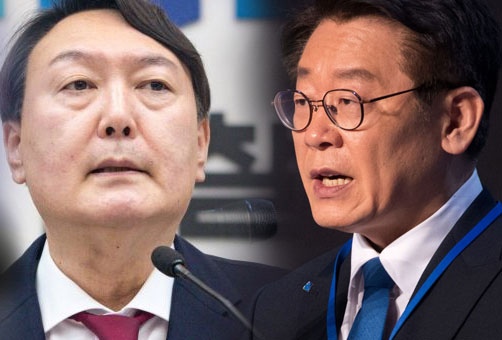
[Asia Economy Reporter Oh Ju-yeon] When comparing the cash support pledges made so far by Lee Jae-myung, the Democratic Party presidential candidate, and Yoon Seok-youl, the People Power Party presidential candidate, the total amount has already grown large enough to give tens of thousands of won to every citizen nationwide with money left over. To avoid criticism of "universal handouts," both candidates have presented detailed pledges by age and occupation, but the total sum has grown to a level that could support the entire population. As a result of the excessive issuance of populist pledges, it is pointed out that this is no different from giving 500,000 won or 1,000,000 won per person, and it is expected to fuel controversy over effectiveness.
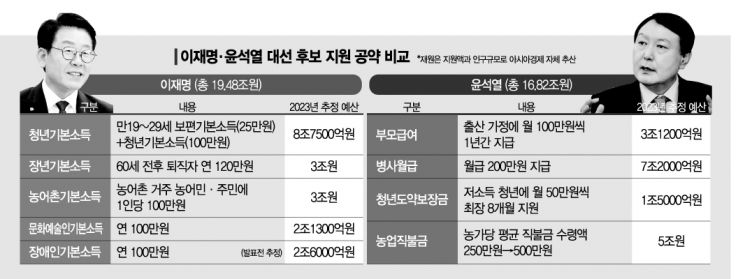
On the 27th, Asia Economy compiled and calculated only the major income support pledges announced by the candidates of the two parties. It was found that Candidate Lee requires a budget of about 19.48 trillion won, while Candidate Yoon requires about 16.82 trillion won. Regarding Lee’s core pledge of "universal basic income," he said at the end of last year, "I will not insist if the people do not want it," but in a broadcast earlier this year, he said, "I plan to provide 250,000 won annually," leading to criticism of inconsistency. Even excluding the nationwide 250,000 won support, the already announced partial basic incomes for youth, middle-aged, rural residents, and cultural artists are expected to require about 16.88 trillion won. A basic income announcement for the disabled is also planned, and if 1,000,000 won is given to the disabled, an additional 2 trillion won will be added. This alone exceeds the scale of the nationwide 250,000 won payment. Candidate Yoon has also countered with cash support pledges including parental benefits of 1,000,000 won per month for one year for families with newborns, increases in soldiers’ monthly pay, youth leap guarantee funds, and increases in agricultural direct payments.
The key point is that these figures exclude indirect costs such as supplementary budgets (supplementary budgets) ranging from 35 trillion to 50 trillion won for COVID-19 small business and self-employed damage support, as well as various government support policies. Including these numbers, both candidates would easily exceed 100 trillion won, enough to give every citizen 1,000,000 won (51.6 trillion won) per person with money left over.
Experts interpret the reason both candidates deliberately divided the cash support plans, which could have been given to all citizens from the start, into smaller parts as an attempt to target specific partial voter bases. Looking at their support targets, it is understood that both place particular emphasis on the "youth" demographic.
Candidate Lee promised to provide an additional 1,000,000 won annually from 2023 to youth aged 19 to 29 (about 7 million people) beyond the universal basic income. This means that youth would receive a total basic income of 22 million won over 11 years starting at age 19. The budget for next year is estimated at 8.75 trillion won. This is about three times the size of the "middle-aged basic income," which provides 1.2 million won annually to retirees around age 60.
Candidate Yoon also announced a pledge to raise soldiers’ monthly pay to 2 million won. Along with this, the "Youth Leap Guarantee Fund," which provides up to 500,000 won monthly for up to 8 months to low-income youth, totals about 8.7 trillion won, similar in scale to Candidate Lee’s youth basic income.
Professor Park Sang-byeong of Inha University said, "Both candidates agree on the need for cash support," adding, "Among them, it is interpreted that they see it as appropriate to select and focus support on the youth, who are the most vulnerable generation." He analyzed, "Their anger was especially evident in the April by-elections last year, so they are paying particular attention."
© The Asia Business Daily(www.asiae.co.kr). All rights reserved.


















