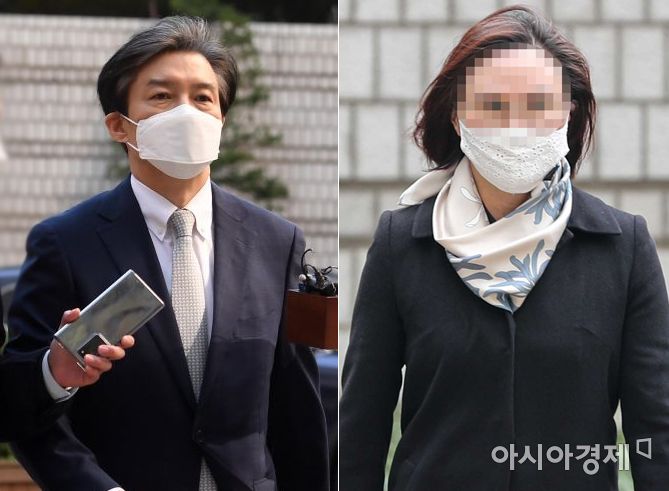
 Former Minister of Justice Cho Kuk and former Dongyang University professor Jung Kyung-shim (from left).
[Asia Economy Reporter Choi Seok-jin, Legal Affairs Specialist] The Supreme Court’s recognition on the 27th of the evidentiary validity of electronic information extracted from the PC in the Dongyang University instructors’ lounge is expected to have a direct impact on the trial of former Minister of Justice Cho Kuk, who was indicted on the same charges as former Dongyang University professor Jeong Gyeong-sim for obstruction of business and other offenses.
Initially, former Chief Judge Kim Mi-ri, who was in charge of Professor Jeong’s trial, refused to consolidate the additional indictment filed by the prosecution, so the remaining charges against Professor Jeong and the case against Cho Kuk are being tried separately under the Criminal Division 21-1 of the Seoul Central District Court (Presiding Judges Ma Seong-young, Kim Sang-yeon, Jang Yong-beom).
On the 24th of last month, the court cited a recent Supreme Court plenary session ruling that “even when investigative agencies receive evidence voluntarily submitted by a third party, appropriate measures must be taken to guarantee the procedural rights of the suspect, including ensuring the suspect’s right to participate and providing a list of seized electronic information,” and declared it would not recognize the evidentiary validity of the PC in the instructors’ lounge and other evidence related to Professor Jeong. The prosecution strongly opposed this and even filed a motion to disqualify the judges.
However, as the Supreme Court ruled on this day that there were no issues with the PC seizure procedures or the information extraction process, it is expected that the first trial court handling Cho Kuk’s case will also be affected.
The Supreme Court confirmed that during the prosecution’s seizure process, the teaching assistant who stored and managed the PC and the head of the administrative support office responsible for Dongyang University’s asset management were asked about their intention to participate and given the opportunity, but since they voluntarily declined, there was no procedural defect in failing to guarantee the suspect’s right to participate in the seizure procedures for the electronic information extracted from each PC in this case.
Furthermore, the Supreme Court concluded that since the PCs had been stored in the instructors’ lounge for nearly three years at the time of seizure, under the premise that Dongyang University personnel would use them as shared PCs or dispose of them by other means, even applying the legal principles from the previous Supreme Court plenary ruling, this case does not require guaranteeing Professor Jeong’s right to participate.
The court reasoned that the exclusive management and disposal rights over the PCs had already been transferred or abandoned to a third party, and merely being the subject of the information does not qualify one as a substantive party to the seizure and search.
Cho Kuk is accused of fabricating and submitting false supporting documents during his daughter Cho Min’s (30) application process to Seoul National University College of Medicine (charges include obstruction of official duties by deception, use of forged official documents, and use of falsely prepared official documents).
Specifically, the prosecution alleges that he conspired with former Professor Jeong to fabricate and submit false internship certificates from the Seoul National University Public Interest Human Rights Law Center, a certificate of completion and internship certificate from the Aqua Palace Hotel in Busan, and altered an internship certificate from the Korea Institute of Science and Technology (KIST) Molecular Recognition Research Center.
Previously, the appellate court in Professor Jeong’s case recognized the conspiracy with Cho Kuk regarding these charges, and the Supreme Court upheld this ruling on this day.
Additionally, Cho Kuk is also accused of conspiring with Professor Jeong to instruct the concealment of evidence related to materials stored at his home and office. Since the Supreme Court maintained the lower court’s guilty verdict, the likelihood of Cho Kuk being found guilty has increased.
Recently, Cho Min applied alone for an additional residency position in the Emergency Medicine Department at Gyeongsang National University Hospital located in Jinju, Gyeongnam, but was not accepted. Following her repeated failures in residency selections, some supporters of Cho Kuk suggested, “Let’s raise funds to establish a hospital and become shareholders,” but Cho Kuk expressed gratitude while requesting that the proposal be withdrawn.
© The Asia Business Daily(www.asiae.co.kr). All rights reserved.
![User Who Sold Erroneously Deposited Bitcoins to Repay Debt and Fund Entertainment... What Did the Supreme Court Decide in 2021? [Legal Issue Check]](https://cwcontent.asiae.co.kr/asiaresize/183/2026020910431234020_1770601391.png)















