Imaging Radar Developer 'Zenda'
Secures Next-Generation High-Performance Sensor Technology
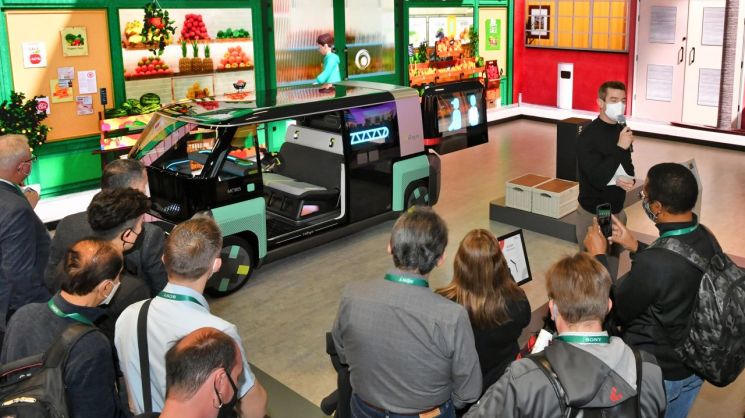 At the recently held 2022 CES, visitors are viewing the Hyundai Mobis autonomous driving concept car, M.Vision Tugo.
 [Asia Economy Reporter Choi Dae-yeol] Hyundai Mobis is entering the next-generation radar development business to accelerate fully autonomous driving.
Hyundai Mobis announced on the 27th that it has invested $4 million in the U.S. software company Zenda. This startup specializes in developing imaging radar, a core technology for autonomous vehicles. This is the first time the company has received investment at the corporate level.
With this investment, Hyundai Mobis expects to secure next-generation high-performance radar sensor technology capable of implementing Level 4 autonomous driving, where the driver does not intervene in the system.
The three core technologies of autonomous driving are perception, decision-making, and control. Imaging radar is related to the perception stage, where the vehicle recognizes external conditions. The imaging radar Hyundai Mobis aims to develop this time is a next-generation radar differentiated from existing ones, characterized by integrating data obtained from radars located at the front, rear, and corners of the vehicle through a central processing unit (ECU) to produce high-resolution images.
Unlike electromagnetic wave-based radar, the company expects this technology to contribute to the popularization of autonomous driving by offering performance comparable to laser-based sensors like LiDAR while maintaining a reasonable price range. Zenda, founded in 2017 by engineers from UC Berkeley, is recognized for its technological capabilities based on its proprietary radar fusion algorithm.
Hyundai Mobis plans to refine the technology by combining Zenda's integrated signal processing radar fusion technology with its own hardware design and software integration development capabilities. The company anticipates that imaging radar can be applied not only to automobiles but also to various industries such as heavy equipment like tractors and excavators, as well as robotics. According to market research firm Yole D?veloppement, while the automotive sensor market is expected to grow at an average annual rate of over 19% until 2025, the imaging radar market is projected to expand by more than 124%.
Kim Young-bin, Head of Planning at Hyundai Mobis, said, "We will continue to enhance our status as a leading mobility platform company by developing proprietary technologies and collaborating with global companies possessing diverse core technologies to combine software and hardware."
© The Asia Business Daily(www.asiae.co.kr). All rights reserved.
![User Who Sold Erroneously Deposited Bitcoins to Repay Debt and Fund Entertainment... What Did the Supreme Court Decide in 2021? [Legal Issue Check]](https://cwcontent.asiae.co.kr/asiaresize/183/2026020910431234020_1770601391.png)
















