Clear Impact After Minimum Wage Surge... Moon Jae-in Government Labor Policy Backfire
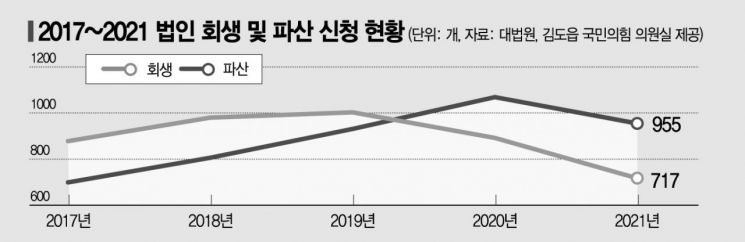
[Asia Economy Reporter Hyunju Lee, Sejong=Reporter Sunhee Son] The phenomenon of a 'dead cross,' where corporate bankruptcy filings exceed rehabilitation applications, has occurred for two consecutive years. This is interpreted to mean that companies facing crises are giving up their businesses entirely rather than going through rehabilitation procedures such as court management. In particular, the fact that the dead cross phenomenon appeared after the sharp rise in the minimum wage has led to criticism that the Moon Jae-in administration's labor policies are driving companies into a corner.
According to data on corporate rehabilitation and bankruptcy status submitted by the Supreme Court to Kim Do-eup, a member of the National Assembly's Legislation and Judiciary Committee from the People Power Party, the number of corporate bankruptcy filings last year was 955, surpassing the 717 rehabilitation applications. This is the second consecutive year that the number of bankruptcy filings exceeded rehabilitation applications since 2020, when bankruptcy filings reached 1,069, exceeding rehabilitation applications at 892.
Since the implementation of the Integrated Insolvency Act in 2007, the number of rehabilitation applications exceeded bankruptcy filings until 2019. Even in 2009, right after the financial crisis, corporate rehabilitation applications numbered 699, about three times higher than the 266 bankruptcies. However, since the start of the Moon Jae-in administration in 2017, the gap between corporate rehabilitation and bankruptcy has rapidly narrowed.
Experts diagnose that the business environment is gradually deteriorating due to regulatory tightening, including the government's implementation of minimum wage increases, the introduction of the 52-hour workweek, increased selling and administrative expenses, and stricter loan maturity extension requirements. The Moon Jae-in administration raised the minimum wage by more than 25% over 2018 and 2019, with the burden on small and medium-sized enterprises becoming apparent from 2020. Regarding the 52-hour workweek, it applied only to companies with 50 to fewer than 300 employees until 2020, but since July last year, it has been implemented across all companies except those with fewer than five employees.
Professor Kang Sung-jin of Korea University’s Department of Economics said, "Large corporations were hardly affected by the 52-hour workweek system or the minimum wage," adding, "It should be seen that mainly small and medium-sized enterprises faced difficulties as they became subject to these regulations." He continued, "With the rapid increase in the minimum wage, some self-employed people were running businesses without even covering their labor costs, and it seems that such companies were mainly hit."
Professor Kim Tae-gi of Dankook University’s Department of Economics explained, "The increase in bankruptcies indicates that companies see their future as bleak, which is evidence that the fundamentals of the Korean economy are weakening," adding, "Under the current atmosphere, including minimum wage hikes, working hours, and the Serious Accident Punishment Act, small and medium-sized enterprises simply cannot survive." Professor Kim also said, "It is hard to view the dead cross phenomenon occurring for two consecutive years as a coincidence," interpreting it as "statistics showing that the entire Korean economy seems to be collapsing."
Considering that countries around the world are raising benchmark interest rates this year, the burden felt by small and medium-sized enterprises is expected to increase further. Representative Kim pointed out that although some macroeconomic indicators recently showed high figures, the domestic and international conditions surrounding Korean companies remain more challenging this year. He said, "Last year's 4% economic growth appears relatively high due to the base effect from the negative growth in 2020," adding, "Companies driving the economy are losing hope for recovery as they can no longer endure."
© The Asia Business Daily(www.asiae.co.kr). All rights reserved.