Financial Security Institute Publishes Analysis Report on Voice Phishing Malicious App Distribution Organizations
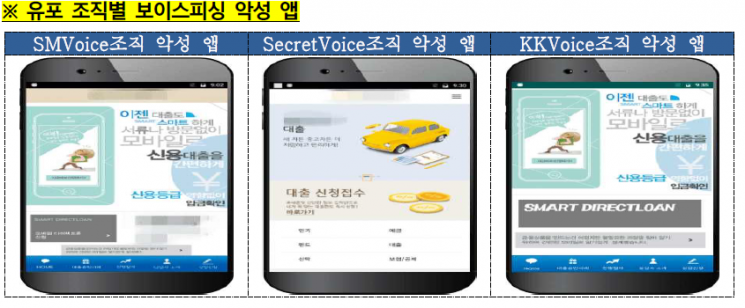 Top 3 Distribution Organizations' Malicious Application (App) Screens (Provided by Financial Security Institute)
[Asia Economy Reporter Minwoo Lee] It has been revealed that 92% of malicious voice phishing applications (apps), which manipulate users' smartphone cameras to take and send photos or disguise voice phishing calls as financial institutions, were distributed by three organizations.
The Financial Security Institute announced on the 27th that it published a report titled "Profiling of Voice Phishing Malicious App Distribution Organizations," containing these investigation details.
According to the report, the Financial Security Institute detected a total of 15,581 distribution activities from January to September last year and collected 4,945 malicious apps (excluding duplicates). The investigation revealed that 92% of the malicious apps and 87% of the distribution activities were created and distributed by three specific organizations.
The malicious app functions distributed by these groups have recently become more sophisticated. They not only intercept calls made by victims to the Financial Supervisory Service, police, or financial companies and connect them to fraudsters but also include features such as ▲ controlling the victim's smartphone to capture and transmit real-time footage ▲ disguising voice phishing organization calls as financial institutions.
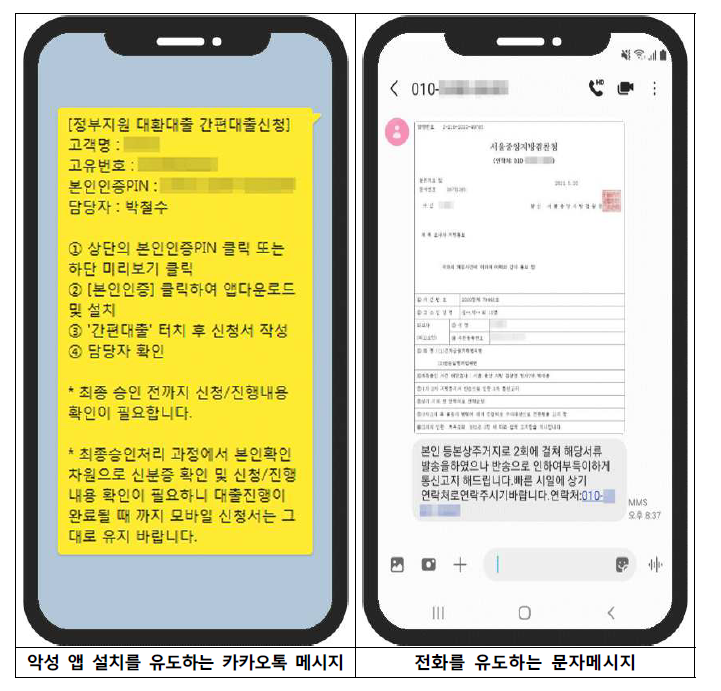 Cases of Malicious Voice Phishing Application (App) Installation Inducement (Provided by Financial Security Institute)
Meanwhile, voice phishing organizations typically induce victims to access fake financial company websites through text messages or KakaoTalk messages, then trick them into installing malicious apps by pretending to fill out application forms or request loan consultations. They also send messages urging victims to contact them, instructing them to install malicious apps under the pretext of loan applications or cooperation with investigations.
The full report containing these details can be found in the Data Room section on the Financial Security Institute's website. A representative from the Financial Security Institute advised, "If a malicious app is installed on a smartphone and data communication is possible, personal information such as real-time video footage and phone numbers can continuously be leaked," adding, "If you have installed or suspect the installation of a malicious app, it is necessary to promptly disable Wi-Fi or mobile data."
© The Asia Business Daily(www.asiae.co.kr). All rights reserved.