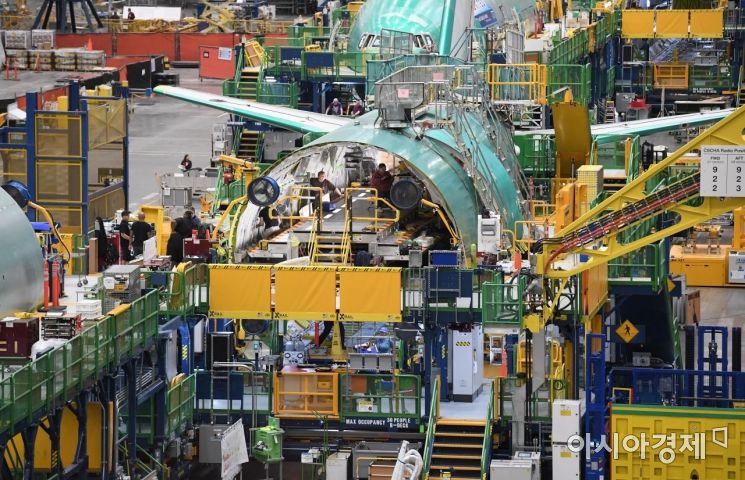
 On the 6th (local time), a 777 model is being assembled on the production line at the Boeing Factory in Everett, Washington, USA. / Everett (USA) Photo by Hyunmin Kim kimhyun81@
[Asia Economy Reporter Yujin Cho] Boeing, the largest aircraft manufacturer in the United States, has posted losses for three consecutive years due to manufacturing defects in its main models and the impact of the COVID-19 pandemic.
On the 26th (local time), Boeing announced in its earnings report that it recorded a net loss of $4.29 billion last year. Although this is a significant reduction compared to the previous year ($11.941 billion), it fell far short of market expectations.
Boeing has been posting losses for three consecutive years since 2019, when its flagship model, the 737 Max, was grounded worldwide following two fatal crashes.
During the same period, revenue increased by 7% to $62.286 billion compared to $58.158 billion the previous year.
In the fourth quarter alone, revenue was $14.793 billion, down 3% year-on-year, with a net loss of $4.164 billion. Both revenue and net loss were well below market expectations.
The concentrated losses in the fourth quarter were due to a $3.5 billion charge related to compensation for delivery delays caused by manufacturing defects.
Boeing is facing its greatest crisis since its founding due to manufacturing defects in its main models, the 737 Max and 787 Dreamliner, and the sharp decline in air passenger demand caused by the COVID-19 pandemic.
Thanks to the resumption of operations of the 737 Max, which had been grounded following consecutive crashes, Boeing doubled its deliveries to 340 units last year compared to 157 units the previous year, but still lost the top spot to Airbus for the third consecutive year.
Boeing's 787 Dreamliner deliveries plummeted from 53 units in the previous year to 14 units last year after deliveries were halted in May due to manufacturing quality defects, and no units have been delivered since June.
This year's performance outlook depends on whether Chinese airlines officially resume commercial operations of Boeing models. Chinese airlines have the second-largest fleet of 737 Max aircraft after U.S. airlines. Currently, 13 Chinese airlines operate a total of 97 737 Max aircraft.
Brian West, Boeing's Chief Financial Officer (CFO), said during a conference call after the earnings announcement, "We expect aircraft deliveries to Chinese airlines to resume as early as the first quarter of this year," adding, "This will lead to cash flow generation and contribute to financial improvement."
However, the outlook for recovery in air passenger demand, which was devastated by the pandemic, is not optimistic. Dave Calhoun, Boeing's Chief Executive Officer (CEO), forecasted, "Passenger traffic will only return to pre-pandemic levels by next year or 2024."
© The Asia Business Daily(www.asiae.co.kr). All rights reserved.