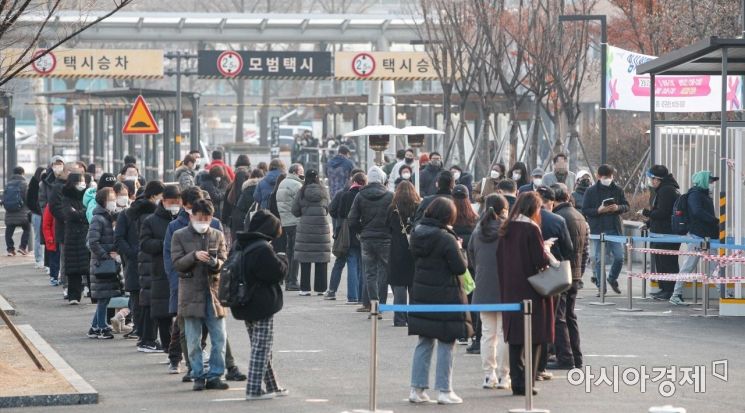
 On the 26th, when 13,012 new COVID-19 cases were reported, an increase of 4,400 cases in just one day, citizens lined up to get tested at a temporary screening clinic set up near the Express Bus Terminal Station in Seocho-gu, Seoul. Photo by Jinhyung Kang aymsdream@
[Asia Economy Reporter Lee Gwan-joo] The medical community has expressed concerns over the quarantine authorities' plan to expand self-administered antigen testing for asymptomatic COVID-19 screening. This is due to the high possibility of 'false negatives' with the antigen test method, which has low sensitivity, potentially leading to further spread of the infection.
On the 26th, the Korean Society for Laboratory Medicine issued a statement saying, "We express serious concerns about the government's plan to implement self-administered antigen testing for asymptomatic individuals," and added, "At this time, when confirmed cases are surging, more active use of highly sensitive polymerase chain reaction (PCR) tests and expansion of antigen tests conducted directly by medical professionals are necessary."
The society pointed out that the sensitivity of rapid antigen tests is below 50% even when performed by medical professionals, and less than 20% when self-administered. Rapid antigen tests require 1,000 to 10,000 times more viral shedding compared to PCR tests to detect the COVID-19 virus.
The society stated, "In the early stage of infection, the sensitivity of antigen tests is very low, and sensitivity is high only when antigen tests are used within one week from the onset of symptoms when a large amount of virus is shed," adding, "If rapid antigen tests are fully introduced for asymptomatic individuals, early-stage infected patients are likely to receive false negative results, making it impossible to isolate false negative patients and thereby increasing the risk of infection spread."
As an alternative to self-administered antigen testing for asymptomatic individuals, the society proposed a strategy based on PCR testing and antigen tests conducted by medical professionals. They suggested actively using PCR tests while capacity allows and urged the government to consult experts to adopt methods that can maximize the expansion of highly accurate PCR testing. Specifically, they mentioned ▲ rapid approval of large-scale automated PCR equipment by the Ministry of Food and Drug Safety ▲ use of oropharyngeal swab specimens, which are less uncomfortable than nasopharyngeal swabs ▲ reallocating personnel and resources from non-essential tests to COVID-19 PCR testing.
They also recommended that when the scale of the outbreak grows, more accurate testing methods should be implemented first, followed by consideration of less accurate methods in stages. They emphasized that thorough quarantine measures must precede the introduction of self-administered antigen tests for asymptomatic individuals.
The society concluded, "Despite the potential to further increase diagnostic testing capacity, we express serious concerns about the government's announcement to fully introduce self-administered antigen tests at this time, contrary to expert opinions," and added, "We urge the government to closely communicate with diagnostic testing experts to wisely overcome the surge in COVID-19 confirmed cases."
© The Asia Business Daily(www.asiae.co.kr). All rights reserved.
![User Who Sold Erroneously Deposited Bitcoins to Repay Debt and Fund Entertainment... What Did the Supreme Court Decide in 2021? [Legal Issue Check]](https://cwcontent.asiae.co.kr/asiaresize/183/2026020910431234020_1770601391.png)















