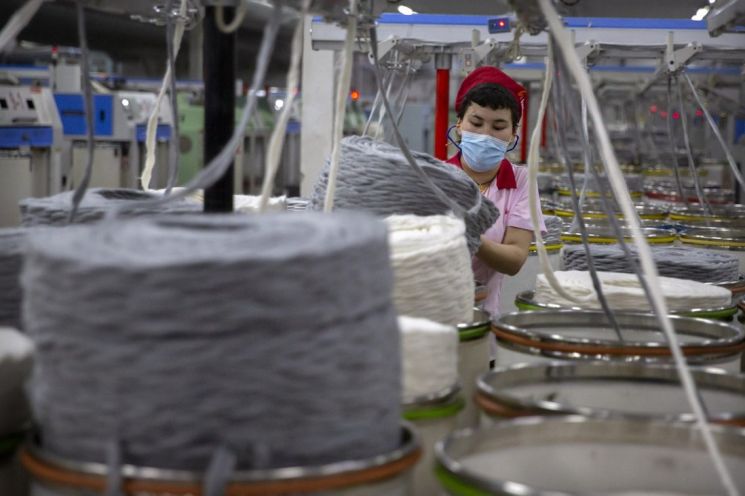
 A worker is collecting cotton yarn at a textile factory in the Xinjiang region of China. (Photo by AP News)
[Asia Economy Reporter Yujin Cho] Thirty-five hardline lawmakers from the UK, the European Union (EU), Australia, Canada, and other countries, forming the Inter-Parliamentary Alliance on China (IPAC), have urged their respective governments to create blacklists of companies involved in human rights abuses against the Uyghur population in Xinjiang, China.
According to the South China Morning Post (SCMP) on the 26th, IPAC members recently sent letters to their governments requesting legislation to prohibit investments in companies implicated in human rights violations in Xinjiang.
Reinhard B?tikofer, a German Green Party member and co-chair of IPAC, stated, "We cannot ignore the role that major banks play in financing abuses occurring in Xinjiang," adding, "It is right to hold accountable those who invest in companies engaged in forced labor and other human rights violations."
SCMP reported that IPAC lawmakers took this action following a report by the UK Sunday Times that HSBC, headquartered in the UK, manages investments in Xinjiang Tianye, a subsidiary of the paramilitary Xinjiang Production and Construction Corps (XPCC). XPCC is subject to U.S. sanctions.
In response, HSBC denied the claims, stating, "We have not invested in Xinjiang Tianye," and added, "We provide stock and investment management services for non-U.S. clients who wish to transact with Xinjiang Tianye. This does not violate any sanctions."
More than a dozen UK lawmakers also urged British Prime Minister Boris Johnson to establish a blacklist of investments related to human rights abuses in Xinjiang.
In letters sent to their governments and the EU Commission, these lawmakers called for the creation of a corporate blacklist similar to that established by the U.S. Department of Commerce.
In June last year, the U.S. Department of Commerce placed five Chinese companies involved in human rights abuses against the Uyghurs in Xinjiang on its export restriction list and banned U.S. citizens from investing in Chinese companies suspected of involvement in Xinjiang human rights abuses or linked to the Chinese military.
Subsequently, last month, U.S. President Joe Biden signed the Uyghur Forced Labor Prevention Act, which generally prohibits the import of goods produced in the Xinjiang region.
© The Asia Business Daily(www.asiae.co.kr). All rights reserved.
![User Who Sold Erroneously Deposited Bitcoins to Repay Debt and Fund Entertainment... What Did the Supreme Court Decide in 2021? [Legal Issue Check]](https://cwcontent.asiae.co.kr/asiaresize/183/2026020910431234020_1770601391.png)















