From February 3, Transition to 'Omicron Response System'
If Not in 'Priority Testing Group', Start with Rapid Antigen Test
Distribution of Self-Test Kits at Screening Clinics from the 29th
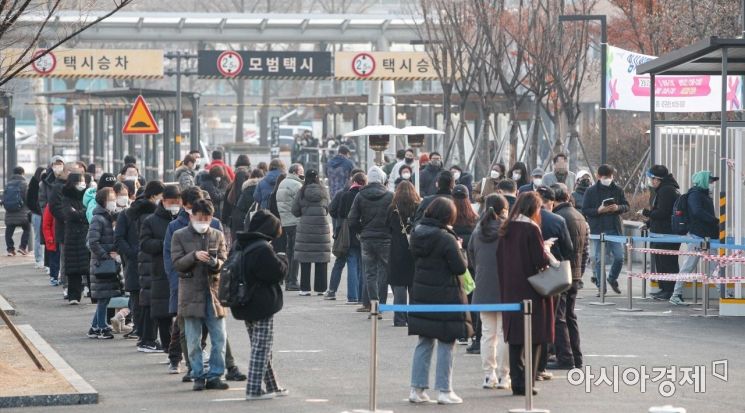 On the 26th, when 13,012 new COVID-19 cases were reported, an increase of about 4,400 cases in one day, citizens lined up to get tested at a temporary screening clinic set up near the Express Bus Terminal Station in Seocho-gu, Seoul. Photo by Jinhyung Kang aymsdream@
[Asia Economy Reporter Lee Chun-hee] Starting from the 3rd of next month, individuals aged 60 and above, epidemiologically related persons, and others who do not fall under these categories will no longer be able to receive polymerase chain reaction (PCR) tests even if they visit screening clinics.
Son Young-rae, head of the Social Strategy Division at the Central Disaster and Safety Countermeasures Headquarters, stated during the regular COVID-19 briefing on the morning of the 26th, "From today (the 26th), we are beginning the transition to a diagnostic testing and epidemiological investigation system centered on high-risk groups, involving local clinics in four regions (Gwangju, Jeonnam, Pyeongtaek and Anseong in Gyeonggi Province). This system will be expanded nationwide starting February 3rd, during the Lunar New Year holiday."
With this system transition, the existing PCR testing method at screening clinics will only apply to high-risk groups (priority testing groups). Accordingly, at the 31 screening clinics established in these regions, only those aged 60 and above, epidemiologically related persons, individuals with a doctor's note indicating the need for a COVID-19 test, and those who test positive on self-test kits or rapid antigen tests will be eligible for PCR testing.
If you are not in the priority testing group, you will not be able to receive a PCR test immediately even if you have respiratory symptoms such as cough or fever. Authorities judged that if everyone who visits based solely on their own judgment of symptoms were given PCR tests, the testing capacity would not be sustainable.
To receive a PCR test at a screening clinic, you must have a positive result from either a self-diagnosis rapid antigen test kit obtained at the screening clinic or a professional rapid antigen test conducted after a doctor's consultation at a respiratory-specialized clinic. If the rapid antigen test conducted at the clinic is positive and the institution can perform PCR testing, PCR tests can also be conducted within the clinic. The test itself is free of charge, but a consultation fee of 5,000 KRW based on clinic standards must be paid by the patient. This is the first instance where a personal expense has been introduced related to COVID-19 testing and treatment, which had previously been fully covered by health insurance.
Self-test kits for rapid antigen testing can be purchased by individuals themselves or obtained free of charge at screening clinics. If the test is positive, a PCR test can be taken at the screening clinic.
The issuance method for negative confirmation certificates, which unvaccinated individuals receive to use facilities requiring a quarantine pass, will also change accordingly. Certificates can be issued if the result is negative from a self-test kit conducted under the supervision of the screening clinic manager or from a professional rapid antigen test conducted after a doctor's consultation at a respiratory-specialized clinic. Results from self-administered tests conducted independently by the individual will not be accepted. The validity period will be reduced from the previous 48 hours to 24 hours.
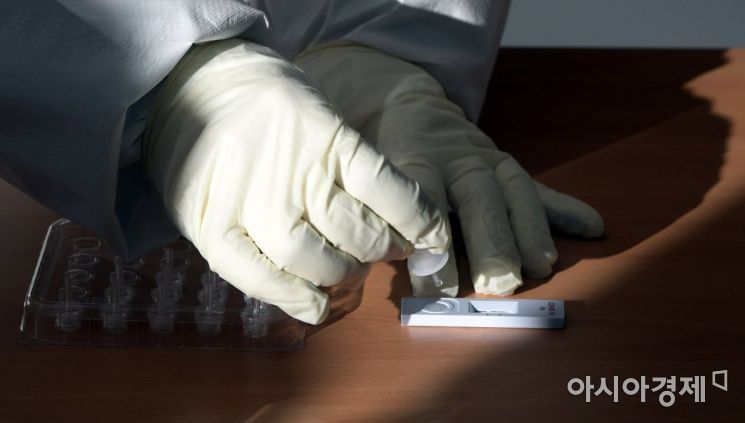 Medical staff are conducting rapid antigen tests for COVID-19 using samples collected at a temporary screening clinic set up in Seoul Plaza, Jung-gu, Seoul. Photo by Hyunmin Kim kimhyun81@
Distribution of self-test kits for rapid antigen testing at screening clinics will begin immediately on the 29th, the start of the Lunar New Year holiday. Those who visit screening clinics for testing can either receive a PCR test or, considering long waiting lines or delayed test results, opt for a rapid test using a self-test kit for faster results. Until the full system transition on the 3rd of next month, individuals can take the self-test kits home and perform the test themselves.
Although authorities initially announced that the nationwide transition to the new response phase would occur after the Lunar New Year holiday, some measures will be implemented from the early part of the holiday. Regarding this, Son emphasized, "The system where PCR testing is only possible after confirming positivity through rapid antigen testing for those excluding high-risk groups will be expanded nationwide from February 3rd," stressing that the full overhaul will take place after the holiday.
Concerns have been raised that this transition might cause disruptions in the supply of self-test kits. Son stated, "The Ministry of Food and Drug Safety is managing production and distribution," adding, "We expect supply to continue without major disruptions and are also considering measures to strengthen management."
Regarding the expansion of testing and treatment systems from February 3rd to include not only screening clinics but also 431 respiratory-specialized clinics nationwide and designated local clinics, Son said, "We are organizing several model types in consultation with medical associations and other healthcare organizations," and added, "We will explain the final plans on Friday."
Meanwhile, authorities maintain that despite the recent surge in confirmed cases due to the spread of the Omicron variant, sufficient management is possible given Omicron's lower fatality rate and the high vaccination rate in South Korea.
Son explained, "(The Omicron variant) is analyzed to have a fatality rate of 0.13%, which is about one-fifth of Delta's 0.8% fatality rate," and added, "Even if confirmed cases increase, considering the current healthcare system capacity and Omicron's reduced severity and fatality, we believe medical services for severe and moderate patients can be provided without major disruptions."
© The Asia Business Daily(www.asiae.co.kr). All rights reserved.
![User Who Sold Erroneously Deposited Bitcoins to Repay Debt and Fund Entertainment... What Did the Supreme Court Decide in 2021? [Legal Issue Check]](https://cwcontent.asiae.co.kr/asiaresize/183/2026020910431234020_1770601391.png)