During Lunar New Year Holiday, a Total of 28.77 Million People Moved, Averaging 4.8 Million per Day
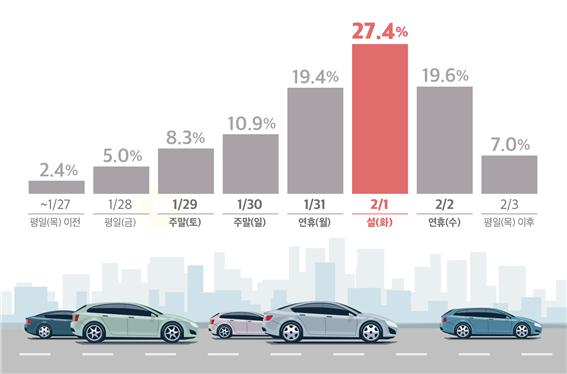
Due to the impact of COVID-19, the preference for private cars has become prominent, and highways are expected to be more congested during the Lunar New Year holiday than last year. The busiest times are expected to be the morning of January 31 for outbound traffic and the afternoon of February 2 for return traffic.
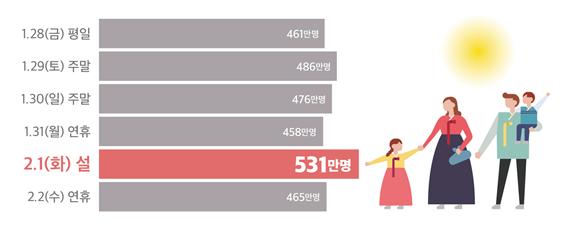
According to the "Mobility Plan Survey Based on COVID-19 Trends" released by the Korea Transport Institute on the 26th, a total of 28.77 million people, averaging 4.8 million per day, are expected to travel during this Lunar New Year holiday (January 28 to February 2).
The average daily travel volume is about 17.4% higher than last year's Lunar New Year (4.09 million). However, it is 26.2% less than in 2020 (6.5 million).
By date, the average daily travel volume is expected to be highest on the Lunar New Year day, February 1, at 5.31 million.
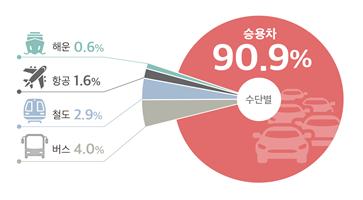
An overwhelming majority of respondents (90.9%) stated they would use private cars as their mode of transportation.
The estimated average daily number of vehicles using highways is 4.62 million, which is 11.6% less compared to last Lunar New Year.
The highways with the highest vehicle usage were the Gyeongbu Line (26.2%), Seohaean Line (14.1%), Jungang Line (10.2%), and Honam Line (7.9%), in that order.
The most common departure time for outbound travel was the morning of January 31, the day before Lunar New Year, at 18.0%, while the most common departure time for return travel was the afternoon of February 2, the day after Lunar New Year, at 27.5%.
Accordingly, the roads are expected to be most congested on the morning of January 31 for outbound traffic and the afternoon of February 2 for return traffic.
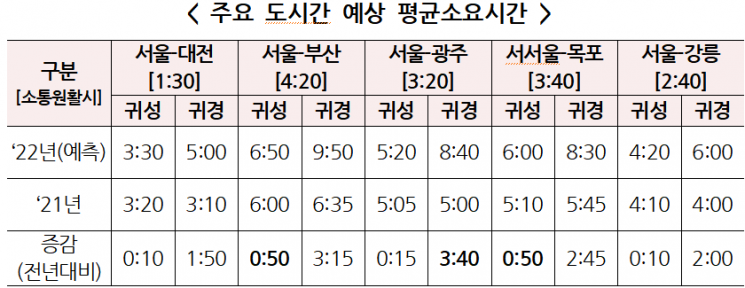
The average travel time between major cities is expected to increase for both outbound and return trips.
For Seoul↔Busan, outbound travel is expected to take 6 hours and 50 minutes, and return travel 9 hours and 50 minutes. For Seoul↔Gwangju, outbound travel is expected to take 5 hours and 20 minutes, and return travel 8 hours and 40 minutes.
However, due to the spread of the Omicron variant, the actual travel volume and congestion situation may vary.
Two out of ten people (19.4%) have not yet decided on their travel plans. The percentage of respondents with undecided travel plans was 2.5 percentage points higher than last year's 16.9%.
The main reason for not traveling home or having undecided travel plans was "concerns about COVID-19," accounting for more than 40%.
Meanwhile, this survey was conducted via mobile using smartphones from December 20 last year to the 16th of this month, targeting 14,026 households.
© The Asia Business Daily(www.asiae.co.kr). All rights reserved.