Serious Accident Punishment Act D-1... Anxious Small Businesses
Hiring Experts Is Like Picking Stars "Can't Even Attend Interviews"
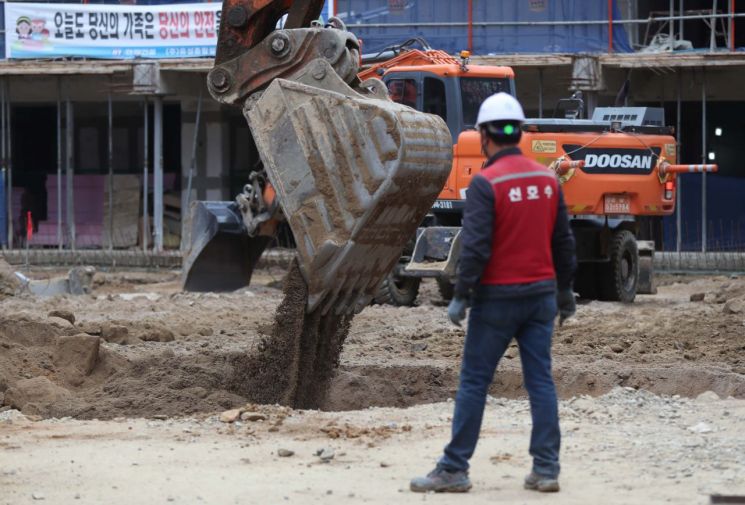 On the afternoon of the 24th, three days before the enforcement of the Serious Accidents Punishment Act, an equipment signal officer was inspecting the site at the Hanyang Construction new apartment construction site in Dong-eup, Uichang-gu, Changwon-si, Gyeongnam.
 [Photo by Yonhap News]
[Asia Economy Reporters: Kim Jong-hwa, Oh Hyun-gil, Kim Bo-kyung] "You need to be able to find safety and health experts before you can hire them, right? We just hope no accidents happen."
The anxiety of small and medium-sized enterprises (SMEs) is burning black as the Enforcement Decree of the Serious Accidents Punishment Act (Serious Accidents Punishment Act) is set to take effect tomorrow. They must hire safety and health experts immediately, but they cannot find anyone.
Article 4 of the Enforcement Decree of the Serious Accidents Punishment Act, which will be enforced from the 27th, stipulates that a dedicated organization must be operated to oversee and manage safety and health tasks and to deploy the necessary personnel for accident prevention. The Serious Accidents Punishment Act is first applied to workplaces with five or more employees. Workplaces with fewer than 50 employees or construction sites with a contract amount under 5 billion KRW have a two-year grace period and will be subject to the law starting in 2024. Currently, there are about 27,000 SMEs with 50 or more employees and about 57,000 workplaces.
Accordingly, large and mid-sized companies have been competitively recruiting safety and health professionals such as Industrial Safety and Health Engineers and Industrial Safety Engineers since last year.
Major conglomerates such as Samsung Electronics, LG Electronics, Hyundai-Kia Motors, and POSCO have appointed Chief Safety Officers (CSOs) and are finalizing organizational restructuring focused on strengthening safety management by establishing safety, environment, and health policies. While they demand legal improvements such as provisions for punishment and exemption of management responsibility for serious industrial accidents without intentional or gross negligence, their response to the law’s enforcement has been relatively smooth.
On the other hand, SMEs are in a position where hiring itself is impossible. Foundry company A located in Gimpo, Gyeonggi-do, has been looking for candidates with industrial safety certifications since last year but has not even conducted a single interview. The CEO of company A said, "We have posted job openings for safety and health experts on recruitment sites for nearly a year, but we only received a few phone calls," adding, "We cannot match the wages offered by large companies, so it is difficult to find personnel. We just hope no accidents occur."
Government support is also merely for show. A representative from the Korea Federation of SMEs said, "There are about 57,000 workplaces subject to the Serious Accidents Punishment Act, but the government’s plan for consulting vulnerable workplaces this year targets only 3,500 companies, which is practically insufficient."
Professor Lee Jeong-hee of the Department of Economics at Chung-Ang University, who formerly served as president of the Korean Small and Medium Business Association, said, "The imbalance in the supply and demand of safety and health experts was already anticipated, but there was insufficient preparation beforehand," adding, "Especially if large companies shift workplaces with high risks of serious accidents to subcontractors, the damage to SMEs could increase. The government needs to respond more actively to the instability in workforce supply."
© The Asia Business Daily(www.asiae.co.kr). All rights reserved.
![User Who Sold Erroneously Deposited Bitcoins to Repay Debt and Fund Entertainment... What Did the Supreme Court Decide in 2021? [Legal Issue Check]](https://cwcontent.asiae.co.kr/asiaresize/183/2026020910431234020_1770601391.png)