Korea Institute of Machinery and Materials Develops 'Cooling and Absorption Hybrid Condensable Fine Dust Removal System'
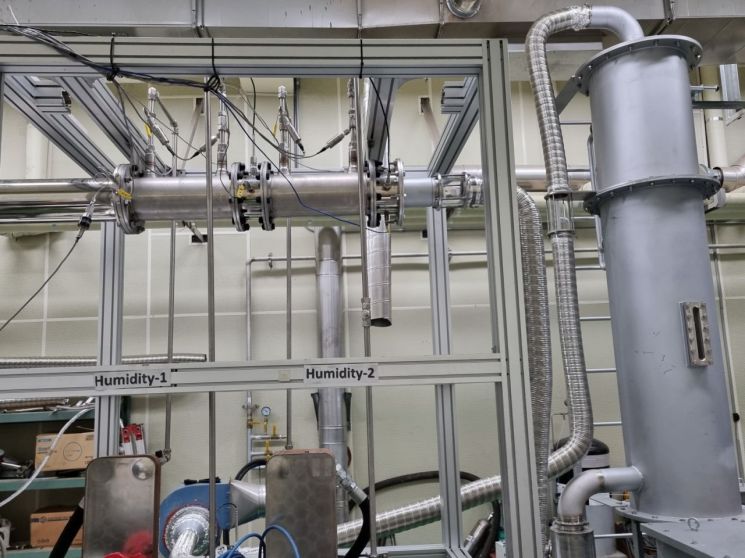 'Cooling and Absorption Hybrid Condensable Fine Dust Removal System' developed by Korea Institute of Machinery and Materials.
[Asia Economy Reporter Kim Bong-su] White smoke (白煙, Baekyeon) emitted from thermal power plants and waste incineration facilities contains substances highly harmful to human health, such as organic carbon and sulfates, but there are currently no specific regulations. A domestic research team has developed a technology that converts these substances into liquid form for removal.
On the 26th, the Korea Institute of Machinery and Materials announced that Kim Young-min, a principal researcher at the Green Power Research Lab of the Environmental Systems Research Division, developed a "Cooling-Absorption Hybrid Condensable Fine Dust Removal System" that simultaneously applies cooling and absorption to remove pollutants from white smoke emitted from chimneys.
White smoke emitted from chimneys of thermal power plants or industrial sites mostly consists of moisture, but also contains some condensable fine dust harmful to human health. Initially, these pollutants exist in a gaseous state when emitted at high temperatures into the atmosphere, but they cool down and transform into particles in the air, making them difficult to remove. Not only condensable fine dust but also moisture-only white smoke can cause road icing in winter, reduce sunlight, and hinder the dispersion of pollutants in the atmosphere, thereby worsening air quality in nearby areas.
The research team pre-cooled exhaust gases above 100°C emitted from chimneys to near room temperature before release. When the gas changed from a gaseous to a liquid state, moisture was removed using a filter, and condensable fine dust was also filtered out. Using this method, they removed 70% of moisture and 80% of condensable fine dust, then sprayed an absorbent to dissolve and remove the remaining moisture once more. Ultimately, moisture and condensable fine dust were reduced by approximately 85% compared to the initial emission state.
Until now, relatively simple cooling methods have been applied to remove such white smoke, but cooling alone has limited removal efficiency. Absorbent methods, which have higher removal efficiency, have limitations due to complex device configurations and the need for significant thermal energy to reuse the absorbent.
The research team first maximized the removal of white smoke and condensable fine dust using a simple cooling method, then applied the absorbent method. This approach reduces the burden of the absorbent method and utilizes the heat recovered during cooling in the regeneration process, separating the absorbent and moisture for reuse.
Principal researcher Kim said, "This technology can simultaneously remove white smoke and condensable fine dust, which have not been properly managed yet, while recovering 100% of the exhaust heat to near room temperature for reuse. Applying this technology is expected to drastically reduce moisture and condensable fine dust in exhaust gases emitted from domestic power plants and industrial chimneys."
This technology has been transferred to a private environmental equipment company and will enter field demonstration projects with increased capacity.
© The Asia Business Daily(www.asiae.co.kr). All rights reserved.