GIST, Developed Using Fuzzy Theory Applications
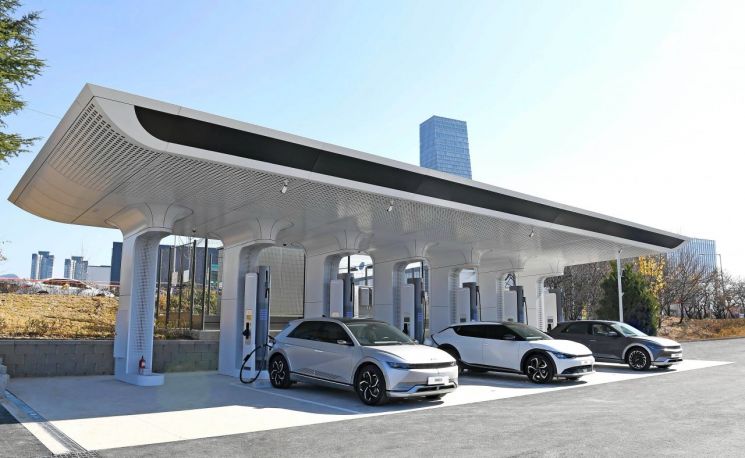
[Asia Economy Reporter Kim Bong-su] A technology has been developed that can significantly reduce the overall charging waiting time by supplying the optimal amount of power considering the battery status of each vehicle when multiple electric vehicles are charged simultaneously at public charging stations.
The research team led by Professor Kim Yoon-soo of the Graduate School of Energy Convergence at Gwangju Institute of Science and Technology (GIST) announced on the 26th that they have developed a technology to reduce charging waiting time at public electric vehicle charging stations using Fuzzy theory. Fuzzy theory refers to a theory that expresses states where objective judgments such as temperature, waiting time, and age are ambiguous.
As the demand for electric vehicles increases, the distribution rate of electric vehicle chargers is also rising, but the temporary concentration of rapid charging can cause problems in the power system supplying electricity. Therefore, a technology is needed to selectively charge multiple electric vehicles connected to chargers without exceeding the capacity of the power system facilities. However, prioritizing charging is not easy because the time electric vehicles stay at charging stations and their remaining charge are uncertain and the criteria for state judgment are ambiguous.
The research team applied fuzzy theory to develop a technology that minimizes electric vehicle charging waiting time. Expected parking time (Stay time), electric vehicle state of charge (SoC), and charging priority (P) were fuzzified. Fuzzification is the process of linguistically expressing ambiguous objective state values; in this study, parking time (ST) and state of charge (SoC) were each expressed in five states (very low, low, medium, high, very high). The team used the linguistically expressed parking time and state of charge information to determine charging priority. Charging priority was also expressed as low (LP), medium (MP), and high (HP) during the fuzzy inference process and was defuzzified to represent the priority as an exact numerical value. Ultimately, this fuzzy inference system (FIS) is used to determine the charging priority of electric vehicles.
The developed technology was validated in a simulation environment considering 200 electric vehicles with random parking times and state of charge. The simulation compared it with seven other commonly used or recently proposed techniques in academic papers. As a result, the average waiting time was reduced by at least 16% and up to 28% compared to other techniques. Charging service efficiency was also confirmed to improve by at least 7% and up to 16%.
Professor Kim Yoon-soo said, “No matter how many electric vehicle chargers are distributed, it is difficult to supply many chargers simultaneously due to the capacity of the power system facilities. As intermittent renewable energy increases, the issues of electric vehicle chargers and power system capacity are expected to expand further, so this technology is expected to shorten electric vehicle charging time and improve efficiency.”
The research results were published online on the 13th in the international journal 'IEEE Transactions on Intelligent Transportation Systems.'
© The Asia Business Daily(www.asiae.co.kr). All rights reserved.
![User Who Sold Erroneously Deposited Bitcoins to Repay Debt and Fund Entertainment... What Did the Supreme Court Decide in 2021? [Legal Issue Check]](https://cwcontent.asiae.co.kr/asiaresize/183/2026020910431234020_1770601391.png)
















