Omicron Spread, Supply Chain Worsening, High Inflation
US 5.2→4.0%, Korea 3.3→3.0%
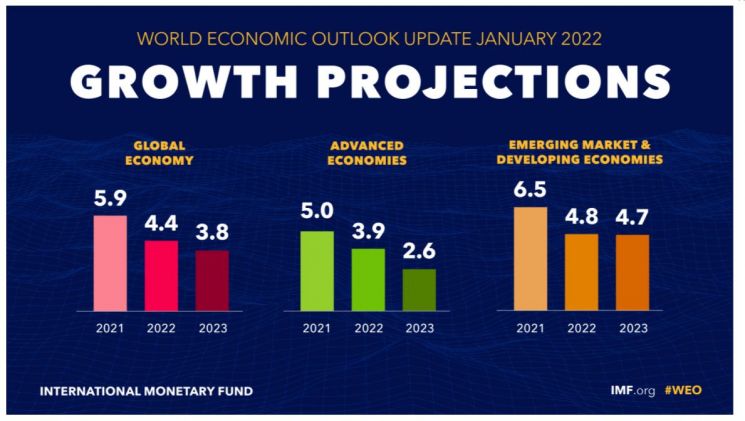
[Asia Economy New York=Special Correspondent Joselgina] The International Monetary Fund (IMF) has downgraded its global economic growth forecast for this year to 4.4%. This is a 0.5 percentage point decrease from the forecast made in October last year, reflecting the recent spread of the new COVID-19 variant Omicron, worsening supply chains, and inflation. South Korea's economic growth forecast was also revised downward to 3.0%.
On the 25th (local time), the IMF released the 'World Economic Outlook' report, which presented this outlook. The global economic growth forecast for 2022 was lowered by 0.5 percentage points from 4.9% in October last year to 4.4%. The growth forecast for advanced economies is expected to fall by 0.6 percentage points to 3.9%, while emerging and developing economies are expected to decline by 0.3 percentage points to 4.8%.
The IMF suggested that the recent downward revision was due to the spread of Omicron and high inflation through the report subtitle, 'RISING CASELOADS, A DISRUPTED RECOVERY, AND HIGHER INFLATION.'
The IMF explained, "As Omicron spreads, countries are again restricting movement," adding, "Energy prices are rising, supply chains are deteriorating, and inflation has been higher than expected in many countries." Risks in China's real estate market and reduced consumption were also cited as factors slowing the pace of economic recovery.
By country, the U.S. growth forecast for this year was lowered by 1.2 percentage points to 4.0%. China’s forecast also dropped by 0.8 percentage points to 4.8%. South Korea’s forecast was lowered by 0.3 percentage points to 3.0%. The downward revision for South Korea was relatively smaller compared to other advanced economies. However, it is slightly lower than the 3.1% forecast released by the South Korean government in December last year. Other countries include Germany at 3.8%, France at 3.5%, Japan at 3.3%, the United Kingdom at 4.7%, and India at 9.0%.
The IMF projected the global economic growth rate for next year at 3.8%, which is a 0.2 percentage point increase from the previous forecast of 3.6%. However, the IMF explained that this reflects a mechanical rebound from this year’s sluggish performance.
By country, the forecasts for next year are South Korea at 2.9%, the U.S. at 2.6%, Germany at 2.5%, France at 1.8%, Japan at 1.9%, and the United Kingdom at 2.3%. The growth forecasts for next year were generally revised upward reflecting this year’s downturn. However, the IMF added that these forecasts assume that global vaccination rates will increase and the COVID-19 situation will improve by the end of the year.
Along with this, the IMF mentioned several factors that could expand downside risks to the economy. It expressed concern that vaccine inequality could lead to the spread of COVID-19 variants and the reintroduction of movement restrictions in various countries. This could cause greater disruptions to global supply chains. Monetary tightening policies in advanced economies including the U.S. were also cited as variables. Debt in developing countries, geopolitical risks, energy price volatility, and climate change were also mentioned.
The IMF emphasized that "the emergence of new variants could be a disruptive factor for the economy, and it is necessary to strengthen international cooperation for effective COVID-19 response," highlighting that effective health strategies are crucial. The IMF originally planned to release the revised report on the 19th but postponed it by a week to further review the impact of the recent Omicron spread, releasing it on this day.
© The Asia Business Daily(www.asiae.co.kr). All rights reserved.
![User Who Sold Erroneously Deposited Bitcoins to Repay Debt and Fund Entertainment... What Did the Supreme Court Decide in 2021? [Legal Issue Check]](https://cwcontent.asiae.co.kr/asiaresize/183/2026020910431234020_1770601391.png)
















