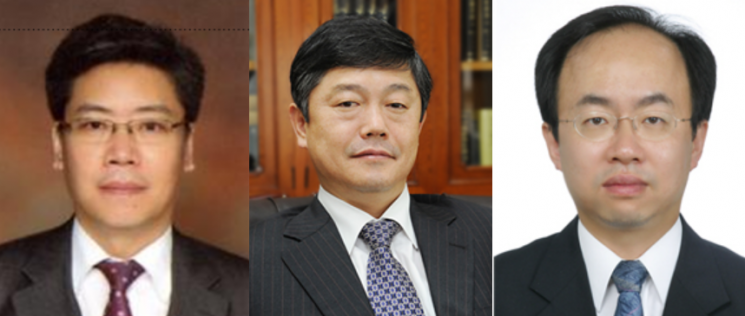
 Kim Yong-bin, Chief Judge of Seoul High Court, appointed as President of the Judicial Research and Training Institute effective the 21st of next month; Yoon Joon, Chief Judge of Seoul High Court, appointed as President of Gwangju High Court; Kim Yong-seok, Chief Judge of Seoul High Court, appointed as President of the Patent Court. Photo by Supreme Court.
[Asia Economy Reporter Choi Seok-jin, Legal Affairs Specialist] On the 25th, the Supreme Court carried out a regular personnel reshuffle involving 14 court presidents, high court chief judges, and district court chief judges.
The Supreme Court conducted transfers effective from the 21st of next month for 24 individuals, including 3 high court presidents and 7 district court presidents, as well as transfers for high court chief judges and high court judges.
Kim Yong-bin, Chief Judge of the Seoul High Court (Judicial Research and Training Institute Class 16), was transferred as the Director of the Judicial Research and Training Institute; Yoon Joon, Chief Judge of the Seoul High Court (Class 16), was transferred as President of the Gwangju High Court; and Kim Yong-seok, Chief Judge of the Seoul High Court (Class 16), was transferred as President of the Patent Court.
The Seoul Administrative Court, Seoul Eastern District Court, Seoul Western District Court, Suwon District Court, and Jeonju District Court appointed new heads recommended by frontline judges.
Among the candidates recommended by each court, the Supreme Court appointed Jang Nak-won, Chief Judge of the Seoul Administrative Court (Class 28), as President of the Seoul Administrative Court; Shim Tae-gyu, Chief Judge of the Seoul Eastern District Court (Class 25), as President of the Seoul Eastern District Court; Choi Sung-bae, Chief Judge of the Seoul Western District Court (Class 23), as President of the Seoul Western District Court; Lee Geon-bae, Senior Chief Judge of the Suwon District Court (Class 20), as President of the Suwon District Court; and Oh Jae-sung, Chief Judge of the Suwon District Court (Class 21), as President of the Jeonju District Court.
Additionally, Jeong Hyo-chae, Chief Judge of the Uijeongbu District Court (Class 20), was transferred as President of the Incheon District Court; and Yang Tae-kyung, Chief Judge of the Daejeon District Court (Class 21), was transferred as President of the Daejeon District Court. Choi Jong-du, Chief Judge of the Incheon District Court (Class 20), was appointed President of the Incheon Family Court; Ha Hyun-guk, Chief Judge of the Suwon District Court (Class 20), as President of the Suwon Family Court; Ham Jong-sik, Chief Judge of the Suwon District Court (Class 24), as President of the Daejeon Family Court; and Baek Jeong-hyun, Chief Judge of the Daegu District Court (Class 24), as President of the Ulsan Family Court.
Lee Seung-young, President of the Patent Court (Class 15), was appointed as a senior judge at the Yongin Branch of the Suwon District Court and is expected to handle first-instance small claims cases going forward.
The position of senior judge at the high courts, previously held by high court chief judges, will now be filled by high court judges. Kim Tae-hyun, Judge of the Daegu High Court (Class 34); Kim Sung-joo, Judge of the Gwangju High Court (Class 26); and Moon Joo-hyung, Judge of the Patent Court (Class 25), were each assigned as senior judges of their respective courts.
Yoon Seung-eun, Chief Judge of the Seoul High Court (Class 23), will concurrently serve as Director of the Court Library, and Kim Sang-woo, Judge of the Patent Court (Class 25), will concurrently serve as Secretary to the Chief Justice.
Furthermore, following consultations with the Judicial Administration Advisory Council and deliberations by the Judicial Personnel Committee, 23 judges were newly appointed as high court judges: 8 at the Seoul High Court, 8 at the Suwon High Court, 3 at the Daejeon High Court, 3 at the Busan High Court, and 1 at the Patent Court.
The Supreme Court stated that through this personnel reshuffle, it expects to ▲expand horizontal and democratic elements in court president appointments ▲firmly promote the dual-track judicial personnel system separating first and second instance courts ▲and lay the foundation for the stable establishment of the lifetime judge system.
© The Asia Business Daily(www.asiae.co.kr). All rights reserved.
![User Who Sold Erroneously Deposited Bitcoins to Repay Debt and Fund Entertainment... What Did the Supreme Court Decide in 2021? [Legal Issue Check]](https://cwcontent.asiae.co.kr/asiaresize/183/2026020910431234020_1770601391.png)
















