Candidates Lee Jae-myung and Yoon Seok-yeol Side by Side with GTX Expansion Pledges
30-Minute Living Zone Across the Seoul Metropolitan Area... Development Expectations
Concerns Over Delays as Existing Lines Fail to Speed Up
7-8 Years Until A Line Construction... B and C Lines Also Facing Difficulties
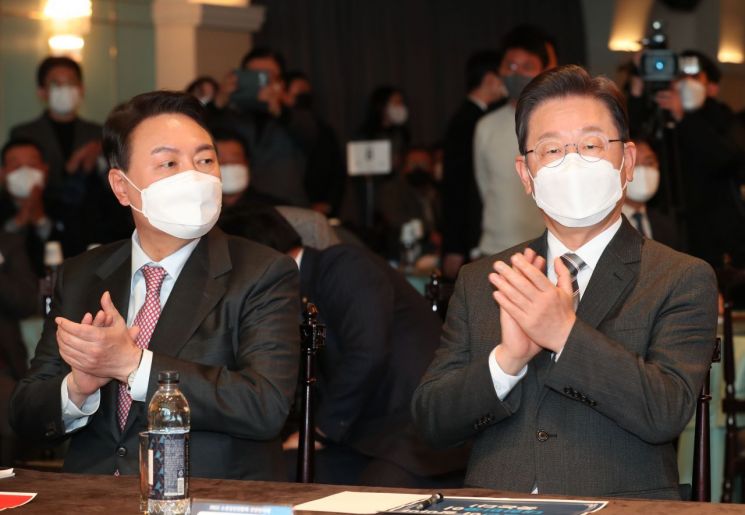
Lee Jae-myung, the presidential candidate of the Democratic Party of Korea, and Yoon Seok-youl, the candidate of the People Power Party, have both announced pledges to expand the metropolitan area express railroad (GTX), raising development expectations among the real estate industry and local residents in the related areas. However, considering that even the fastest-moving existing GTX line, Line A, took 7 to 8 years from planning to groundbreaking, it is expected that the pledges of both candidates will also require a considerable amount of time before actual construction and opening. Especially since these pledges were hastily made ahead of the election, uncertainties regarding project feasibility and costs must also be taken into account.
According to political circles and the real estate industry on the 25th, Lee’s ‘GTX Plus Project’ pledge involves extending the currently underway GTX A, C, and D lines to Pyeongtaek, Dongducheon, and Hanam respectively, and establishing new E and F lines. Compared to Yoon’s GTX pledge, which was announced earlier, Lines A and C are similar, but there are differences in stops and sections for Lines D, E, and F.
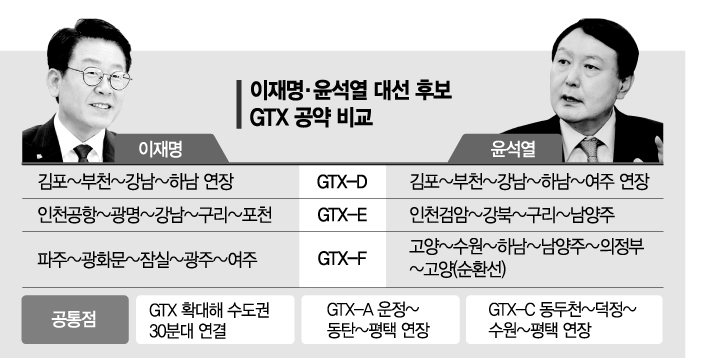
Within the industry, while there is some expectation that the GTX expansion pledges by the two candidates could accelerate the realization of a ‘30-minute living zone in the metropolitan area,’ many analyses suggest that rapid groundbreaking will be difficult given the scale of the projects. Even Line A, which is relatively fast among existing GTX projects, was included in the second national railway network construction plan in 2011, and after two preliminary feasibility studies and operator selections, the groundbreaking ceremony was held only in December 2018, about eight years later.
Lines B and C, which have yet to break ground, are also facing ongoing difficulties. For Line B, the basic plan, originally scheduled for August last year, was delayed until the end of February this year, causing overall schedule delays and making it likely that the planned groundbreaking by the end of the year will be postponed beyond this year. Line C, for which the Hyundai Construction consortium was selected as the preferred negotiator in June last year, is also struggling due to controversies over additional station designations and local opposition to above-ground construction in the Dobong section. Many in the industry believe that if the implementation agreement for Line C is delayed, groundbreaking by the end of next year will also be difficult.
Amid delays in existing GTX projects, there is also analysis that the announcement of extension plans for Lines A, C, and D by political circles has increased project uncertainties. Among residents in areas where GTX stations will be located, there is backlash, saying, "Existing projects are not being properly carried out, so proposing expansion plans alone is nonsensical."
An official from the Ministry of Land, Infrastructure and Transport said, "Since there are existing tracks for the extensions of Lines A and C to Pyeongtaek and Dongducheon, the amount of work itself does not seem large," but added, "It is practically difficult to redo feasibility studies from the beginning by overlapping extension projects onto ongoing projects, so they will likely have to be pursued as separate projects."
Enormous costs and project feasibility are also cited as issues. According to the Ministry of Land, Infrastructure and Transport, the budget required to carry out the current A, B, C, and D projects alone is estimated to be 17.25 trillion won. A construction industry official said, "Because the GTX projects are large in scale, it seems likely they will proceed as private investment projects," adding, "If normal procedures are followed, including mid- to long-term plan revisions, preliminary feasibility studies, private investment eligibility reviews, and selection of project negotiators, it is difficult even to estimate the opening date."
© The Asia Business Daily(www.asiae.co.kr). All rights reserved.
![User Who Sold Erroneously Deposited Bitcoins to Repay Debt and Fund Entertainment... What Did the Supreme Court Decide in 2021? [Legal Issue Check]](https://cwcontent.asiae.co.kr/asiaresize/183/2026020910431234020_1770601391.png)
















