Stagnant Support in the 30% Range Continues
86 Group's Eldest Member Unveils Reform Card
Uncertain Chain of Withdrawal Announcements
Presidential Election Nears, Personnel Shake-up 'Reversal Card'
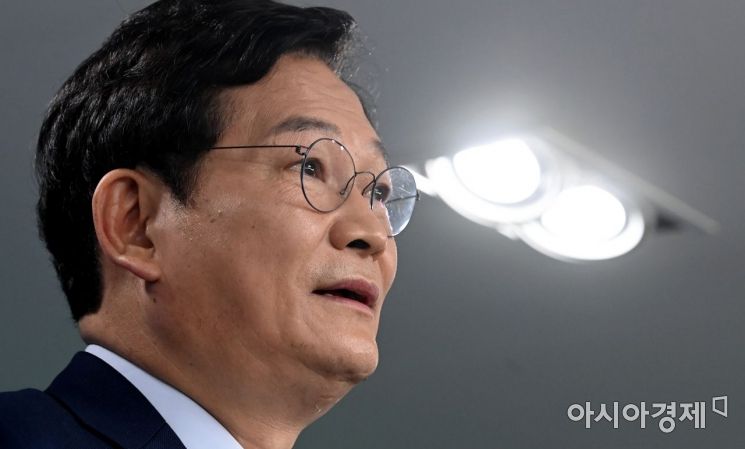 Song Young-gil, leader of the Democratic Party of Korea, holds an emergency press conference at the central party office in Yeouido, Seoul, on the 25th. Photo by Yoon Dong-joo doso7@
[Asia Economy Reporters Oh Ju-yeon, Koo Chae-eun, Jeon Jin-young] Song Young-gil, leader of the Democratic Party of Korea, has announced that he will not run in the next general election. Along with this, the party has decided not to nominate candidates in certain constituencies for the by-elections for the National Assembly, which will be held simultaneously with the presidential election in March. This move is interpreted as a strategic gamble following the stagnation of presidential candidate Lee Jae-myung’s approval ratings in the 30% range. Since seven close aides of candidate Lee declared they would not accept appointed positions the day before, Song, who is considered the eldest figure of the ‘86 Group’ (those born in the 1960s who entered university in the 1980s), announced his decision not to run, raising expectations that the Democratic Party’s personnel reform is accelerating.
On the 25th, Song announced a party reform plan centered on his decision not to run in the next general election, including ▲no candidate nominations in by-elections for constituencies such as Jongno ▲a ban on running for more than three consecutive terms in the same district ▲and expulsion of lawmakers Yoon Mi-hyang, Lee Sang-jik, and Park Deok-heum. This came just one day after the ‘White Army’ declaration by the seven-member group closest to candidate Lee. He said, "I deeply feel that the high demand from the public for a regime change is due to our shortcomings," and added, "I will not run in the next general election. There are criticisms inside and outside the party that the 586 generation has become vested interests. As seniors, it is now time for us to step out into the wilderness again."
By declaring his non-candidacy, following the personnel reform movement ignited by the seven-member group, Song is effectively pressuring the ‘86 lawmakers’ to relinquish their vested interests. This is a drastic measure to overcome the stagnation in approval ratings, which have failed to break through the 40% barrier and are trailing behind candidate Yoon Seok-youl in recent polls. Reactions within the party to Song’s gamble are mixed. Lawmakers belonging to the 86 Group are skeptical. A senior lawmaker from the 86 Group said in a phone interview, "I think the ‘86 retirement theory’ should not be approached in a way that disparages and cynically undermines politics itself."
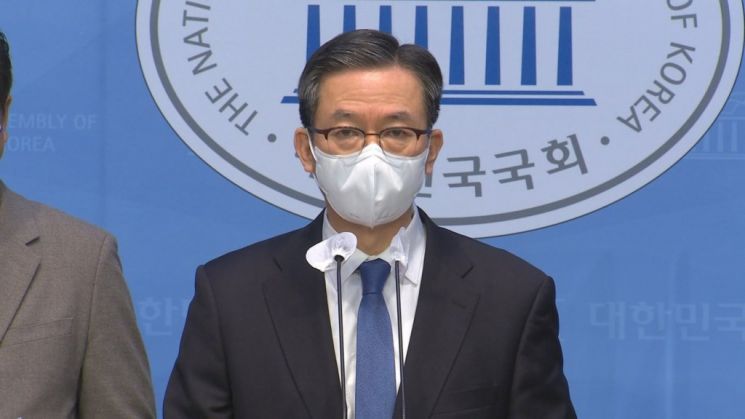
Democratic Party lawmaker Cho Eung-cheon also appeared on the radio that day and said, "I wouldn’t say it’s a general trend yet," adding, "It’s not broadly formed, and while there isn’t enough backlash to cause a stir, individual members seem to be contemplating it." On the other hand, Lee Dong-hak, the party’s youth supreme council member, expressed support on social media, saying, "I support Leader Song Young-gil’s decision," and added, "Half-hearted reform cannot create a great transformation in Korea. Innovation in the Democratic Party is an essential element for Korea’s great transformation." A party election committee official said regarding this, "For the 86 Group to relinquish their vested interests overall, voluntary declarations of non-candidacy must be made, but it is a matter that requires their own decision."
Song announced that the party will not nominate candidates in three constituencies?Jongno, Anseong, and Cheongju Sangdang District?in the by-elections held alongside the presidential election on March 9. He explained, "Giving up nominations is a painful decision for now, but it will be an opportunity for our Democratic Party to grow as a responsible party." The party also plans to institutionalize the clause agreed upon during the political reform special committee and the integration process with the Open Democratic Party, which prohibits running for more than three consecutive terms in the same constituency. Song explained, "We will build a solid foundation so that politics is not ‘stagnant water’ but ‘new water’ continuously flowing in, establishing a political culture that always innovates and works hard."
Song also stated, "We will promptly process the expulsion proposals for lawmakers Yoon Mi-hyang, Lee Sang-jik, and Park Deok-heum, which were recommended by the National Assembly Ethics Review Advisory Committee." He added, "The judgment has been made that there were wrongdoings, and we must follow the advisory committee’s decision to expel them." He said, "In consultation with Floor Leader Yoon Ho-jung and Ethics Committee Chair Kim Jin-pyo, we will swiftly handle the expulsion proposals in the Ethics Committee, submit them to the plenary session, and proceed with the vote," and added, "If the People Power Party understands the fear of the people, I hope they will join in the expulsion." Along with reform, the party plans to introduce a youth nomination quota system. Song said, "Simply by giving 2030s more opportunities to participate directly in politics, young party members will be able to find solutions," and pledged that in the upcoming local elections in May, more than 30% of all metropolitan and basic council members nominated will be youth.
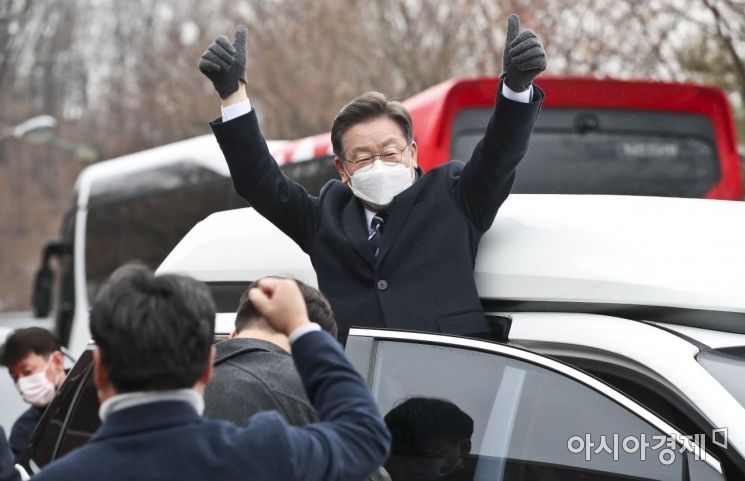 Lee Jae-myung, the Democratic Party presidential candidate, is greeting the citizens of Pocheon as he gets off the vehicle to announce agricultural pledges at the Pocheon Agricultural Technology Center in Gyeonggi-do on the 25th. Photo by National Assembly Press Photographers Group
© The Asia Business Daily(www.asiae.co.kr). All rights reserved.
![User Who Sold Erroneously Deposited Bitcoins to Repay Debt and Fund Entertainment... What Did the Supreme Court Decide in 2021? [Legal Issue Check]](https://cwcontent.asiae.co.kr/asiaresize/183/2026020910431234020_1770601391.png)