China's Economic Triumvirate: Guangdong, Jiangsu, and Shandong Each at 5.5%... Hainan Tops at 9%
Not Low Considering China's Overall Economy... Awaiting Results of China's Monetary Easing
[Asia Economy Beijing=Special Correspondent Jo Young-shin] Among China's 31 provinces, municipalities, and autonomous regions, 30 provincial-level local governments have set this year's economic growth targets ranging from a low of 5.5% to over 9%. These provincial-level targets are reported at the National People's Congress and the Chinese People's Political Consultative Conference, the largest political events in China, and serve as the basis for the central government to set the national economic growth target for the year.
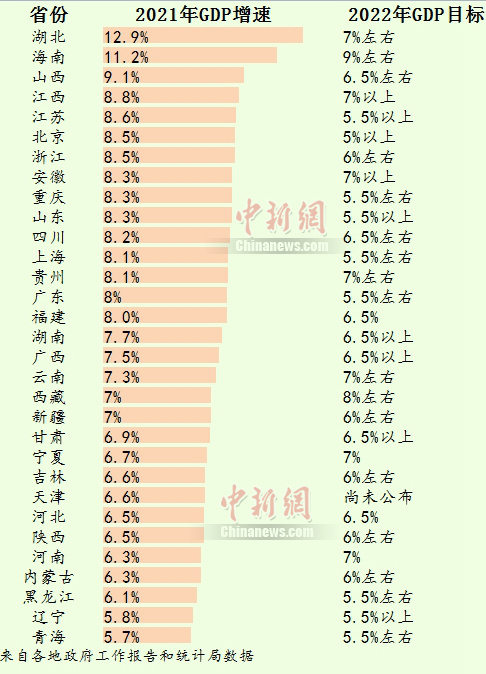
According to Chinese media including Pengpai on the 25th, out of the 31 provinces, municipalities, and autonomous regions, 30 local governments except Tianjin have submitted reports containing this year's economic growth targets to the central government. The average target submitted by the 30 local governments is 6%.
Pengpai reported that among the 30 local governments, Hainan Province set the highest target. Hainan's target for this year is about 9%. Pengpai added that Hainan posted an 11.2% year-on-year increase last year, ranking second nationwide in growth rate after Hebei Province.
Last year's economic growth in Hainan Province appears to have been driven by duty-free shops. It is estimated that last year's duty-free sales in Hainan exceeded 60 billion yuan (approximately 11.32 trillion Korean won). Thanks to duty-free sales, Hainan's retail sales ranked first nationwide last year. Duty-free shops are also expected to lead economic growth this year.
China's top economic regions Guangdong Province, Jiangsu Province, and Shandong Province have each set their targets at 5.5% this year. This is 1 percentage point lower than last year's target of 6.5%. These three provinces located on the eastern coast have such large economies that they effectively lead the entire Chinese economy. In fact, last year Guangdong's gross domestic product (GDP) was 12.437 trillion yuan (2,350 trillion Korean won). In terms of GDP size alone, Guangdong is estimated to have surpassed Italy, a member of the Group of Seven (G7).
Pengpai explained that there are slight differences in the economic growth targets for this year among the three provinces ranked first to third in economic size in China. Guangdong's target is 5.5%, while Jiangsu and Shandong have targets of over 5.5%. Pengpai added that last year Guangdong, Jiangsu, and Shandong all set targets of 6.5%, but actually grew by 8%, 8.6%, and 8.3%, respectively.
The capital Beijing and financial hub Shanghai have set their targets at over 5% and about 5%, respectively, for this year. Pengpai reported that these two cities, each with a GDP exceeding 4 trillion yuan last year, have submitted their targets to the central government. It also added that last year's GDP for Beijing and Shanghai were 4.02696 trillion yuan (an 8.5% increase year-on-year) and 4.32 trillion yuan (an 8.1% increase year-on-year), respectively.
Shanghai Mayor Gong Jing said, "Considering the triple pressures of demand, supply, and expectations, we set this year's economic growth target," and added, "We will achieve this year's target for stable growth."
Although the economic growth targets for 30 Chinese provinces this year are lower than last year's targets, considering China's total economic size of 113.367 trillion yuan (2,142.9 quadrillion Korean won), these are not low figures in absolute terms.

At the Central Economic Work Conference held in December last year, the Chinese government diagnosed that the Chinese economy is facing three pressures: demand contraction, supply shocks, and weakening expectations. This means the Chinese economy is not in good shape. After the economic work conference, the Chinese government instructed local governments to issue special bonds and invest in infrastructure and other areas.
Also, the People's Bank of China, the central bank, implemented monetary policies supplying money to the market, such as lowering the Loan Prime Rate (LPR), which is the benchmark interest rate. This was done preemptively to prevent economic deterioration.
Pengpai expressed optimism that although the 30 local governments in China have lowered their GDP growth targets compared to the previous year, they will be able to achieve this year's targets.
Meanwhile, the Chinese government will hold the 5th annual session of the 13th National People's Congress on March 5 and announce this year's economic growth target. Inside and outside China, it is expected that the government will announce a growth target of "over 5%," which is 1 percentage point lower than last year's target.
© The Asia Business Daily(www.asiae.co.kr). All rights reserved.
![User Who Sold Erroneously Deposited Bitcoins to Repay Debt and Fund Entertainment... What Did the Supreme Court Decide in 2021? [Legal Issue Check]](https://cwcontent.asiae.co.kr/asiaresize/183/2026020910431234020_1770601391.png)
















