Urgent Diagnosis of Domestic Stock Market
Early Normalization of US Monetary Policy... Tapering Expected to End Next Month
LG Energy Solution Listing 'Black Hole'... US-Russia Conflict and Omicron Among Negative Factors
[Asia Economy Reporters Song Hwajeong and Hwang Junho] The stock market decline at the beginning of the year is steep. Due to repeated adverse factors since the start of the year, the KOSPI has fallen below the 2800 level. Experts predict that a turnaround in the situation is unlikely in the short term.
As of 10:30 AM on the 25th, the KOSPI recorded 2747.07, down 44.93 points (1.63%) from the previous day. At 10:20 AM, it even dropped to the 2730 level.
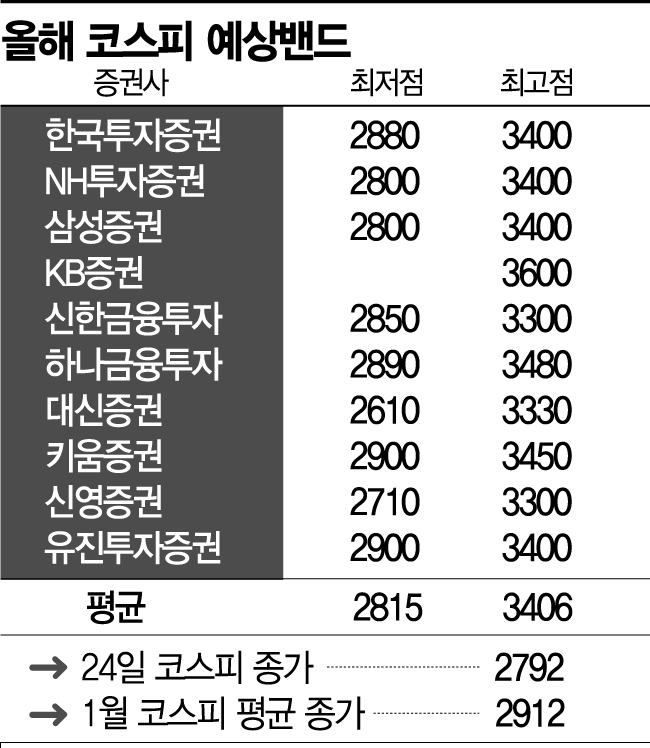
At the beginning of the year, the securities industry expected the KOSPI to rise as high as 3600 this year, but within a few days, the KOSPI plunged to 2700. Initially, an average of 2815 was considered an appropriate lower bound, but on the 24th, it dipped to 2792.00, raising concerns more than ever.
In just over 20 days, the U.S.'s strengthened early normalization stance on monetary policy laid a bearish foundation for the stock market. Currently, the market anticipates the tapering (asset purchase reduction) to end next month. There are opinions that the base interest rate could be raised 4 to 7 times annually (1.00~1.75%) starting in March. As the Federal Reserve (Fed) discusses the necessity of quantitative tightening, preference for safe assets has significantly increased, while demand for stocks has weakened.
Amid growing uncertainty over external supply and demand instability, domestically, LG Energy Solution's listing is acting as a black hole for stock market supply and demand. Additionally, the expanding possibility of war between Russia and Ukraine and the global COVID-19 Omicron cases surpassing 3 million continue to impact economic slowdown and stock market decline.
Kim Hyung-ryeol, Head of Research at Kyobo Securities, said, "Except for 2020, the domestic stock market has never declined in January over the past five years, but this year it started with a deep decline in January." He added, "While there is a considerable possibility of an autonomous rebound due to the February shock, considering that inflation and policy environments are unlikely to change easily, it is difficult to assign more significance than a rebound."
Inflation is cited as a persistent factor behind the stock market weakness. Kim Hak-gyun, Head of Research at Shin Young Securities, explained, "The current decline fundamentally stems from rising interest rates after all asset prices rose under low interest rates." He added, "Interest rate hikes are due to central banks becoming hawkish because of inflation, but signs of slowing U.S. inflation could be a turning point for the overall asset market to stabilize."
However, given the recent prolonged weakness, a technical rebound seems possible. Jung Yeon-woo, Head of Research at Daishin Securities, said, "The burdens of rising interest rates and oil prices that have troubled global financial markets since the beginning of the year have eased, and the perception of excessive decline has begun to enter, laying the groundwork for a technical rebound." He explained, "The fact that the Volatility Index (VIX) surged to 38% and then reversed downward also suggests that the short-term selling climax and extreme fear may have passed." Jung added, "Since the extreme choices feared by the market are unlikely to be mentioned at the January FOMC, it could serve as a trigger for a short-term rebound."
There are also forecasts that a rebound in the domestic stock market will not be easy. Lee Seung-woo, Head of Research at Eugene Investment & Securities, said, "The Nasdaq has fallen nearly 20% from its peak, attracting bargain hunters, but the KOSPI has not dropped that much yet." He added, "Moreover, with forecasts that energy prices may rise further, concerns about the slowdown in domestic economic growth centered on exports are emerging."
For a sustained rebound, easing inflationary pressures will likely be necessary. Yoon Chang-yong, Head of Research at Shinhan Financial Investment, said, "The essence of the stock market correction is concerns over monetary policy tightening due to inflation, so while a short-term volatility peak may pass, it is premature to expect a sustained rebound until inflation concerns ease." He added, "Materials for a sustained stock market rebound will be the easing of inflationary pressures and signals of an expanding long- and short-term interest rate spread."
Defensive responses are advised. Jung said, "Short-term trading strategies focusing on oversold stocks are effective." He added, "Strategically, risk management is still necessary, and above the KOSPI 2900 level, it is recommended to reduce stock holdings and increase cash holdings again." Lee said, "A defensive portfolio should be constructed," and added, "It is better to liquidate especially high-valuation stocks that surged rapidly last year with high expectations."
© The Asia Business Daily(www.asiae.co.kr). All rights reserved.
![User Who Sold Erroneously Deposited Bitcoins to Repay Debt and Fund Entertainment... What Did the Supreme Court Decide in 2021? [Legal Issue Check]](https://cwcontent.asiae.co.kr/asiaresize/183/2026020910431234020_1770601391.png)