'External Economic Policy Promotion Strategy' Unveiled on the 25th
Aiming for MSCI Watchlist Inclusion in June
CPTPP Membership Application to Be Submitted in April
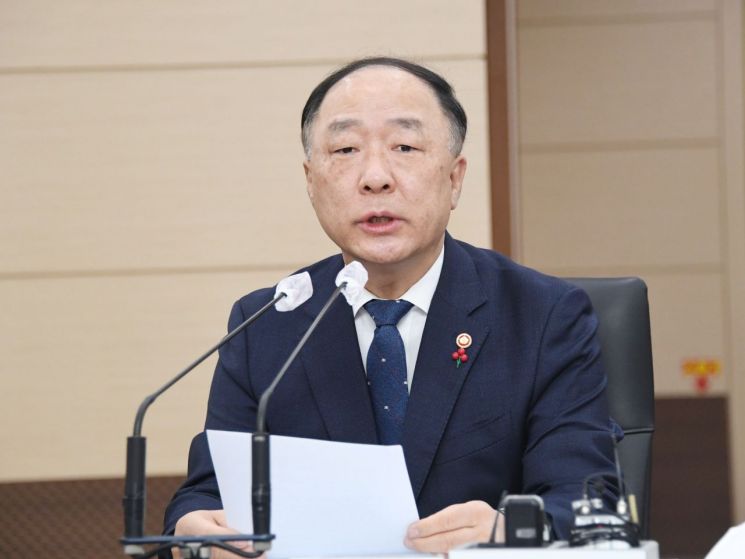 Hong Nam-ki, Deputy Prime Minister and Minister of Economy and Finance, presides over the "227th Ministerial Meeting on External Economic Affairs and 140th External Economic Cooperation Fund Management Committee" and delivers opening remarks at the Government Sejong Complex on January 25. (Photo by Ministry of Economy and Finance)
[Sejong=Asia Economy Reporter Moon Chaeseok] The government is considering measures to relax foreign exchange market regulations, such as extending trading hours and allowing offshore won transactions, to facilitate South Korea's inclusion in the Morgan Stanley Capital International (MSCI) developed markets index. It plans to submit a comprehensive and gradual application for membership in the Comprehensive and Progressive Agreement for Trans-Pacific Partnership (CPTPP) in April and expand its free trade agreement (FTA) network to cover 90% of the world's gross domestic product (GDP) this year.
On the morning of the 25th, the government held an external economic ministers' meeting at the Government Complex Sejong, chaired by Deputy Prime Minister and Minister of Economy and Finance Hong Nam-ki, where it unveiled the 2022 external economic policy promotion strategy.
◆ Considering extension of foreign exchange market trading hours and allowing offshore won transactions = The government decided to completely overhaul the foreign exchange transaction system this year and actively pursue South Korea's inclusion in the MSCI developed markets index. This aligns with Deputy Prime Minister Hong's announcement last December during an investor relations (IR) event in London, UK, where he declared the challenge to join the MSCI developed markets index.
The immediate goal is to be listed as a "watchlist" country by June. To achieve this, the government plans to comprehensively revise the foreign exchange legal framework within this year. It will also implement practical institutional improvements to enhance convenience for overseas investors.
According to a survey conducted from November to December last year targeting over 50 global investment institutions, overseas investors cited inconveniences such as "inability to directly participate in the domestic foreign exchange market" and "difficulty exchanging currency after market hours." In response, the government is considering significantly extending the domestic foreign exchange market trading hours, currently from 9 a.m. to 3:30 p.m., to cover overseas business hours. It is also reviewing measures to allow direct participation of foreign financial institutions in the domestic foreign exchange market and to permit offshore won transactions through deregulation of foreign exchange controls.
The government plans to finalize improvement measures after considering factors such as foreign exchange market stability and gathering domestic and international opinions. Additionally, it will officially introduce an electronic trading system where exporters, importers, and overseas investors can check price information in real time and place and execute foreign exchange orders via an electronic platform.
To prepare a comprehensive revision bill for foreign exchange transaction laws by the end of the year, a "Foreign Exchange System Improvement Task Force (TF)" composed of the Bank of Korea, Financial Supervisory Service, Korea Customs Service, and Korea Institute of Finance will collect market opinions and formulate a comprehensive reform plan within the first half of the year.
◆ "CPTPP membership application to be submitted in April" = The government stated that it will submit the CPTPP membership application in April as previously announced at the end of last year.
Domestically, it will review supplementary measures for sensitive sectors such as agriculture, fisheries, and small and medium manufacturing industries. It will accelerate social discussions through sectoral councils and regional roundtable meetings. Externally, it will continue membership discussions with key countries including the chair countries Singapore and New Zealand.
Regarding the Regional Comprehensive Economic Partnership (RCEP), the world's largest mega free trade agreement expected to take effect this month, the government plans to increase utilization by Korean industries through joint public-private briefings and attend the RCEP joint committee scheduled for the first quarter to identify areas for joint cooperation. RCEP, led by China, is an agreement involving five countries including Korea, China, Japan, Australia, and New Zealand, along with the 10 ASEAN countries.
Alongside mega FTAs with developed countries, the government will expand bilateral FTAs with emerging countries. It expects the FTA network to cover 90% of the global GDP in the future. Negotiations will accelerate with emerging countries worldwide, including the New Southern Policy, New Northern Policy, Latin America, and the Middle East. In particular, it plans to ratify FTAs with Cambodia in the New Southern region and Israel in the Middle East during the first half of the year.
For overseas orders, the government aims to exceed the $30 billion target for the third consecutive year through financial support and activation of joint entry into third countries. It will promote investment in promising sectors by signing basic credit agreements between the Export-Import Bank of Korea and national oil companies of the United Arab Emirates (UAE) and Saudi Arabia, and proceed with the Korea Eximbank special account and easing restrictions on external debt guarantees.
◆ Preparing supply stabilization measures for 180 key economic security items to counter 'supply chain risks' = Having mitigated supply chain risks through the so-called "element water crisis," the government announced it will present supply stabilization measures for 180 key items within the first quarter. Previously, the government announced 200 key economic security items based on external dependency and plans to implement customized supply management.
Regarding this, the 180 key items will have supply stabilization plans prepared and announced by the relevant ministries within the first half of the year. For the top 20 priority management items closely related to major industries, the government will implement already prepared supply stabilization measures such as expanding stockpiles and securing long-term supply sources. The government stated, "Based on the experience responding to the element water incident, we will prepare crisis management manuals for key items and proactively establish response systems in case of supply instability."
The government will also actively strengthen technology protection. With the "National Advanced Strategic Industry Act" set to be enforced in the second half of the year, it plans to select detailed core technologies by sector in 10 national essential strategic technology fields such as semiconductors, displays, and secondary batteries, and prepare R&D roadmaps for each technology in the first half of the year. The 10 technologies include semiconductors, displays, secondary batteries, 5G/6G, artificial intelligence (AI), advanced robotics and manufacturing, hydrogen, cybersecurity, quantum, space and aerospace, and advanced bio.
A government official said, "The progress of policy implementation by sector will be reviewed through the Major Economic Meeting and the Economic Security Strategy Meeting within this year," adding, "The first half-year performance will be checked in July."
© The Asia Business Daily(www.asiae.co.kr). All rights reserved.
![User Who Sold Erroneously Deposited Bitcoins to Repay Debt and Fund Entertainment... What Did the Supreme Court Decide in 2021? [Legal Issue Check]](https://cwcontent.asiae.co.kr/asiaresize/183/2026020910431234020_1770601391.png)















