The 43rd Interministerial Joint Response Meeting on Urea Solution Supply
[Sejong=Asia Economy Reporter Son Seonhee] The government has decided to ease the reporting obligations for producers, distributors, and importers related to domestic AdBlue supply and demand, judging that the stability of the domestic AdBlue supply is strengthening. However, considering some remaining uncertainties in the global market, export restrictions on urea and AdBlue will be maintained until the end of March.
Han Hoon, Deputy Minister of Strategy and Finance, held a 'Pan-government Joint Response Meeting on AdBlue Supply and Demand' at the Government Complex Seoul on the morning of the 25th to discuss these matters.
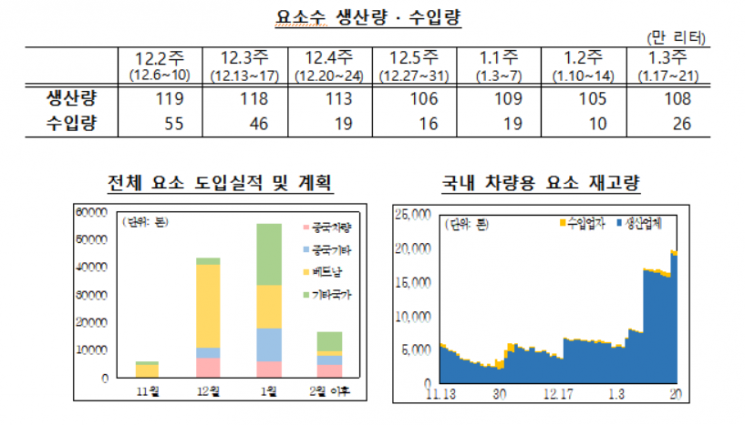
Since the beginning of this year, production has consistently been maintained at about twice the daily average consumption of AdBlue (600,000 liters), and difficulties in stable import, domestic production, and distribution of urea are gradually being resolved. In addition, more than 55,000 tons of overseas urea are scheduled to be imported this month, and domestic vehicle urea stock is about 19,000 tons (as of January 20), which is approximately a 93-day supply.
Accordingly, at the Cabinet meeting on the morning of the same day, the government revised the emergency supply adjustment notice to partially ease the reporting obligation that required producers, distributors, and importers of urea and AdBlue to report daily status. From now on, reports need only be submitted on Mondays for weekends, and when entering QR codes at gas stations, double reporting to the Ministry of Environment’s system is not required. The validity period of the revised notice has been extended by two months from the original January 31 to March 31. In case of a recurrence of supply instability, the government can immediately issue adjustment orders, and export restrictions on urea and AdBlue to protect the domestic market will be maintained.
The government explained, "This decision was made considering that despite the stability of domestic urea and AdBlue supply and distribution, international uncertainties remain, such as rising overseas urea prices and AdBlue prices in Japan and Australia."
At the end of last year, the adjustment orders limiting AdBlue sales locations and purchase quantities were lifted, and resale prohibition regulations were also removed. Therefore, from this year, AdBlue can be purchased and sold through online shopping malls, marts, and secondhand trading platforms.
With the termination of the hoarding notice on the 31st, restrictions on inventory size for AdBlue manufacturers, importers, and sellers, as well as urea importers, and the obligation to sell within 10 days after import, manufacture, or purchase will be lifted.
© The Asia Business Daily(www.asiae.co.kr). All rights reserved.

















