Impact of Omicron Becoming the Dominant Variant
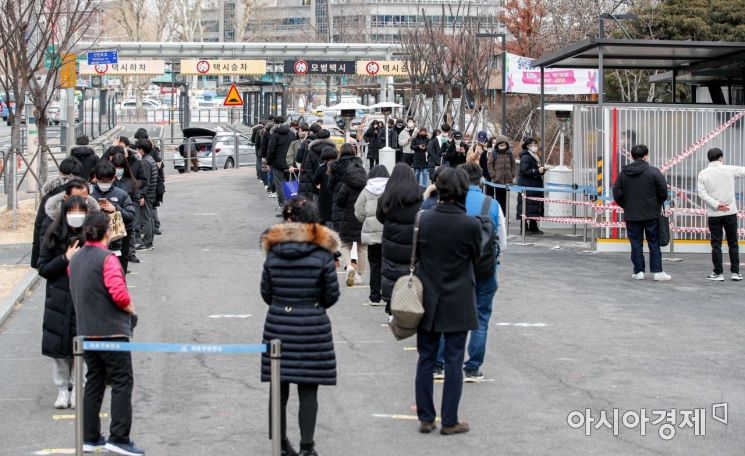 On the 24th, citizens who visited the temporary screening clinic at the Express Bus Terminal Station in Seocho-gu, Seoul, are lining up to get tested. Photo by Jinhyung Kang aymsdream@
[Asia Economy Reporter Kim Daehyun] On the 25th, when the number of new confirmed cases is expected to reach an all-time high due to the spread of the Omicron COVID-19 variant, the quarantine authorities stated, "An increase in confirmed cases is inevitable in the future, but we must slow down the transmission speed as much as possible so that the medical system can withstand it."
On the morning of the 25th, Son Youngrae, head of the Social Strategy Division of the Central Disaster and Safety Countermeasure Headquarters, said in a phone interview with CBS Radio's 'Kim Hyunjung's News Show,' "When the Omicron variant detection rate exceeds 90% within 2 to 3 weeks and becomes the dominant strain, the spread speed will be 2 to 3 times faster than the Delta variant, making an increase in confirmed cases inevitable. (The daily confirmed cases) will reach 20,000 to 30,000," he said.
Son also explained, "The Omicron variant has a lower severity rate and fatality rate than the Delta variant," adding, "The important issue is how much the number of confirmed cases will surge during the one month that Omicron becomes the dominant strain. A typhoon is coming, so it is important to pass through the change itself as gently and smoothly as possible."
Accordingly, the quarantine authorities plan to first apply the 'Omicron Response Quarantine Medical System' to areas where the Omicron variant is dominant, such as Gwangju, Jeonnam, Pyeongtaek, and Anseong, starting from the 26th.
Under this medical system transition, the existing method of PCR testing at screening clinics will only be available to high-risk groups. High-risk groups are limited to ▲elderly aged 60 and above ▲epidemiologically linked individuals ▲those with a doctor's note stating the need for a COVID-19 test ▲and those who test positive on self-test kits or rapid antigen tests.
If you do not belong to the high-risk group, you cannot immediately receive a PCR test even if you visit a screening clinic; you can only receive a PCR test if you test positive on the provided self-test kit.
If symptoms are present and you visit a respiratory specialist clinic, you will receive a professional rapid antigen test after a doctor's examination. If positive, the institution will conduct a PCR test. The test fee is free, but you must pay 5,000 KRW for the consultation fee at clinics. This is the first case where a personal expense has been incurred related to COVID-19 testing and treatment, which had previously been fully covered by health insurance.
For unvaccinated individuals, the negative confirmation certificate issued for using facilities requiring vaccination proof or negative test confirmation (quarantine pass) will also be replaced by a negative certificate from a self-test kit or rapid antigen test at screening clinics. However, the validity period is shortened from the existing 48 hours to 24 hours. The certificate can be issued if the test result is negative from a self-test kit conducted under the supervision of a screening clinic manager or a professional rapid antigen test conducted after a doctor's examination at a respiratory specialist clinic.
© The Asia Business Daily(www.asiae.co.kr). All rights reserved.