Seoul City Announces Three Major Policies on Jobs and Startups Aiming for a "Rebounding Global Economic Innovation City Seoul"
[Asia Economy Reporter Lim Cheol-young] The Seoul Metropolitan Government is set to actively implement three major policies aimed at restoring the "job ladder" and establishing a "startup ladder." By 2025, it plans to nurture 40,000 Seoul-style future talents, support the matching of 2,000 startups with large and medium-sized enterprises, and open an online platform for technology transactions and investment matching between companies in April.
On the 25th, Seoul announced its three major job and startup policies, which include training young job seekers as talents in new technologies of the 4th industrial revolution such as AI and IoT to facilitate employment and entrepreneurship. It also plans to support the co-growth of large and medium-sized enterprises and promote the activation of an online startup ecosystem without spatial and temporal constraints, thereby driving the growth of startups.
The three major job and startup ladder policies are ▲ nurturing 40,000 Seoul-style future talents ▲ supporting co-growth by expanding collaboration points between medium-sized enterprises and startups ▲ opening the online startup ecosystem platform "Startup Plus" without spatial and temporal constraints.
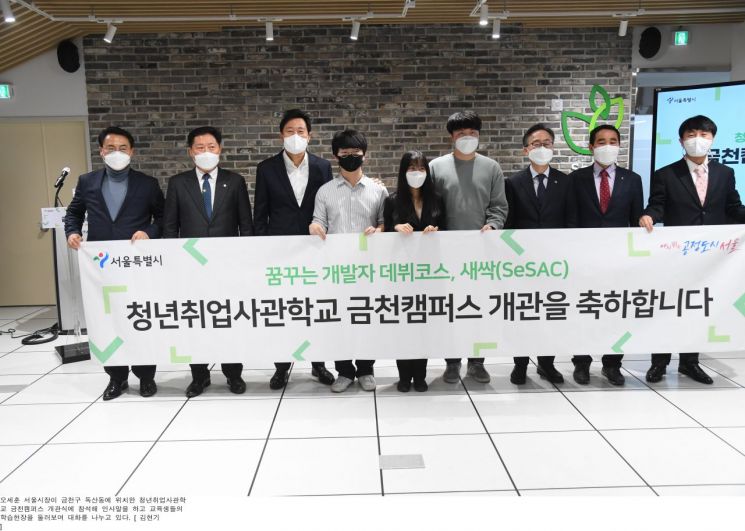
First, by 2025, 40,000 "Seoul-style future talents" will be nurtured. Through the "Youth Employment Academy," a training center for 4th industrial revolution technology talents, 18,000 talents will be produced. Starting this year, the "Youth Employment Academy" will be linked with "Campus Town" universities to provide more advanced educational programs in fields such as AI and big data. The city will support the budget while universities handle facilities and programs, operating in a way that will produce talents from a total of 15 universities by 2025.
To this end, a total of 10 centers will be opened early across Seoul by 2025, advancing the original 2030 opening goal by five years. Seven innovation hubs?Hongneung-Bio, Yeouido-Finance, Yangjae-AI, Yongsan-Drone, etc.?will nurture a total of 10,000 specialized talents required by industrial sites. Collaboration with specialized educational institutions will be expanded, and customized educational programs will be established.
By 2024, the goal is to support the co-growth of 200 large and medium-sized enterprises and 2,000 startups by activating technology partnerships. The "Open Innovation 200 Center," which provides comprehensive support from company matching to funding, will open this year at seven major startup support facilities including Magok Seoul Startup Hub M+ and Yeouido Fintech Lab. At 11 "Seoul Startup Cafes" across the city, which provide startup information and consultation, private experts such as startup planners and VCs will reside to diagnose the feasibility of commercializing innovative ideas and provide feedback on areas for improvement through the "365 Pitching Center."
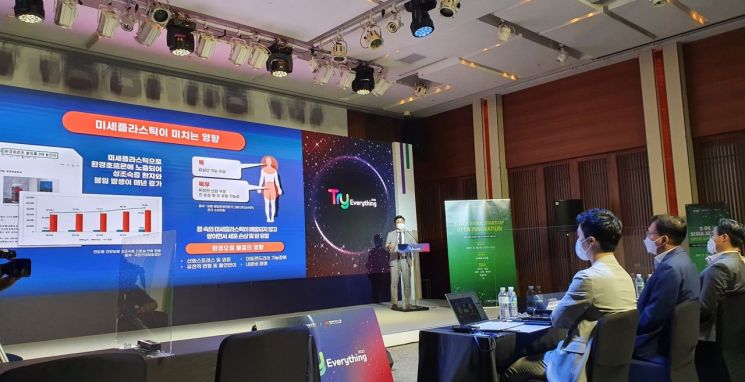
The cloud-based startup ecosystem platform "Startup Plus," where anyone can view company and investment information in one place without time and space constraints and where technology transactions and investment connections between companies are made, will open in April. Seoul plans to use this as an opportunity for the Seoul startup ecosystem, which is growing quantitatively, to take a leap forward, as in leading startup countries in Europe and the US where corporate support and investment linkage have already been established online amid the global normalization of non-face-to-face interactions due to COVID-19.
On Startup Plus, various data such as support projects held by startup support facilities (42), private startup support facilities (14), large corporations (9), VCs and startup planners (16), startup sales and investment attraction performance, and the status of Seoul's startup ecosystem can be checked in one place. It will also introduce, for the first time in the public sector, a function that allows technology owned by startups to be traded online with the needs of medium-sized enterprises.
Additionally, AI technology will analyze investors' interests and main fields to provide one-on-one matching, and the city will support all preparations such as contract drafting to ensure that actual technology transactions or investment attraction results follow. The city plans to start English services in October this year to improve accessibility for overseas investors and expand functions to include corporate transactions such as M&A in 2023.
Hwang Bo-yeon, Director of Seoul's Economic Policy Office, said, "We will focus on nurturing core talents needed in rapidly changing corporate fields to restore the 'job ladder' and build a 'startup growth ladder' that leads to win-win growth between large and medium-sized enterprises and startups by maximizing the capabilities and experiences of the private sector. We will transform Seoul into a city that is good for doing business and startups, and a city where good jobs can be found."
© The Asia Business Daily(www.asiae.co.kr). All rights reserved.