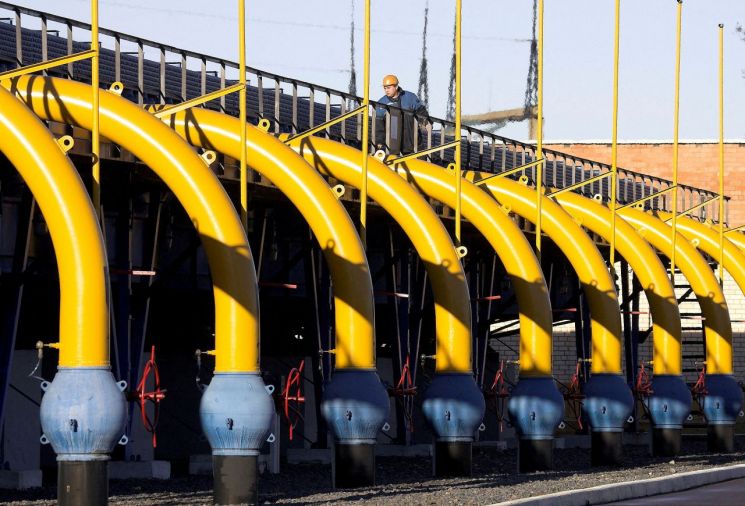
[Asia Economy Reporter Hyunwoo Lee] Amid growing concerns over Russia's invasion of Ukraine, the natural gas storage levels in underground gas storage facilities (USG) across Europe and Ukraine have reportedly dropped to historic lows. As Russia blatantly weaponizes natural gas, there are fears that the unity of Europe?especially countries like Germany with high natural gas dependence?and the United States in their joint response against Russia may weaken.
According to Russia's TASS news agency on the 24th (local time), Gazprom, the Russian state-owned gas company, announced that the gas storage levels in five European UGS sites located in Germany and Austria, as well as Ukraine's UGS, have fallen to historic lows.
Gazprom reported that as of the 22nd, the gas storage volume in European UGS was 13.3 billion cubic meters, filling only about 28% of the total storage capacity, which represents a decrease of more than 26% compared to the previous year. Ukraine's UGS gas storage also sharply declined by 44.6% year-on-year to 12.1 billion cubic meters, reaching a historic low, Gazprom stated.
Consequently, natural gas prices in Europe are surging again. On this day, the Dutch TTF exchange, a benchmark for European natural gas prices, recorded a futures price of 92.1 euros (approximately 124,800 KRW) per megawatt-hour (MWh), a sharp increase of 16.61% compared to the previous session. This price had dropped to the 78-euro range immediately after the US-Russia talks held on the 21st but surged again as military tensions between the two sides escalated.
Due to this rapid rise in gas prices, Germany, which has a high dependence on natural gas in its energy sector, is expected to struggle with the increasing energy costs. According to the Wall Street Journal (WSJ), Germany's energy prices, as compiled by the German Federal Office last month, soared by 69% compared to the same month last year.
Currently, natural gas accounts for 25% of Germany's electricity production, which is quite high, and over 90% of its natural gas is imported from Russia. Therefore, energy prices are expected to rise further due to the impact of the Ukraine crisis. This is anticipated to create difficulties in participating in the strong US-led sanctions against Russia, raising concerns about weakening cohesion within the Atlantic alliance.
© The Asia Business Daily(www.asiae.co.kr). All rights reserved.