Optimism in US and Europe: "Infection Trend Likely to Subside"
Omicron's Fatality Rate One-Fifth of Delta
"Large-Scale Outbreak in Short Time Could Increase Damage" Warning Voices Also Raised
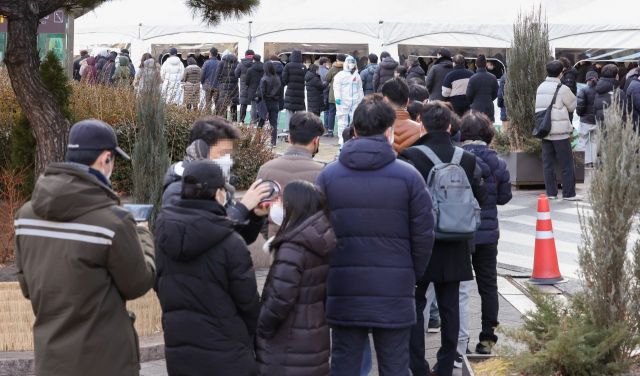 On the 24th, citizens are waiting to get tested at the COVID-19 screening clinic at Songpa-gu Public Health Center in Seoul. / Photo by Yonhap News
[Asia Economy Reporter Lim Ju-hyung] Can the COVID-19 pandemic, which has disrupted daily life worldwide for over two years, come to an end? Some countries are cautiously optimistic that COVID-19 may also subside after the Omicron variant peaks. Meanwhile, a domestic study has found that the fatality rate of Omicron is much lower than that of the Delta variant.
◆Cautious optimism in the US and Europe: "The end of the pandemic seems near"
Hans Kluge, head of the World Health Organization (WHO) Regional Office for Europe, said in an interview with AFP on the 23rd (local time), "More than 60% of the population in Europe could be infected with Omicron by March," adding, "We can see that we are heading toward the end of the pandemic."
Omicron, known to spread much faster than Delta, could infect the majority of a country's population, thereby building immunity and calming the spread. Kluge said, "It could be quiet for weeks or months," and predicted, "Even if COVID-19 returns by the end of the year, it may not reach pandemic levels."
Anthony Fauci, director of the US National Institute of Allergy and Infectious Diseases, also foresaw a decline in COVID-19 spread.
In an interview with ABC News on the same day, he said, "In most states, Omicron cases will peak by mid-February," adding, "Looking at the Omicron spread patterns in South Africa, the UK, and Israel, the spread sharply declined after peaking. I don't want to be overconfident about the US situation, but it currently seems to be moving in the right direction."
◆Omicron’s fatality rate five times lower than Delta’s... Caution over potential increase in social damage
Omicron is known to spread much faster than previously known variants like Delta. However, with widespread vaccination leading to increased immunity, there is growing hope that the 'Omicron wave' will pass without placing a heavy burden on healthcare systems.
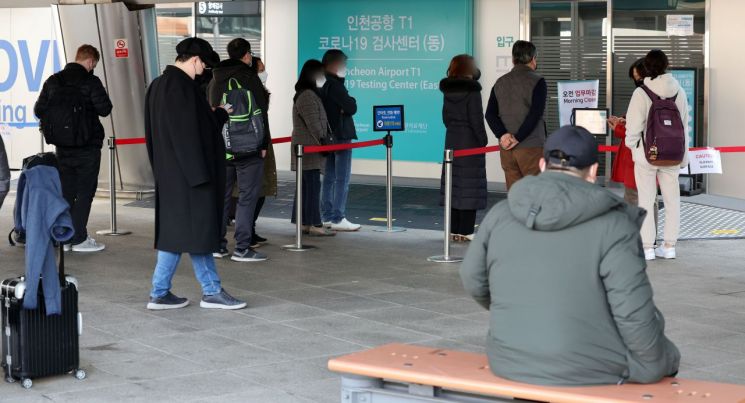 Arrivals are waiting for testing at the COVID-19 testing center in Terminal 1 of Incheon International Airport. / Photo by Yonhap News
In this regard, a domestic study also found that Omicron’s fatality rate is lower than Delta’s. The Central Disease Control Headquarters (CDCH) announced on the 24th that an analysis of 9,860 domestic Omicron cases showed a fatality rate of 0.16%, which is one-fifth of the Delta variant’s fatality rate (0.8%). The CDCH estimated the fatality rate of influenza at 0.1%, about 0.06% lower than that of Omicron.
Additionally, the CDCH estimates that Omicron’s transmissibility is more than twice that of the Delta variant, based on domestic and international data.
However, it remains unclear whether Omicron is less dangerous to society and healthcare systems than Delta. The CDCH pointed out, "If the number of high-risk confirmed cases increases due to the Omicron variant’s spread, it could lead to severe cases," adding, "In that case, the number of severe cases and deaths is likely to increase."
They warned, "Even if individual severity is low, a large-scale outbreak in a short period can increase the overall social damage."
◆"Even with lower risk, a surge in cases can overload medical facilities"
Concerns have also been raised that a sudden increase in daily confirmed cases could paralyze essential social functions. Typically, infected individuals undergo self-isolation, but if the number of people in self-isolation rises sharply, industries where remote work is impossible, as well as sectors like healthcare and logistics, could face labor shortages.
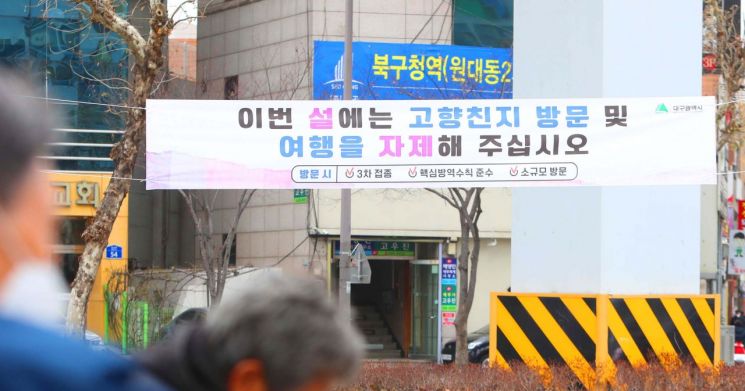 On the 24th, a banner urging "Refrain from visiting hometown relatives and traveling during Seol" was hung at an intersection in Buk-gu, Daegu. / Photo by Yonhap News
In this context, Prime Minister Kim Boo-kyum issued a 'Special Public Address on COVID-19 Prevention during the Lunar New Year Holiday' at the Government Seoul Office, urging the public to follow government prevention guidelines.
Prime Minister Kim said, "We have directly experienced how nationwide movement and gatherings during holidays can worsen the COVID-19 situation," expressing concern that "Since last weekend, Omicron has become the dominant variant in Korea, and despite the weekend, the number of confirmed cases has not decreased but rather increased."
He continued, "Although Omicron has a somewhat lower severity rate than the Delta variant, its transmissibility is two to three times higher," explaining, "Even if the risk is lower, a rapid surge in cases over a short period can cause serious overload in medical facilities."
He added, "We are preparing response plans in various sectors such as healthcare, education, transportation, firefighting, and police to prepare for the paralysis of essential social functions already seen overseas," emphasizing, "We once again ask you to refrain from visiting your hometown and to spend the holiday quietly at home."
© The Asia Business Daily(www.asiae.co.kr). All rights reserved.