Establishment of Omicron Response Headquarters, Preparation of Stepwise Response Strategy for Over 1,000 People per Day
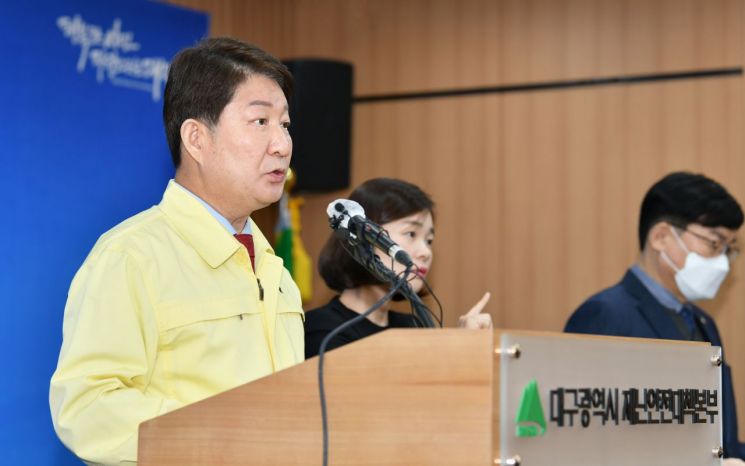 Daegu Mayor Kwon Young-jin is delivering a public address on the response to the spread of Omicron at the city hall situation room on the 24th. [Image source=Daegu City]
[Asia Economy Yeongnam Reporting Headquarters Reporter Yeo Jong-gu] Kwon Young-jin, Mayor of Daegu, announced a preemptive medical and quarantine response strategy and delivered a public address on the 24th to reduce community damage amid the nationwide spread of Omicron.
According to Daegu City, an 'Omicron Response Headquarters' has been established, led by the Deputy Mayor as the head, with participation from public officials, the Daegu Medical Association, and infectious disease advisory professors to oversee the response to the Omicron spread.
The number of confirmed cases, which remained around 100 throughout December last year, reached the 300s on the 20th, and in the past three days has surged past 400, marking the highest number of confirmed cases since early March 2020.
Considering the rapid transmission rate of Omicron, it is estimated that nationwide daily confirmed cases will reach between 15,000 and 30,000 by February.
Daegu City is also concerned about an explosive outbreak with 750 to 1,500 daily confirmed cases. Accordingly, on the 20th, it held a meeting with heads of tertiary hospitals and local medical professionals, and on the 21st, an emergency meeting with district and county heads to discuss response measures.
Additionally, medical response and quarantine measures have been prepared to cope with a situation where an average of 1,500 patients occur daily.
Regarding medical response, an additional 125 dedicated treatment beds will be secured by early February, bringing the total to 1,248 beds. The number of residential treatment centers will also increase by opening two more centers in addition to the existing two, securing over 1,000 beds.
Considering Omicron’s low severity rate and rapid transmission characteristics, a home treatment management system will be established for large-scale treatment of asymptomatic and mild confirmed cases.
To this end, the region will be divided into five zones, and a one-stop medical system from testing to hospitalization will be established by linking infectious disease-specialized hospitals with medium and small hospitals within each zone.
To expand testing capacity in quarantine response, additional specimen collection personnel will be deployed, and operating hours extended to minimize inconvenience to citizens. A new diagnostic testing system will be considered, implementing rapid antigen tests and limited PCR tests in pilot and operational areas where Omicron is dominant.
The epidemiological investigation method will be shifted to focus on speed and efficiency, concentrating investigation capacity on groups with high transmission risk and concern.
Furthermore, to increase the third dose vaccination rate, comprehensive policies such as expanded weekend vaccinations, support for visit vaccinations, and strengthened public promotion will be implemented to encourage citizen participation in vaccination.
Mayor Kwon Young-jin stated, “The medical and quarantine response and measures to increase the third dose vaccination rate are unavoidable strategies to minimize damage by focusing on early diagnosis and treatment of severe patients and to protect the lives and safety of citizens.” He added, “Although this is a long and exhausting battle with no end in sight, I hope to overcome it together with the citizens and return to normal daily life.”
© The Asia Business Daily(www.asiae.co.kr). All rights reserved.
![User Who Sold Erroneously Deposited Bitcoins to Repay Debt and Fund Entertainment... What Did the Supreme Court Decide in 2021? [Legal Issue Check]](https://cwcontent.asiae.co.kr/asiaresize/183/2026020910431234020_1770601391.png)